Water heater upkeep for Colorado Springs homes
A tank water heater has a few parts that wear out quietly: the anode rod, the drain valve, the relief valve and the sediment layer. A yearly visit checks them before one turns into a leak.
- Flush and anode check
- Relief valve tested
- Phones answered 24/7
Updated October 2026Phones answered 24/7
Want a price on this job?
Call and describe the job. We answer 24/7 and set a visit.
Quick answer
Water heater maintenance in Colorado Springs is a once-a-year job on most tanks, and it matters more in towns like Fountain and Monument where water runs around 8 grains per gallon. A visit drains the sediment, pulls and measures the anode rod, and tests the relief valve, roughly an hour on a typical tank.
What is included
What our maintenance visit covers
Some maintenance visits are little more than a drain. Ours covers these.
- Data plate age and model noted
- T&P valve tested
- Discharge pipe checked
- Anode rod pulled and inspected
- Tank flushed until clear
- Drain valve checked for leaks
- Burner or elements checked
- Vent connector and draft on gas units
- Expansion tank air charge checked
Three parts that decide how long a tank lasts
Sediment settles on the tank bottom, insulates the water from a gas burner, and makes the steel run hot and pop. The anode is a sacrificial rod of magnesium or aluminum that corrodes so the tank lining does not; once it is gone, the tank starts to rust from inside. The T&P valve opens if pressure or temperature climbs too high, and a valve untouched for years can stick shut.
Maintenance also catches what is happening around the heater: a drain valve that drips, a vent connector that has slipped, a missing expansion tank on a house with a pressure regulator. If the anode is spent and the tank is sound, a new rod is the cheapest way to add years. If the flush pulls out rust flakes or the base is wet, we talk about replacing the heater instead. Tankless units follow their own routine under tankless descaling, and homes on hard water may want a softener.
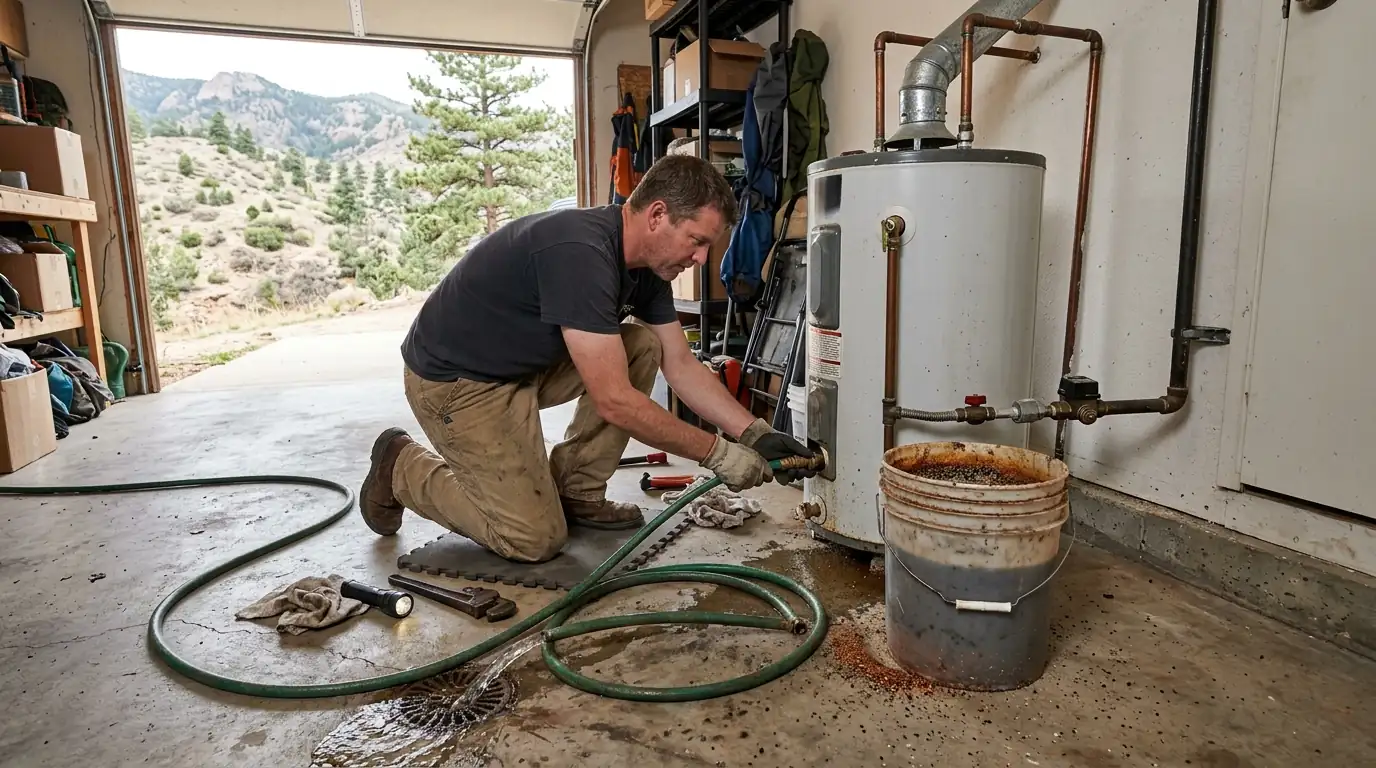
Flushing sediment from a tank
We turn the burner to pilot or kill the power, close the cold inlet, run a hose from the drain valve and let the tank empty. Then we open the cold inlet in short bursts to stir the bottom and drain again until the water runs clear. Plastic drain valves on many tanks clog with sediment and can crack, so we may swap one for a full-port brass valve that drains faster. A tank that has gone years without flushing can carry a layer too hard to move, and we tell you rather than forcing it.
Anode rod checks
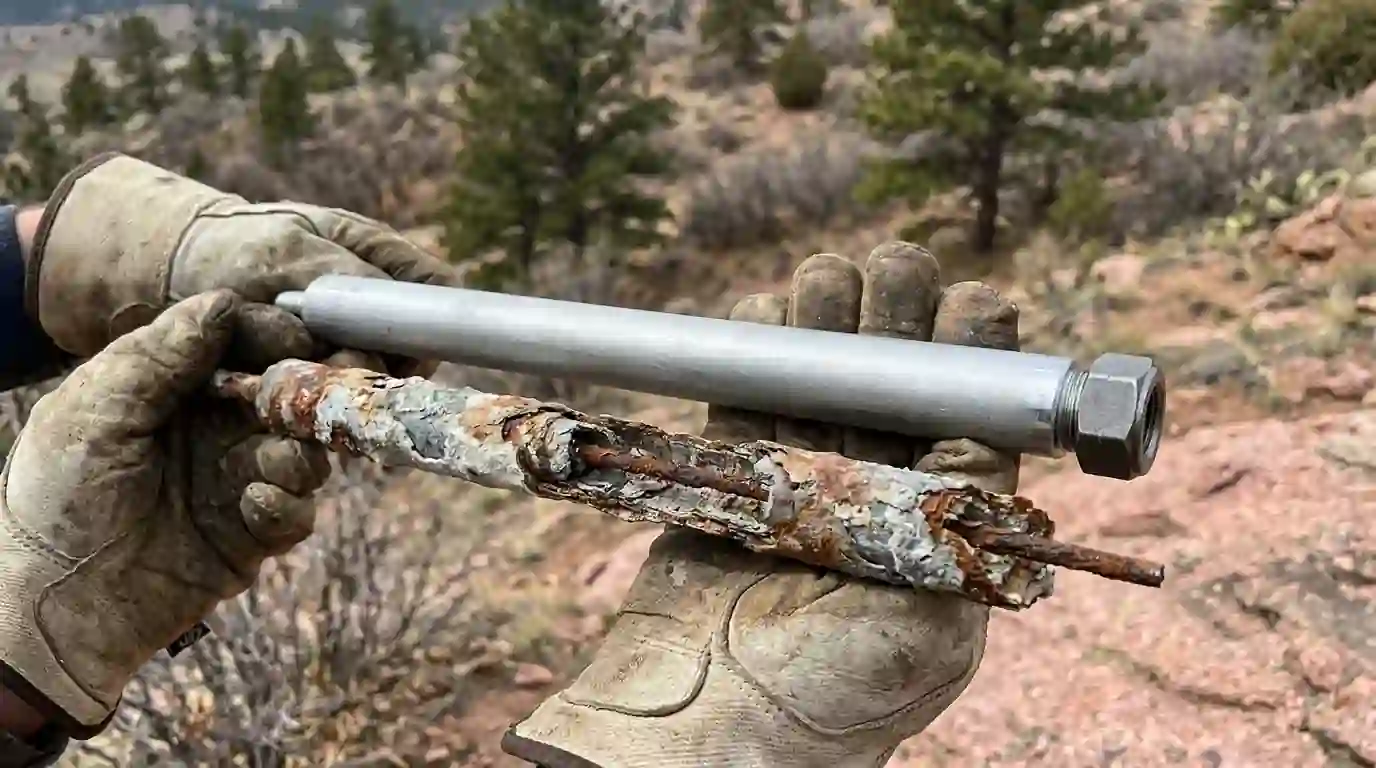
The anode threads into the top of the tank, sometimes combined with the hot outlet nipple. We break it loose and pull it. A healthy rod is still thick; a spent one shows bare steel core wire for several inches or has crumbled away. Replacements come in magnesium, aluminum-zinc or powered versions, and the choice depends on whether the hot water smells of rotten eggs. Where headroom is tight, a flexible segmented rod goes in without moving or tipping the tank.
Testing the relief valve
We lift the T&P lever for a few seconds and let water run out the discharge pipe. The valve should open, flow freely, then snap shut and seal. One that will not open, or keeps dripping after the test, gets replaced. We also confirm the discharge pipe is full size, runs downhill with no cap or threads on the end, and stops where hot water cannot hurt anyone. Old valves sometimes start weeping after their first test in years, so we bring a replacement.
Local conditions
Lower boiling points and harder water outside the city
Colorado State University Extension notes that water boils at about 203 F at 5,000 feet and 198 F at 7,500 feet, against 212 F at sea level, which leaves a narrower margin between a hot tank and steam up around Woodland Park. That is one reason we check the thermostat and relief valve on every visit. Hardness shapes the schedule too. Fountain and Monument are estimated at 8.2 grains per gallon and Woodland Park at 7.6, so tanks there build sediment faster and a yearly flush earns its keep.
Cost
What a maintenance visit costs
A flush with an anode and relief valve check is a modest visit; a new anode rod or T&P valve adds parts. These published figures are context, not our price.
What moves the price
- Anode replaced or not
- Seized anode needing extra work
- Drain valve swap
- T&P valve replacement
- Hard-to-reach location
Ranges are published market figures for planning, not a quote. We price your job after we see it.
How the job runs
What happens during a maintenance visit
Read the data plate
Note age, size and model to judge what the tank needs.
Test the relief valve
Lift the lever, watch the flow, confirm it reseats.
Pull the anode
Inspect it and replace it if it is spent.
Flush the tank
Drain, stir and drain again until the water runs clear.
Restart and check
Refill with a hot tap open, relight or power up, and check the burner, venting and fittings for leaks.
Do it yourself?
Upkeep you can handle between visits
Some of this is easy for a homeowner. A seized anode or a valve that will not reseat is where we come in.
| Task | Homeowner | Plumber |
|---|---|---|
| Drain a few gallons | Open the drain valve into a bucket every few months | Full flush and drain valve swap when it clogs |
| Relief valve | Lift the lever once a year with a bucket under the pipe | Replace a valve that sticks or keeps dripping |
| Anode rod | Note the install date and plan a check | Pull, inspect and replace the rod |
| Around the tank | Keep storage and lint away from the burner | Inspect venting, gas connector and draft |
Brands we service
We maintain Rheem, A. O. Smith, Bradford White and American Standard tank water heaters.
- Rheem
- A. O. Smith
- Bradford White
- Navien
- Rinnai
- Noritz
- Moen
- Delta
- Kohler
- American Standard
- InSinkErator
- Uponor
- Watts
- Zurn
FAQ
Water heater upkeep questions
Once a year is a sound default, and it matters more on hard water. A tank that pops or rumbles needs it sooner, and a tank that has never been flushed gets a look before we start.
Sometimes. After many years without a flush, sediment may be sealing a weak spot, or a plastic drain valve may not reseal. We look the tank over first and tell you if flushing is a risk.
It corrodes so the tank does not. Once it is used up, the steel tank begins rusting from inside, usually at the welds first. A new rod costs far less than a new heater.
Bacteria in the tank react with a magnesium anode to make hydrogen sulfide. Swapping in an aluminum-zinc or powered anode and flushing the tank usually ends it. Pulling the anode out entirely also stops the smell, but it leaves the tank to rust, so we do not do it.
Yes. We check its air charge with a tire gauge against house pressure and tap it for a waterlogged bladder, which is a common reason relief valves weep between visits.
Related services

