Fixing gas and electric water heaters in Colorado Springs
Most tank failures come down to a handful of parts: thermocouple or flame sensor, gas valve, elements, thermostats and the relief valve. We test each, replace what failed, and say plainly when the tank itself is done.
- Gas and electric tanks
- Burner checked for altitude
- Phones answered 24/7
Updated October 2026Phones answered 24/7
Water running right now?
Close the main shut-off, then call. A person answers 24/7.
Quick answer
Water heater repair in Colorado Springs averages $334 on HomeServe's Colorado figures, a fraction of a new heater, so it is worth doing whenever the tank itself is sound. The exception is a leak from the tank body: no part fixes rusted-through steel. Pilots, elements, thermostats and valves usually are repairable.
Warning signs
What your water heater is telling you
Hot water runs out early
A broken dip tube or dead lower element cuts usable capacity.
Water at the base
A fitting, the drain valve, or a tank that has rusted through.
Pilot will not stay lit
Thermocouple, flame sensor or air intake trouble.
Rusty hot water
The anode is spent or the lining is failing.
Relief valve dripping
High pressure, high temperature or a worn valve.
Finding the part that actually failed
No hot water from a gas tank usually means the pilot will not stay lit, the burner will not fire, or the gas valve has failed. On an electric tank it is usually a burned-out element or a tripped high limit. Water that heats but runs out early points to a broken dip tube, a dead lower element, or a burner buried in sediment. We test with a meter and manometer instead of swapping parts.
We also look for what shortens a repair's life: poor draft, heavy sediment, a spent anode, a missing expansion tank. If a ten-year-old tank needs a gas valve, we price the repair beside a new heater so you can choose. A unit that is merely noisy may only need a flush and anode check.
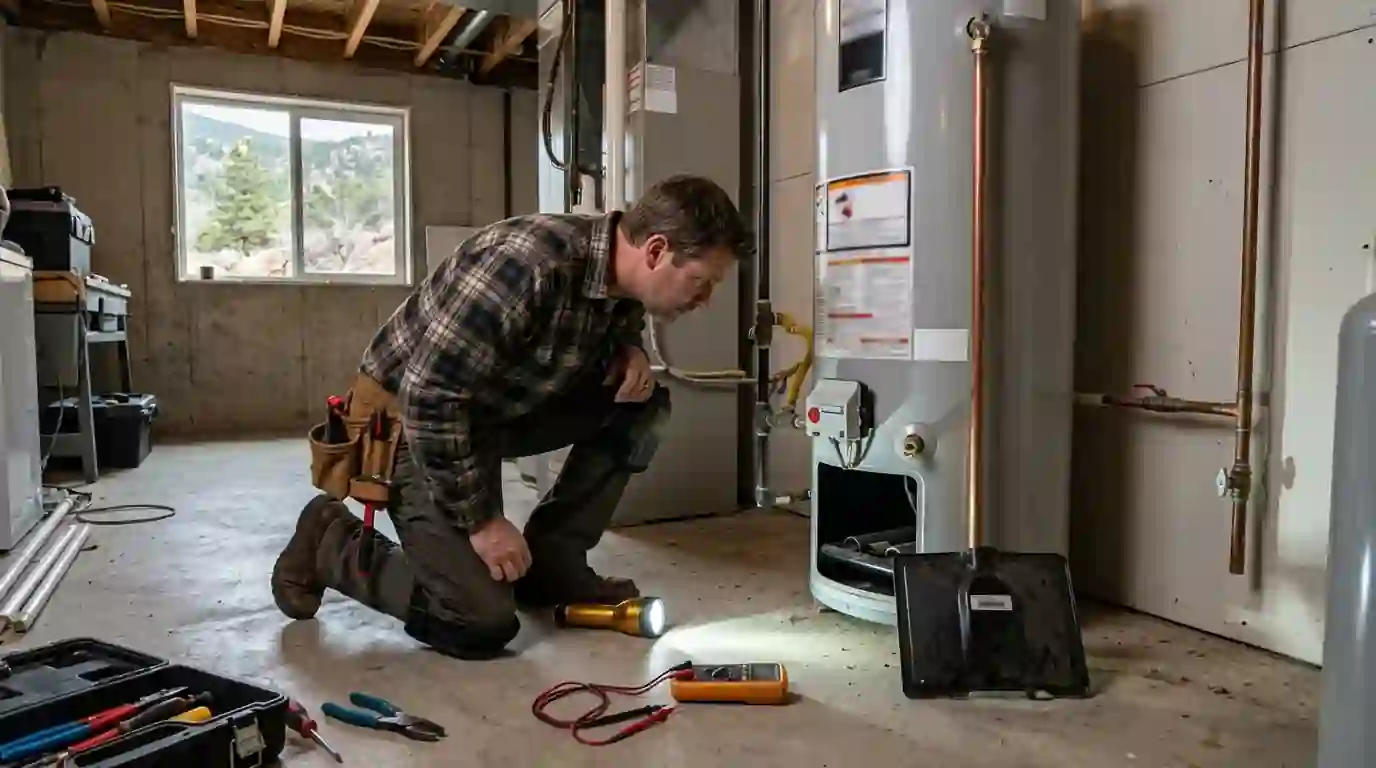
How the job runs
A water heater repair visit, step by step
Check the basics
Gas supply, breaker, pilot status and thermostat setting.
Test, do not guess
Meter on elements, manometer on gas pressure, millivolts from the thermocouple.
Look for root causes
Sediment, vent draft and house pressure.
Repair and correct
Replace the failed part, and fix burner setup if it is wrong for the altitude.
Run a full cycle
Confirm the tank heats and shuts off at its setpoint, then tell you whether it is worth more repairs.
No hot water from a gas tank
Start with the pilot. If it lights but dies when you release the knob, the thermocouple, or the flame sensor on newer flammable-vapor-resistant models, is the usual suspect. A pilot that will not light at all can mean a dirty pilot tube, a lint-clogged air intake screen at the base, or a tripped thermal cutoff. If the pilot holds but the main burner never fires, we test the gas valve's thermostat. Power-vent models add a blower, pressure switch and igniter. Each is a test and a part, not a new heater.
Electric elements and thermostats
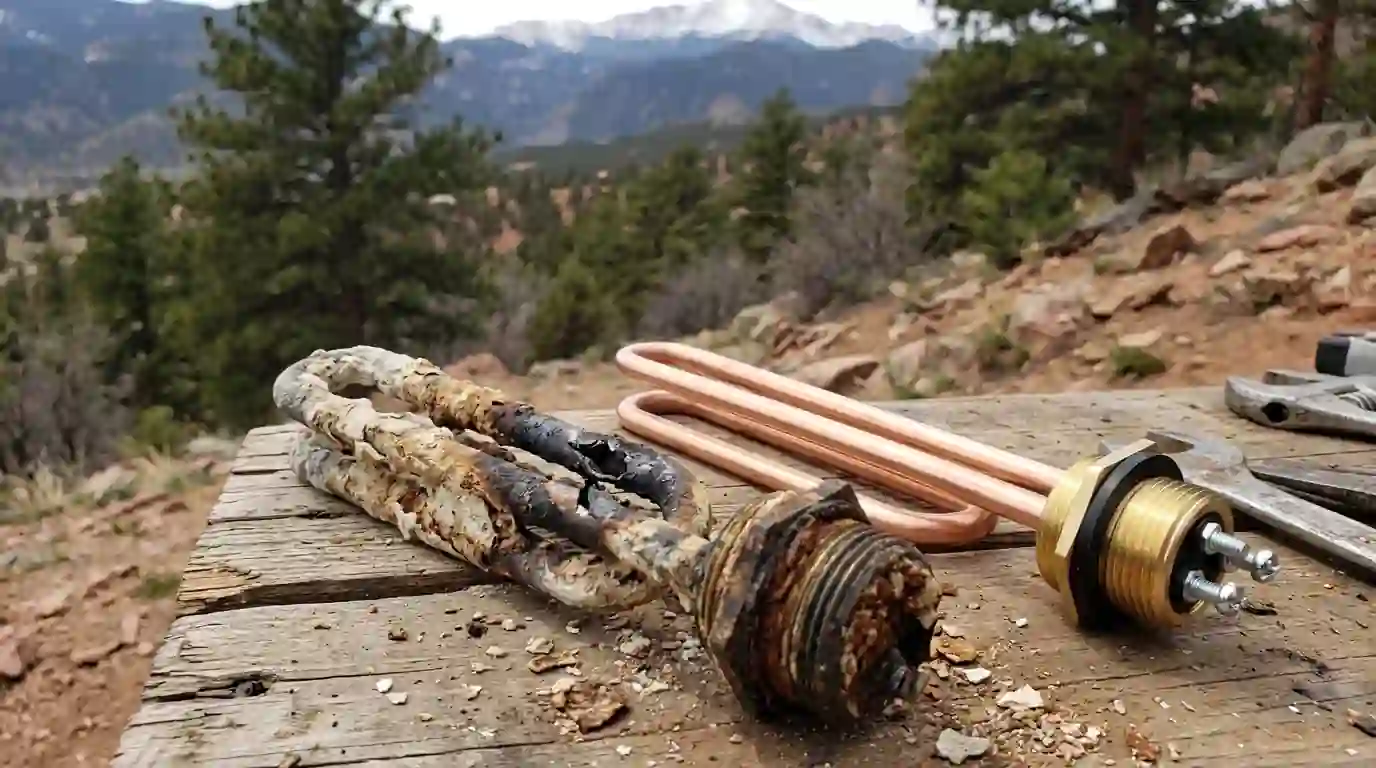
Electric tanks have an upper and a lower element, each with its own thermostat. Lukewarm water that runs out fast usually means the lower element has burned out. No hot water at all often means a failed upper element or a tripped high limit, which has its own cause, often a stuck thermostat or grounded element. We kill the breaker, read each element's resistance, test both thermostats and replace what failed. Elements that keep burning out are usually sitting in sediment, so the tank gets flushed too.
Leaking tanks and relief valves
Water on the floor does not always mean a dead tank. A dripping T&P discharge can be a worn valve, or pressure climbing every heating cycle because there is no expansion tank, or a thermostat set too high. A leak at the drain valve or a supply fitting is a simple fix, and we check that the discharge pipe runs full size, unrestricted, to where hot water can spill safely. Water from under the jacket or the base, with rust, means the tank has rusted through, and repair is over.
HomeGuide puts tank repairs at $150 to $700 on average, with a national average of $455.
Timing
How long you may be without hot water
Most part repairs, a thermocouple, element, thermostat or relief valve, are typically finished on the first visit, then the tank needs time to reheat: around an hour for gas, longer for electric. Parts for an uncommon power-vent model sometimes have to be ordered.
Local conditions
Why a gas burner needs a second look here
A water heater technical service bulletin says altitude starts affecting gas water heaters at about 2,000 feet, and that the main burner orifice should shrink by four percent for each 1,000 feet of elevation. Colorado Springs sits far above that threshold, so a tank set up for sea level burns rich here: a lazy yellow flame, soot on the flue baffle, and a pilot that keeps going out. When we repair a gas unit, we look at the burner flame and the orifice, not only the part that quit.
Do it yourself?
Safe checks before you call
A few things are worth trying first. Gas and 240-volt work beyond these is ours.
| Task | Homeowner | Plumber |
|---|---|---|
| Electric tank cold | Check the breaker and press the high-limit reset once | Find why it tripped, test elements and thermostats |
| Gas pilot out | Relight by the label if there is no gas smell | Replace the thermocouple or flame sensor |
| Relief valve dripping | Check the thermostat setting | Test pressure, add an expansion tank, replace the valve |
| Gas smell | Leave the house and call the gas utility | Repair the leak once the utility clears it |
Cost
Water heater repair costs in context
Most repairs are one part and a service visit. These published figures give context, not our price; ours follows testing.
What moves the price
- Gas or electric
- Atmospheric or power-vent
- Which part failed
- Sediment and tank age
- Closet, attic or crawlspace access
- Missing expansion tank
Ranges are published market figures for planning, not a quote. We price your job after we see it.
Brands we service
We repair Rheem, A. O. Smith, Bradford White and American Standard tank water heaters, gas and electric.
- Rheem
- A. O. Smith
- Bradford White
- Navien
- Rinnai
- Noritz
- Moen
- Delta
- Kohler
- American Standard
- InSinkErator
- Uponor
- Watts
- Zurn
FAQ
Water heater repair questions
Depends on the part. A thermocouple or element buys time cheaply. A gas valve or power-vent blower on an old tank usually belongs toward a new heater instead. A leaking tank is never repaired.
A weak thermocouple, a dirty pilot or a vent draft problem. On newer units, a clogged flame arrestor screen at the base starves the burner of air, and lint from a nearby dryer is a common cause.
Rust on the hot side only points to a spent anode or failing lining. A rotten egg smell is usually the anode reacting with the water, often fixed with a different anode rod.
Sediment on the bottom of a gas tank traps water that flashes to steam as the burner fires. Flushing helps when the layer is thin; a heavy, hardened layer may be past flushing.
Yes. Tankless heaters fail differently, with flame rods, flow sensors, error codes and scale in the heat exchanger instead of thermocouples and elements. That work is covered under tankless repair and descaling.
Related services

