Tankless water heater repair and descaling in Colorado Springs
A tankless unit tells you a lot through its error codes. We read the code, check gas, venting, flow and the flame rod, and descale the heat exchanger when the evidence says scale is the problem.
- Error codes diagnosed
- Heat exchanger descaling
- Phones answered 24/7
Updated October 2026Phones answered 24/7
Water running right now?
Close the main shut-off, then call. A person answers 24/7.
Quick answer
Tankless water heater repair in Colorado Springs starts with the code on the display, which narrows the fault to ignition, flame, venting, flow or overheating. Descaling runs $75 to $300 on HomeGuide's figures, but city water here is soft at 2.1 grains per gallon, so scale is less often the culprit than people expect.
Warning signs
Signs your tankless needs attention
A code on the display
Even one that clears itself is worth writing down.
Temperature swings mid-shower
Scale, gas supply or flow is upsetting the burner's modulation.
Clicking with no flame
The igniter sparks but the burner never lights.
Water dripping from the unit
A condensate line or relief valve may be leaking.
Shutting off after a few minutes
Overheat protection tripped, often from scale.
Reading the code before replacing parts
Every manufacturer numbers its codes differently, but they fall into a few families. Ignition failures point to gas supply, a dirty flame rod or the igniter. Flame loss mid-shower can be gas pressure sagging when the furnace starts, a blocked vent, or a condensate drain backing up. Overheat and flow codes often mean scale or a clogged inlet filter. Where the board stores a code history, we read it, because a fault that has been building for months tells a different story than a new one.
Some problems are not inside the unit at all. A heater that will not fire for one bathroom sink may simply not be seeing its minimum flow. A unit on an undersized gas line or an overlong vent will keep throwing codes however many parts are changed, and then the fix is in the installation itself. For a tank heater with similar symptoms, see tank water heater repair.
How the job runs
What we do on a tankless repair call
Read the code and history
Note the current code and any stored history on the control board.
Check gas and air
Measure gas pressure at full fire and inspect the intake and exhaust terminations.
Check the water side
Clean the inlet filter and check flow and the condensate drain.
Repair or descale
Clean or replace the flame rod, igniter or sensor, or circulate descaler through the exchanger.
Run at full demand
Open several hot taps and confirm a steady temperature with no codes.
Error codes and ignition faults
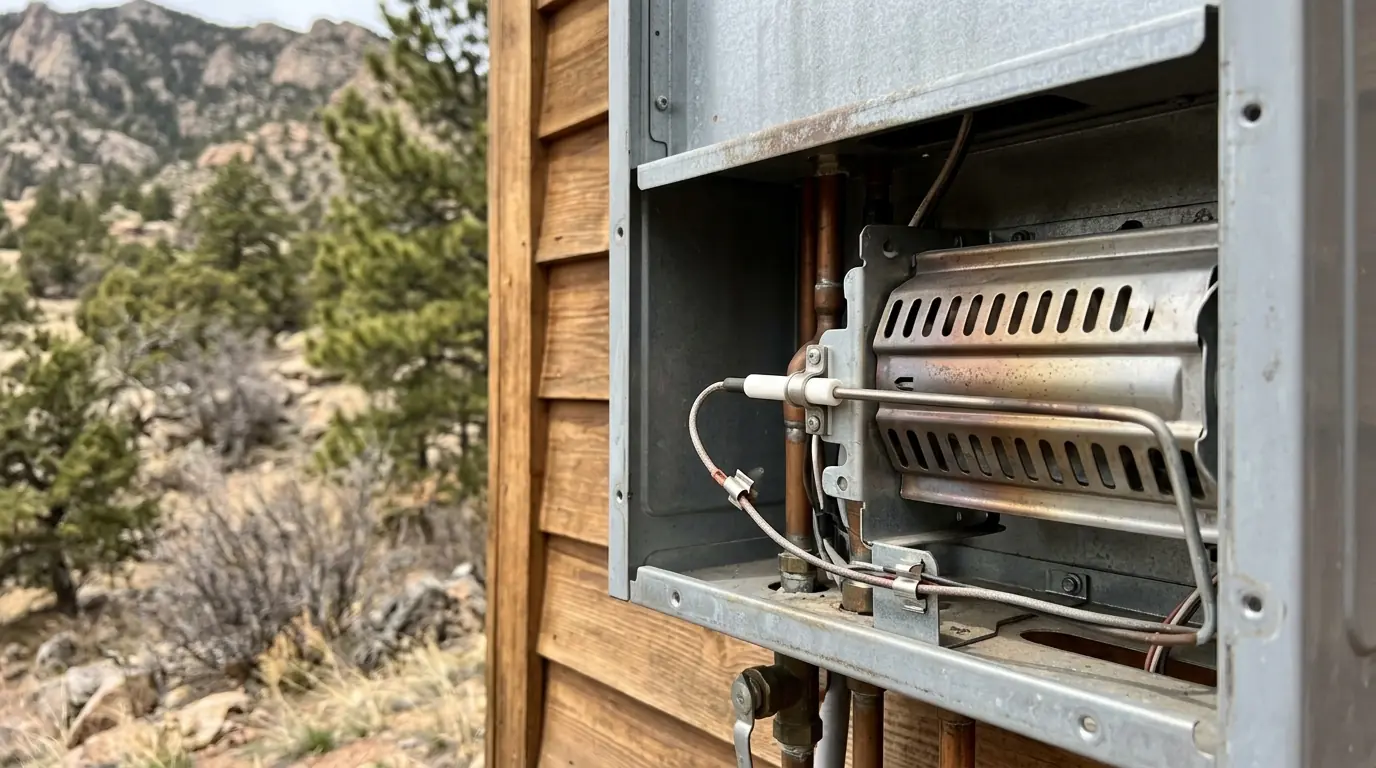
Ignition codes usually appear right after a hot tap opens: the fan spins, you hear clicking, then nothing. We measure gas pressure at the unit with every gas appliance running, pull and clean the flame rod, and test the igniter. A code that shows up only on cold mornings or when the furnace runs points to gas supply. Fan and air pressure codes usually mean a blocked intake, a nest in the vent, or snow drifted over a side-wall termination. Boards and burners are the last thing we replace, not the first.
Descaling the heat exchanger
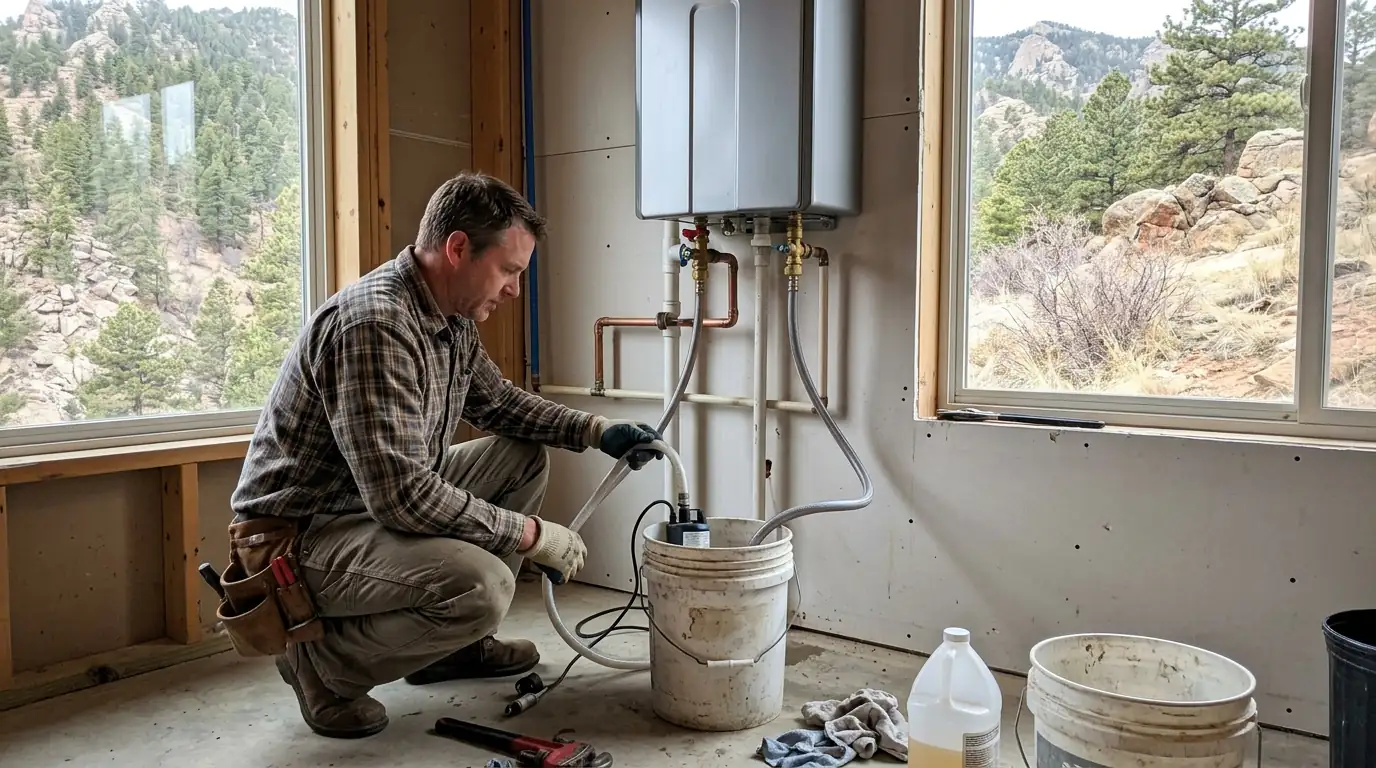
Scale forms when hard water is heated, and in a tankless unit it coats the narrow passages of the heat exchanger. The signs are an overheat code, temperature swings or reduced flow at the tap. We close the isolation valves, connect a small pump and circulate descaling solution through the exchanger for about an hour, then flush with clean water and clean the inlet screen. A unit installed without isolation valves needs them added before it can be descaled properly.
Angi puts a tankless flush and descale at $150 to $250.
Cold water sandwich complaints
The cold water sandwich is a slug of cold between two slugs of hot, usually after someone shuts the shower off and back on. Water left in the pipe is still hot, the unit takes a few seconds to relight, and the cold that passed through in that gap reaches you. It is a trait of the design rather than a fault. The fixes are a model with a small internal buffer tank, a recirculation loop, or simply not stopping the water mid-shower. If cold bursts happen during steady use, we look at minimum flow and gas supply instead.
Local conditions
Soft city water, thin mountain air
Utility-reported data rates Colorado Springs tap water as soft, at 35.8 mg/L or 2.1 grains per gallon, so a tankless unit on city water scales slowly. That moves the usual suspects for codes toward gas and air. A gas water heater service bulletin says altitude effects begin around 2,000 feet and call for a four percent smaller burner orifice per 1,000 feet. A tankless unit never configured for elevation in the Pikes Peak region can show flame codes that no amount of descaling will clear.
Do it yourself?
Tankless checks you can do yourself
These are safe and often solve it. Anything behind the front cover is for us.
| Task | Homeowner | Plumber |
|---|---|---|
| Inlet filter | Close the cold isolation valve and rinse the screen | Inspect the flow sensor if the problem stays |
| Aerators | Unscrew and clean faucet aerators | Check minimum flow and the mixing valves |
| Vent terminations | Clear snow or debris from the outside intake and exhaust | Inspect the full vent for blockage or damage |
| Error code | Write it down and reset power once | Diagnose the cause behind the code |
Cost
Descaling and repair costs
A descaling visit is the most predictable cost; part repairs depend on what failed. These are published figures for context, not our price.
What moves the price
- Which code and which part
- Isolation valves present or not
- Condensing or non-condensing model
- Vent or condensate problems
- Gas line capacity
- Board or heat exchanger replacement
Ranges are published market figures for planning, not a quote. We price your job after we see it.
Brands we service
We repair Navien, Rinnai, Noritz and Rheem tankless water heaters.
- Rheem
- A. O. Smith
- Bradford White
- Navien
- Rinnai
- Noritz
- Moen
- Delta
- Kohler
- American Standard
- InSinkErator
- Uponor
- Watts
- Zurn
FAQ
Tankless problems we hear about
On soft city water, less often than the manuals assume. On hard well water or harder town supplies, yearly is sensible. We judge it by the unit's flow and temperature behavior rather than the calendar.
Usually gas pressure dropping when another appliance starts, flow falling below the unit's minimum when a second tap closes, or an overheat shutdown from scale. The code history points to which one.
Intermittent codes are early warnings, often about gas supply or venting. Write down the code, the time and what else was running when it appeared; that tells us a lot before we arrive.
Usually. Flame rods, igniters, fans, flow sensors and boards are all replaceable parts. A cracked or leaking heat exchanger on an older unit is where replacement starts to make more financial sense.
The unit needs a minimum flow to fire, often around half a gallon per minute. A low-flow faucet, a clogged aerator or a single-handle faucet set mostly cold can stay below it.
Related services

