Annual backflow testing for Colorado Springs sprinklers and buildings
Every testable backflow assembly needs a passing result on file once a year. We open the test cocks, run the differential gauge, record what each check and relief valve did, and send the report in.
- Phones answered 24/7
- Results filed with the utility
- Home and commercial assemblies
Updated October 2026Phones answered 24/7
Want a price on this job?
Call and describe the job. We answer 24/7 and set a visit.
Quick answer
Backflow testing in Colorado Springs is a once-a-year obligation: Colorado Springs Utilities requires each assembly to be tested when installed and annually after that, by a certified backflow tester. Irrigation assemblies must pass before the system is winterized. A routine residential test is a short visit with a gauge; repairs only come up when a check fails.
What is included
What a complete test report should show
A rushed test leaves thin paperwork. A complete report carries:
- Assembly type, make and model
- Serial number and size
- Exact location on the property
- Readings for each check valve
- Relief valve opening point on an RP
- Air inlet reading on a PVB
- Pass or fail, with repairs noted
- Tester name and certification number
- Test date and gauge calibration date
What the tester is actually measuring
A backflow assembly is a pair of spring-loaded check valves, plus a relief valve between them on a reduced pressure (RP) assembly, that keep sprinkler water, fertilizer or treated boiler water from being pulled back into the drinking supply when pressure drops. Testing means connecting a differential gauge to the test cocks, closing shutoffs in sequence, and reading whether each check holds and whether the relief opens when it should.
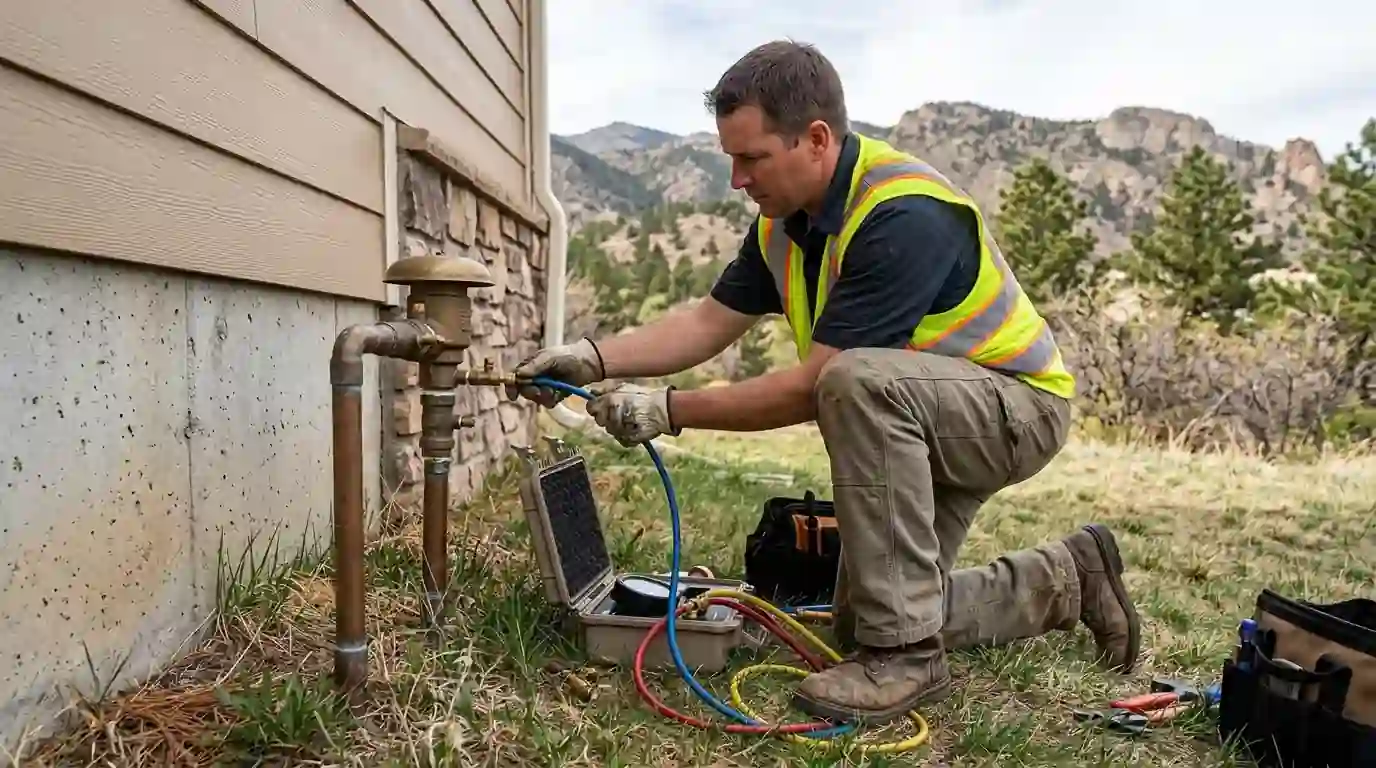
Most homes we test have a pressure vacuum breaker (PVB) on the sprinkler line, standing above ground near the foundation. Businesses tend to add double check or RP assemblies on boilers, beverage equipment and irrigation. Each type has its own test sequence and its own weak points.
When a check fails, the fix is usually a rubber kit, a spring or debris cleaned off a seat, then a retest; that work lives on our backflow repair page. If the gauge shows house pressure running high, we will also point you to the pressure reducing valve feeding it all.
Annual sprinkler system tests
For a house, this is the PVB on the irrigation line. The system has to be charged with water for the test, which is why late spring through early fall is the window. We read the check valve and the air inlet poppet, note the assembly's make, size and serial number, and confirm both shutoffs are back fully open before we leave, the step most often missed. Our sprinkler winterizing guide covers what happens after the test.
Commercial assembly tests
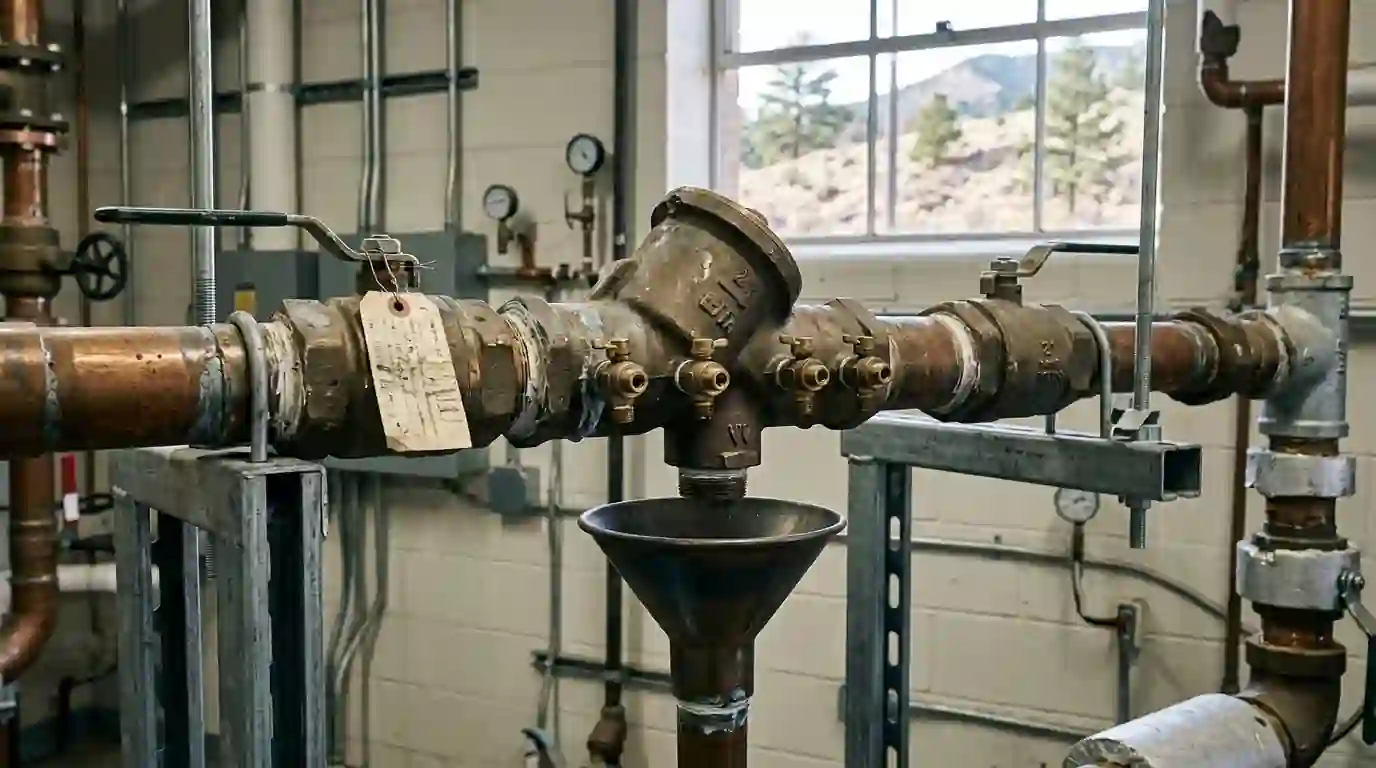
Restaurants, offices and apartment buildings usually carry more than one assembly: a double check or RP on the domestic line, another on irrigation, sometimes one on a boiler fill or a beverage line. RP tests take longer and briefly interrupt water to whatever the assembly protects, so we set the time with the manager ahead. Relief valves that dump water during the test, or checks that will not hold, get written up with the part needed rather than left as a bare fail.
Filing results with the utility
The test only counts once the program has it. Each report carries the assembly type, make, model, serial, size and location, the readings for every check and relief valve, the pass or fail result, and the tester's details. We file it with the backflow program and give you a copy, so the notice that arrives next season matches an assembly on record. If an assembly was moved, replaced or removed since last season, the report says so, so the program's record matches what is actually installed.
Local conditions
The Colorado Springs Utilities deadline that catches people
Colorado Springs Utilities requires backflow assemblies to be tested on installation and every year after by a certified tester; owners can test their own only if they are certified and file that certification with the program. Irrigation customers must test before the system is winterized. In 2019, records were due October 1, violation notices started October 4, and customers had 20 days to comply, or 10 days after an Imminent Hazard Order, before water service was suspended. Check your own notice for this year's date.
Cost
Backflow test fees, by the numbers
A test is mostly labor and a calibrated gauge, so fees sit in a narrow band unless repairs come up. Neither figure below is our price.
What moves the price
- Number of assemblies on the property
- PVB, double check or RP
- Access: valve box, mechanical room or locked cage
- Whether water can be interrupted briefly
- Repair parts and a retest after a failure
Ranges are published market figures for planning, not a quote. We price your job after we see it.
Timing
How long the water is off during a test
A residential PVB test takes the irrigation side down for a few minutes while the shutoffs are closed; the house keeps its water. A double check or RP on a building takes longer, and whatever it protects is without water during the sequence, so for a restaurant or office we set the time with you, before opening if that is what works.
How the job runs
A backflow test visit, step by step
Identify the assembly
Type, make, model, size and serial, matched to the notice.
Confirm it is charged
The line has to be under water pressure to read anything.
Connect the gauge
Hoses go on the test cocks in the order that assembly type calls for.
Run the sequence
Each check and the relief or air inlet is read and recorded.
Restore and file
Shutoffs back fully open, report sent in, copy left with you.
FAQ
Backflow test questions from Colorado Springs owners
Only after the line is recharged, because the assembly must be under pressure. That is why the program wants the test done before winterizing; recharging a drained system in cold weather risks a freeze crack.
Only if you are a certified backflow tester with current certification filed with the Colorado Springs Utilities program. Results from anyone else will not count toward the annual requirement.
A PVB stands above ground with one check, an air inlet cap and two test cocks. A double check is longer, with two checks in line. An RP has a relief port on the bottom that can discharge water.
No. Hose bib vacuum breakers are non-testable devices. The annual test applies to testable assemblies, the ones with test cocks.
The report records which check or relief valve failed. Most failures are fixed by cleaning or rebuilding the internals, followed by a retest so a passing result goes in.
Related services

