Sewer line repair for Colorado Springs homes
When the main backs up twice in one season, the pipe is telling you something. We camera the line, find the joint or section that failed, and fix that piece.
- Camera before we quote
- Clay, cast iron and PVC
- Phones answered 24/7
Updated October 2026Phones answered 24/7
Want a price on this job?
Call and describe the job. We answer 24/7 and set a visit.
Quick answer
Sewer line repair in Colorado Springs runs $600 to $1,050 on HomeAdvisor's figures when one section has failed. We camera the line first, mark the defect's distance and depth, then dig or line only that spot. If the video shows damage along most of the run, we say so before anyone digs.
Fixing the one bad section instead of the whole lateral
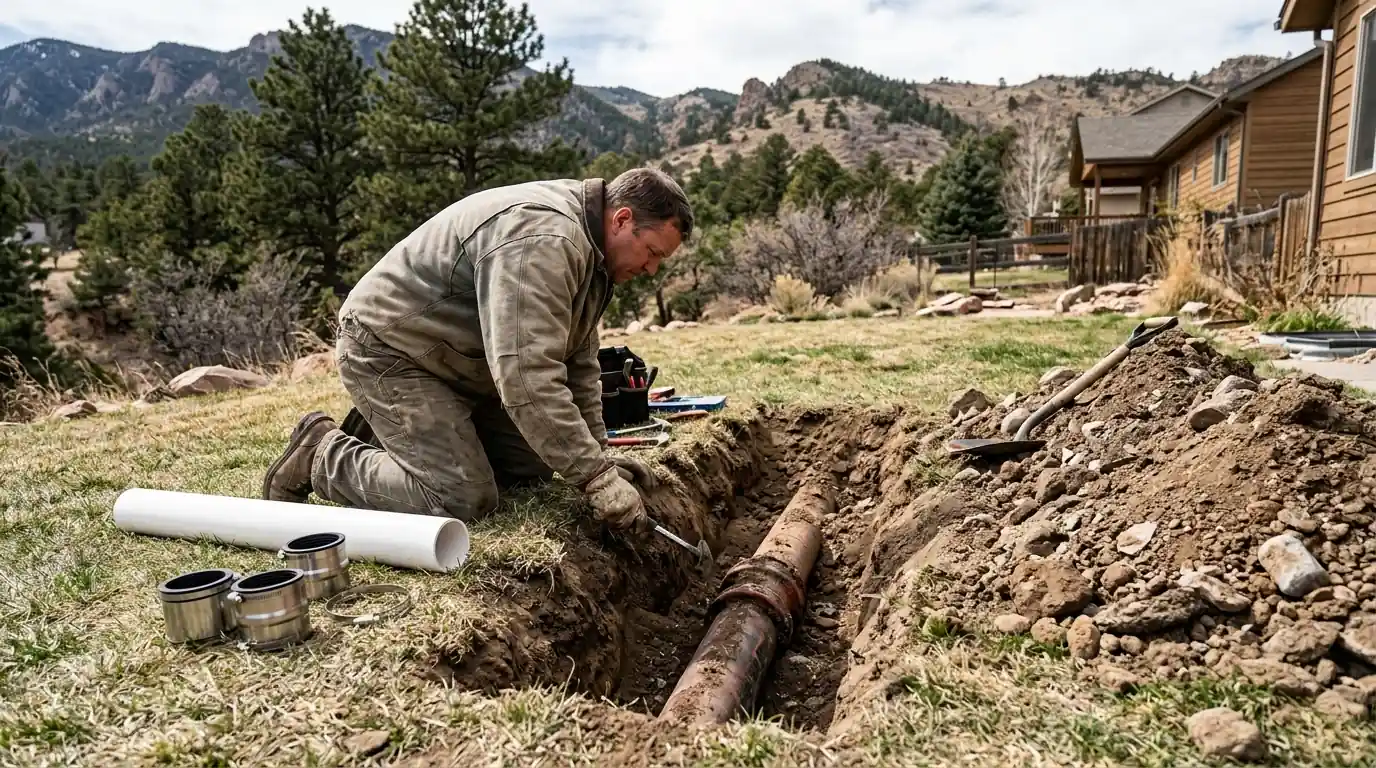
Most laterals do not fail end to end. A clay joint lets roots in, a cast iron section rusts through, or settling soil leaves a belly. Each is a local problem with a local fix. If the line is backed up, we cable the main first. Then we run a camera down the line, find the defect with a locating transmitter and mark the ground above it, so the dig is one pit, not a trench across the lawn.
Repair makes sense when the rest of the pipe is sound. If the video shows cracked bells every few feet or roots at most joints, patching one spot only moves the next backup down the line. Then we walk you through a full replacement or a trenchless option with the footage in front of you.
Cost
What a sewer repair costs before and after the camera
A shallow spot repair under lawn and a deep one under a driveway are different jobs, so published ranges are wide. These are third-party figures for context, not our price; yours comes after the camera shows depth, material and length of bad pipe.
What moves the price
- Depth of the pipe at the defect
- Concrete, driveway or landscaping over the dig
- Pipe material on each side of the repair
- Adding a cleanout where none exists
- Loose or wet soil that needs shoring
Ranges are published market figures for planning, not a quote. We price your job after we see it.
Your options
Spot repair or a new lateral: what the footage decides
Both are legitimate answers; the video shows which fits your pipe.
| Spot repair | Full replacement | |
|---|---|---|
| Best when | One or two defects in otherwise sound pipe | Defects along the run or soft pipe |
| Digging | One pit over the defect | A trench, or two pits for trenchless |
| Drains out of use | Usually part of a day | Often one to two days |
| Main risk | Another old joint can fail later | Higher upfront cost |
Sagging sections and bellies
A belly is a low spot where the pipe has dropped below grade. Water and paper sit in it, and cabling clears the slow main for a month or two. On camera the lens goes underwater partway down. We dig at the sag, remove the low pipe, compact a gravel bed and reset new pipe on a steady fall, at least an eighth of an inch per foot on a 4 inch line. A shallow belly holding an inch of water can often be left alone.
Offset or separated joints
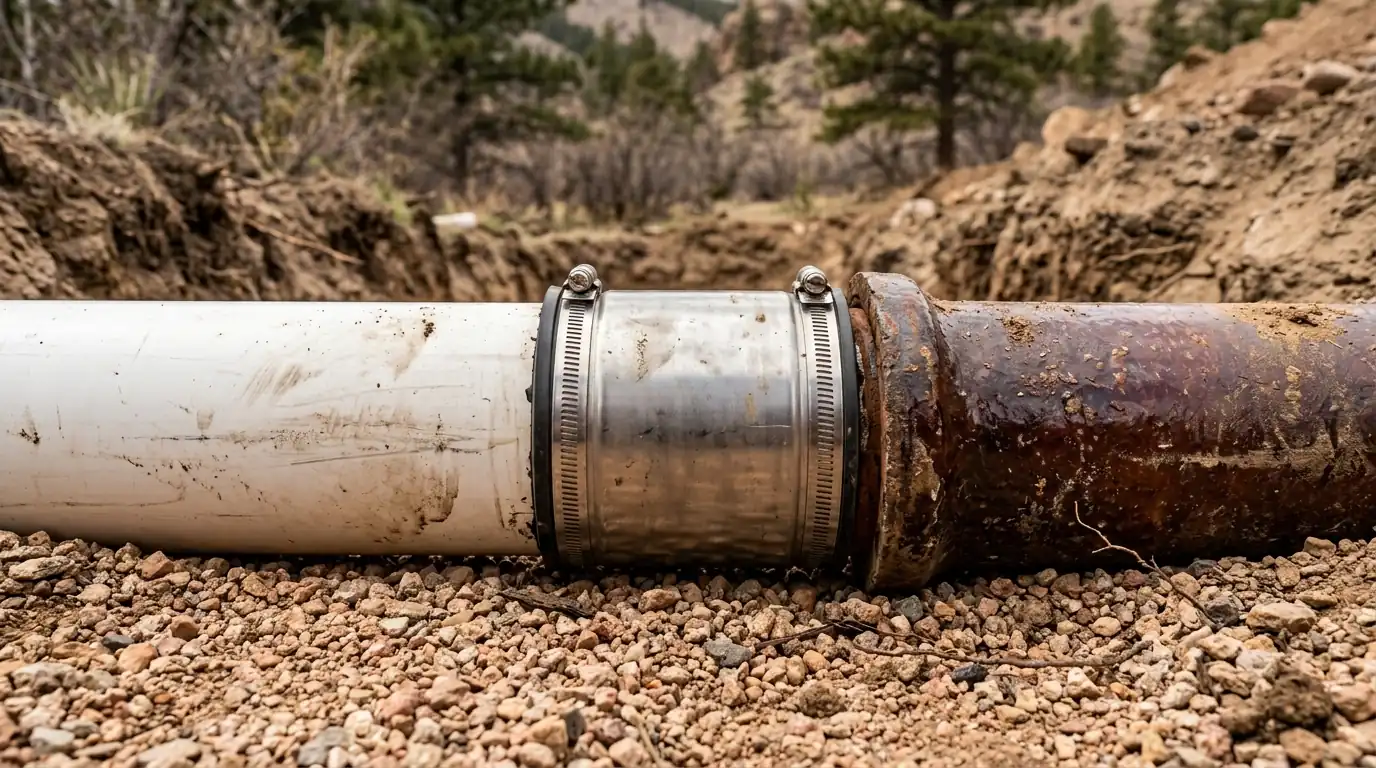
Clay and cast iron went in as short lengths joined at a bell. When the ground moves, one length drops or slides away from the next, leaving a lip that catches waste or a gap that lets roots in. The backup keeps returning, and the camera stops at the same distance every time. We excavate the joint, cut out the offset pieces and splice in PVC with shielded transition couplings, so clay or cast iron meets plastic without a step.
Cracked clay or cast iron sections
A hairline crack in clay can weep for years before roots find it. Cast iron rusts thin along the bottom until a channel opens and the pipe loses its floor. Both show up as roots, rust flakes or soil on the cable. One cracked length gets cut out and replaced with PVC. If the pit exposes a second cracked length beside it, we show you before going further. Cast iron channeled along most of its run is past spot repair.
Local conditions
Whose pipe it is, and why the clay keeps moving it
Colorado Springs Utilities places the wastewater service line, from your house to the utility's main, on the homeowner, along with damage from blockages in it. The ground adds to the problem. The Colorado Geological Survey says bentonite clays found across the Front Range can swell up to 20% by volume when wet, lists sewer lines among the damage, and has mapped heave risk for the city. That movement is what pulls joints apart and drops bellies into a line.
Warning signs
Clues that a section of your sewer line has failed
Same backup, same season
A floor drain that backs up every spring points to a joint letting in roots or water.
Toilet gurgles when the washer drains
Air pushed ahead of a slow main bubbles through the nearest trap.
A green or sunken stripe in the yard
Grass over a leaking lateral grows faster; a sinking strip means soil is washing into a break.
Cleaning that lasts only weeks
Something in the pipe is catching waste again and again.
Roots or dirt on the cable head
The pipe wall is open somewhere.
How the job runs
From camera run to backfill
Clear the line
A backed-up main gets cabled open so the house drains and the camera can see.
Camera and locate
We record the run and mark the defect's spot and depth; buried utilities get located.
Open one pit
We dig at the mark, shore loose sides, and expose sound pipe on both sides.
Replace the section
New PVC goes in on a compacted bed, joined with shielded couplings.
Camera again, then backfill
We video the new section, then backfill in compacted layers so the ground does not sink.
FAQ
Sewer repair questions from Colorado Springs homeowners
Cutting roots restores flow, but the opening is still there, and they return. If roots enter at one joint, repairing it ends the cycle. If they enter at nearly every joint, scheduled cleaning or a new line are the honest options.
Colorado Springs Utilities assigns the service line from the house to its main to the customer. Our guide on who owns the lines on your lot explains where that responsibility starts and stops.
We count defects on the video. One or two bad joints in sound pipe is a repair. Defects every few feet, or cast iron with no floor left, is a replacement. Our repair or replace guide covers the cutoffs.
Not once the pipe is cut. Plan on no drains from the moment we open the line until the new section is joined, part of a day on a simple repair. We warn you before we cut.
We can splice a short stretch, but Orangeburg is tar-soaked fiber that deforms with age, and the pipe beside a repair is usually just as soft. We normally recommend replacing the run.
Related services

