Sump pump repair and replacement for Colorado Springs basements
A sump pit can sit dry for months, then fill fast after one hard storm. We fix pumps that never shut off, replace sticking floats, and add backups for when the power goes out.
- Phones answered 24/7
- Floats, check valves, discharge lines
- Battery backup pumps
Updated October 2026Phones answered 24/7
Water running right now?
Close the main shut-off, then call. A person answers 24/7.
Quick answer
Sump pump repair in Colorado Springs usually comes down to three parts: the float switch, the check valve and the discharge line. A pump that sits idle for months can seize when water finally arrives. HomeGuide puts replacing an existing pump at $400 to $700 nationally; we test the whole setup before replacing anything.
Warning signs
Signs a sump pump is about to quit
Humming without pumping
A jammed impeller or failed capacitor.
Running with no water coming in
A float stuck in the on position.
A thud every time it stops
Water column slamming a check valve.
Rust or silt around the base
Corrosion or a clogged intake.
Water seeping around the pit lid
The pump is losing the race.
What a sump system is made of, and where it fails
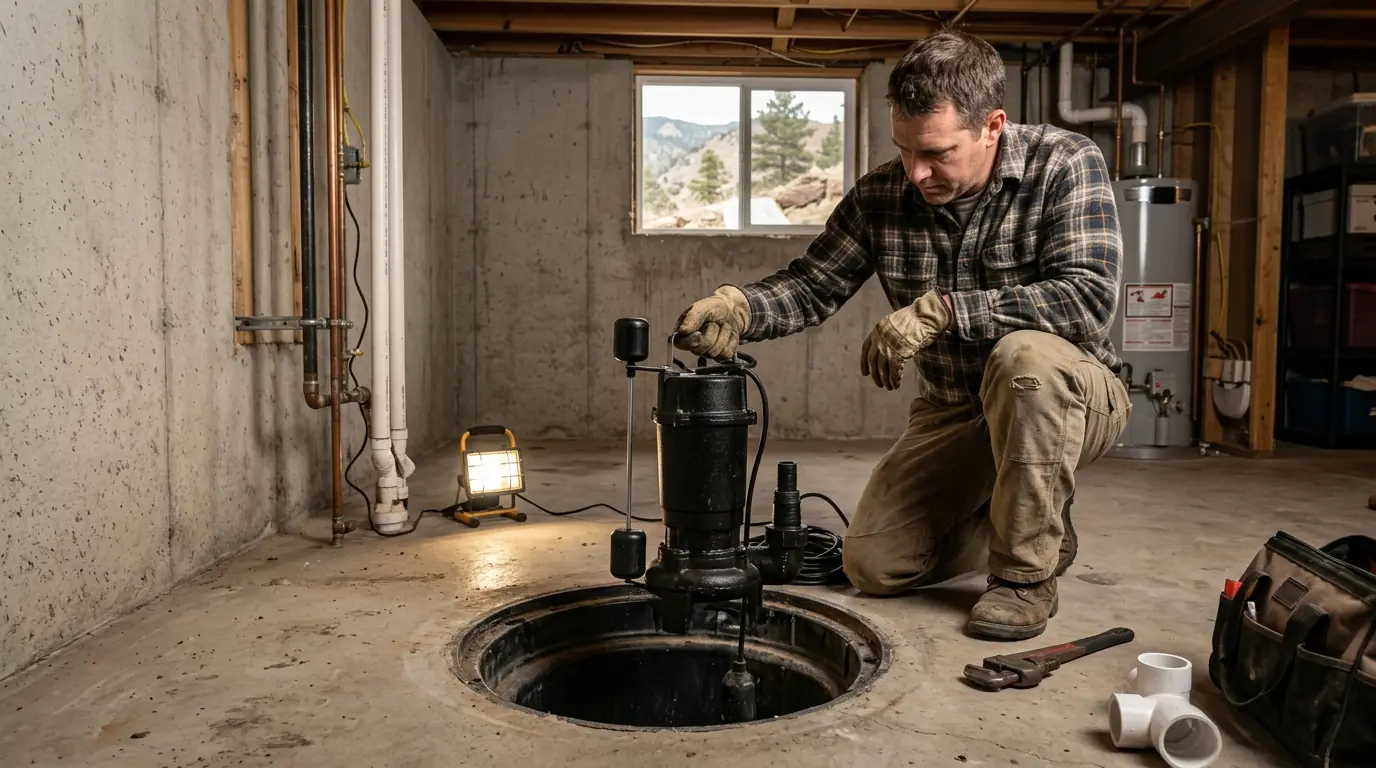
The pit collects water from foundation drain tile or the gravel under the slab. Inside sits a submersible or pedestal pump, a float switch (tethered, vertical or electronic) that starts it, a check valve so pumped water does not fall back into the pit, and a discharge pipe carrying water outside and away from the foundation.
When a pump fails, we look at all of it. A burned-out motor may have been short cycling on a failed check valve. A pump that ran dry may have had its float pinned against the pit wall. A discharge that freezes at its outlet makes a new pump fight a blocked pipe.
Sumps get confused with ejectors. A sealed pit taking toilet or shower drainage is a sewage ejector. Water rising through a floor drain instead of the pit points at the main line and a main sewer cleaning.
How the job runs
How we troubleshoot a sump pit
Check the power
Breaker, outlet and any tripped GFCI first.
Watch a cycle
Fill the pit and see the float lift, the pump run and the level drop.
Check valve and discharge
Backflow into the pit, a blocked or frozen outlet.
Judge the inflow
Groundwater, or a leak feeding the pit.
Repair and retest
Switch, valve or pump replaced, then another full cycle.
Pumps that run nonstop
A pump that never shuts off is either fighting real inflow or being fooled. We check whether the float is stuck up, whether the check valve is letting the discharge column drain back, whether a worn impeller is moving too little water, and whether the outlet is blocked or frozen. If the pit keeps filling in dry weather, the water may not be groundwater at all; a leaking supply line or an irrigation line near the foundation can feed it, and leak detection finds that.
Failed float switches
The switch, not the motor, is behind a large share of sump failures. A tethered float catches on the cord, the pit wall or the discharge pipe, and a vertical float rod gums up with silt. In a narrow pit, a tethered float may not have room to swing. We test by filling the pit with a hose or bucket and watching the switch through a full cycle, then replace the switch alone or move to a pump with an integral switch built for a tight pit.
Battery backup pumps
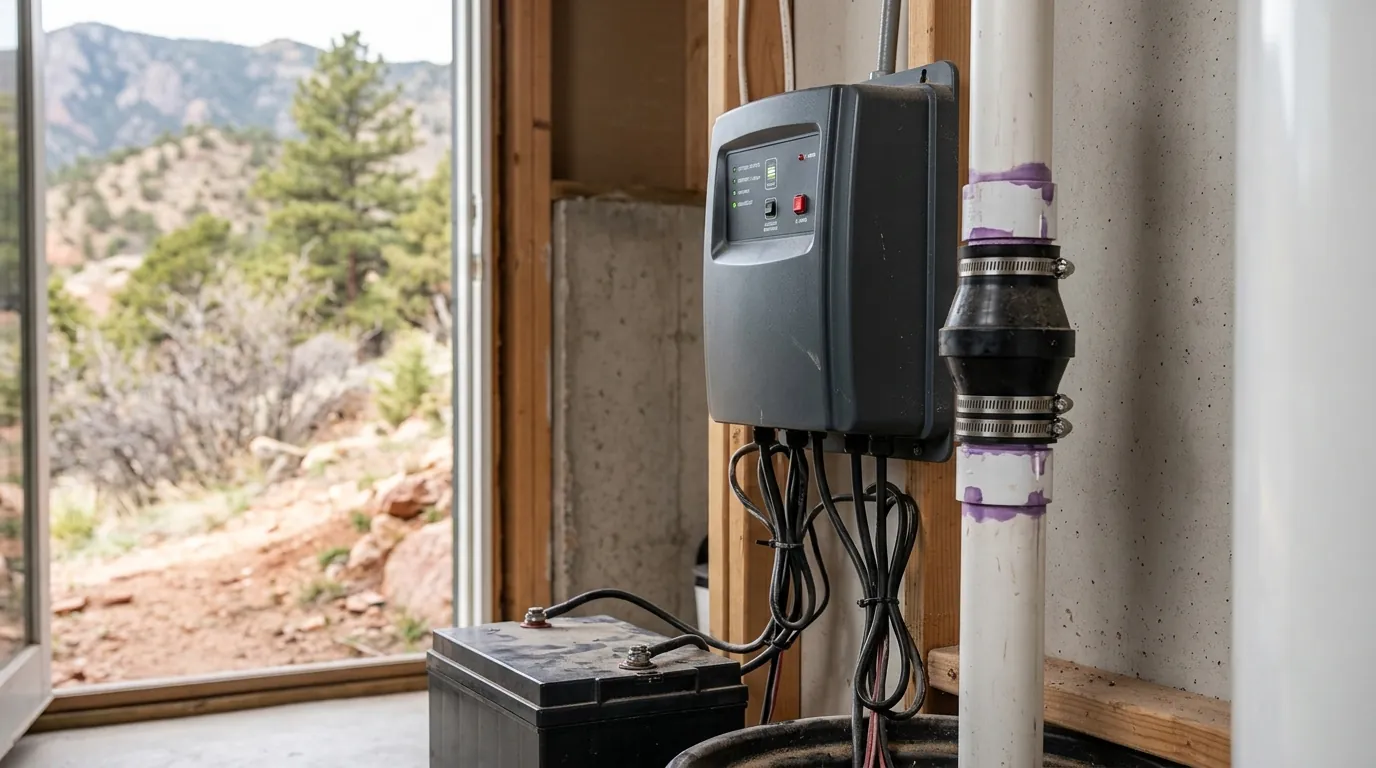
The primary pump stops when the power does, often during the storm that is filling the pit. A battery backup is a second pump on its own check valve, tied into the discharge, with a deep-cycle battery, a charger and an alarm. It moves less water than the primary and only for as long as the battery lasts, so it is a bridge, not a replacement. The battery needs regular testing and eventual replacement, and the alarm tells you when the backup has taken over.
HomeGuide lists $600 to $2,500 for a sump pump with installation, nationally.
Local conditions
Sump pits in Colorado Springs basements
In Colorado Springs, plenty of basement sump pits stay dry for long stretches, and that is exactly how pumps fail unnoticed: a pump that never runs never tells you it has seized. Pour a bucket of water into the pit a few times a year and watch the float lift and the pump empty it. Run the discharge to daylight away from the foundation, and keep its outlet clear of snow and ice through winter.
Your options
Battery backup or water-powered backup?
Both keep the pit draining when the primary stops. They draw power from different places.
| Battery backup | Water-powered backup | |
|---|---|---|
| Power source | Deep-cycle battery and charger | City water pressure |
| Run time in an outage | Until the battery runs down | As long as city pressure holds |
| On a private well | Works | Does not; the well pump stops too |
| Upkeep | Battery testing and replacement | Valve test, backflow protection on the supply |
Do it yourself?
What you can check before calling
Three of these take five minutes and solve a fair share of calls.
| Task | Homeowner | Plumber |
|---|---|---|
| Pump will not start | Check the breaker and reset the GFCI | Test the motor and switch |
| Float test | Pour a bucket into the pit | Replace a sticking switch |
| Discharge outlet | Clear snow, ice or leaves | Reroute or protect a line that freezes |
| Backup battery | Press the test button | Replace the battery or charger |
Cost
Sump pump installation and replacement prices
Swapping a pump in an existing pit is the low end. A new pit, new discharge piping or a backup system adds to it. National figures, not our price.
What moves the price
- Pump swap in an existing pit vs a new pit
- Pump size and cast iron vs plastic housing
- Float switch type
- New check valve and discharge piping
- Battery backup with charger and alarm
- Outlet near the pit
Ranges are published market figures for planning, not a quote. We price your job after we see it.
Brands we service
We fit Watts check valves on discharge lines and backflow devices on water-powered backups, Zurn floor drain parts around the pit, and Uponor PEX for a water-powered backup's supply.
- Rheem
- A. O. Smith
- Bradford White
- Navien
- Rinnai
- Noritz
- Moen
- Delta
- Kohler
- American Standard
- InSinkErator
- Uponor
- Watts
- Zurn
FAQ
Sump pump questions homeowners ask us
Usually a failed check valve letting the discharge drain back into the pit, or a float set with too little travel. Short cycling wears out motors quickly.
Generally no. Sump water is meant to go outside, and many utilities prohibit clear water in the sanitary sewer. We route discharge to daylight away from the foundation.
No. It pumps less water and only until the battery runs down. It covers outages and primary-pump failures, not days of heavy inflow.
Not always. A jammed impeller or a stuck float can make it hum without pumping. With power off, we pull it, clear the intake and test before calling it dead.
It depends on how often it runs and what it pumps. Pumps that cycle constantly wear out sooner, and pumps that sit idle for years can seize. Testing a few times a year catches both.

