Replacing worn-out sewer lines in Colorado Springs
When the camera shows a lateral failing along its length, patching stops making sense. We replace the run in new pipe, house drain to utility main, and show you the footage that got us there.
- House drain to utility main
- Footage reviewed with you
- Phones answered 24/7
Updated October 2026Phones answered 24/7
Want a price on this job?
Call and describe the job. We answer 24/7 and set a visit.
Quick answer
Sewer line replacement in Colorado Springs is priced largely by length, $50 to $250 per linear foot on HomeAdvisor's figures, so a 40 foot lateral and a 90 foot one are very different jobs. We measure the run with the camera first. Depth, what sits on top of the pipe, and the connection at the main set the rest.
When a sewer line is past patching
Replacement is the answer when the pipe itself is the problem, not one joint in it. Clay tile has a joint every two or three feet, and each is a root entry. Cast iron under a slab corrodes from the inside until the bottom is gone. Orangeburg, a tar paper pipe, slowly flattens. In each case a spot repair fixes one place while the next failure is already visible on the video.
New laterals go in as solid-wall PVC with glued joints, bedded and sloped to drain, with a two-way cleanout outside the foundation so the line can be reached without pulling a toilet. Where digging is the obstacle, a driveway, a mature tree, a finished yard, we price bursting or lining alongside, and tell you when the old pipe is too broken or bellied for either.
Cost
Sewer replacement costs, by the foot and by the job
Length drives the number most, then depth and whatever has to be cut and put back. These are published figures for context, not our price; yours follows a measured camera run.
What moves the price
- Length from the house to the main
- Depth at the foundation and at the tap
- Slab, driveway or street to cut and patch
- Basement finishes over a cast iron run
- Trees along the route
- New cleanout at the foundation
Ranges are published market figures for planning, not a quote. We price your job after we see it.
Replacing old clay tile
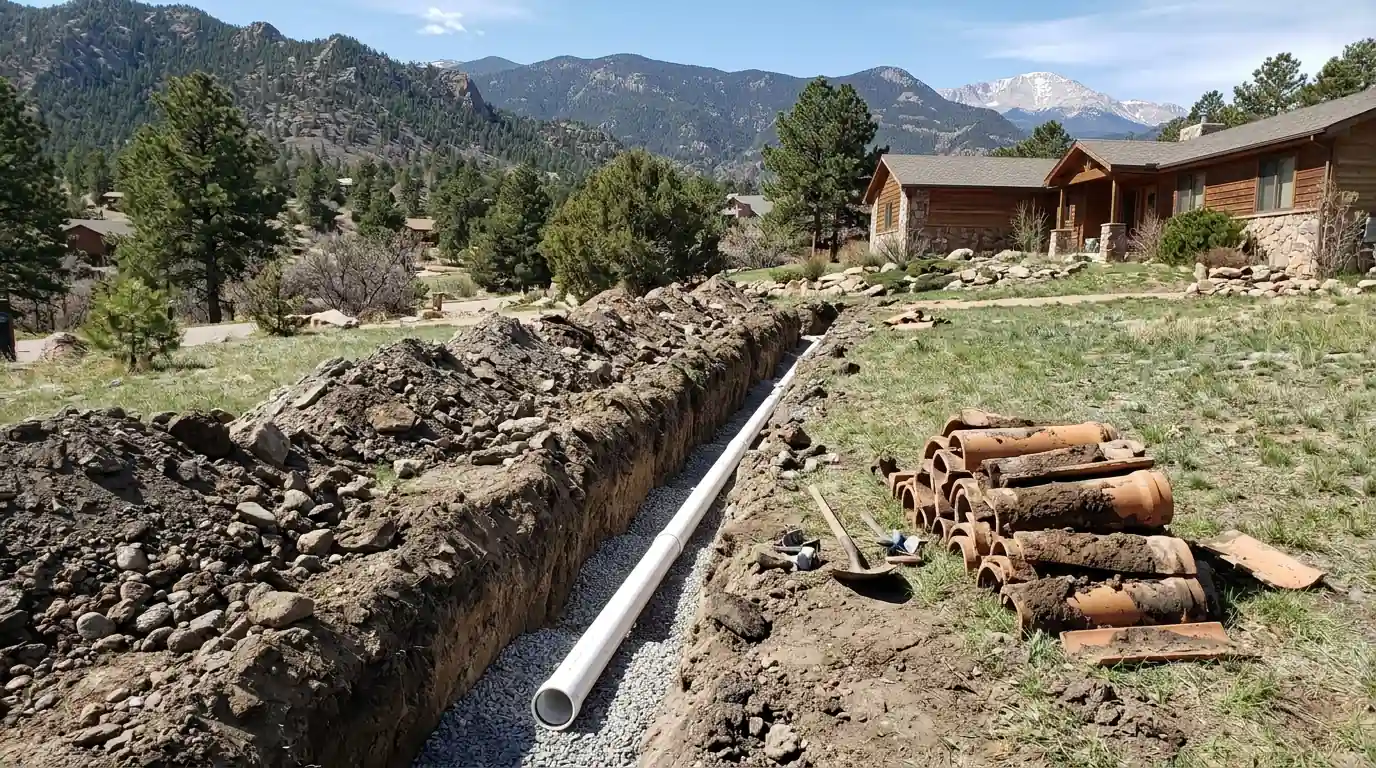
Clay shows on video as short sections with a ring at every joint and roots hanging through several of them. Homeowners usually know it as a main that needs cabling once or twice a year, every year. Replacement means exposing the line from the foundation to the main, removing the clay and laying PVC on a graded bed, with transition couplings where new pipe meets the house's cast iron or the tap. Chasing roots joint by joint in a long clay run costs more over time than replacing it.
Replacing cast iron under a basement
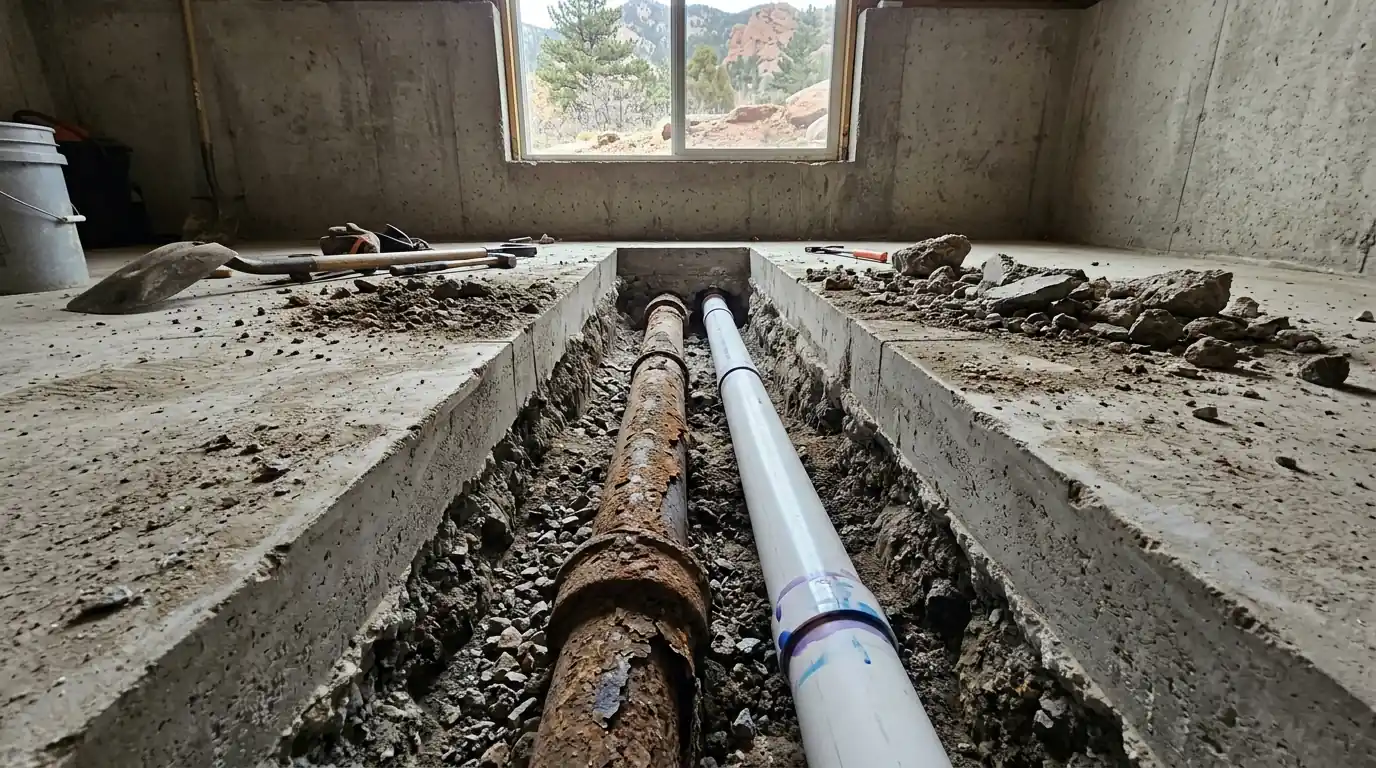
Cast iron under a basement slab gives itself away through slow floor drains, a sewer smell downstairs, or rust scale in the camera picture. The pipe is often worse than its outside suggests, because it corrodes from the bottom up. We saw-cut a trench in the slab along the run, break out the concrete, replace the pipe with PVC at proper fall, then backfill and patch the floor. Finished basements add drywall, flooring and sometimes a wall, so we map the route before anything is cut.
Full lateral to the city main
Sometimes the whole run has to go: the pipe is soft, bellied in several places, or roots fill most joints. A full lateral ends at the tap on the utility's main, which can sit well out under the street, so the job may involve right-of-way work and traffic control. We set a new two-way cleanout at the house, run new pipe on a consistent grade, connect at the tap and run the camera through the finished line before any backfill goes in.
HomeGuide puts replacement at $50 to $250 per linear foot on average, or $2,000 to $10,000 for 40 linear feet.
Local conditions
Why the year your house was built matters
Age is the first thing we ask about. The median Colorado Springs home was built in 1990, a decade newer than the national median, and a house from that era most likely has a plastic lateral that needs a joint repaired, not a new run. The older core is different. The Old North End Historic District, listed on the National Register in 1982 and expanded in 2015, holds homes in styles from 1885 to 1965, the decades when clay tile, cast iron and Orangeburg went into the ground.
What is included
What a full sewer replacement quote should spell out
Scopes vary a lot between plumbers. Ask any quote, ours included, to cover these.
- Camera footage with defects marked
- Total length being replaced
- Pipe material and diameter
- Excavation method and route
- New cleanout location
- Who patches concrete or asphalt
- Connection at the main
- Final camera run of the new line
Timing
How long the drains are out of service
An outside lateral with clear access usually takes one to two days from first cut to backfill, and the drains are out only between cutting the old pipe and connecting the new one. Deep lines, a tap far out under the street, or rock in the trench add time.
Basement slab work runs longer, since concrete is cut, hauled out and patched.
How the job runs
From the first camera run to a new lateral
Camera and measure
We record the full run and measure length and depth at the key points.
Choose the route
Open trench, slab cut or trenchless, based on what sits above the pipe and how broken it is.
Remove and lay new pipe
After utility locates, old pipe comes out and PVC goes in on a compacted bed with steady fall.
Connect both ends
Transition couplings at the house and a sound connection at the tap.
Camera, then backfill
We video the new line, backfill in compacted lifts and restore the cuts we agreed on.
FAQ
What people ask before replacing a sewer line
We backfill, compact and replace concrete we cut. Sod, rock, pavers and sprinkler heads in the trench path need a plan, and we agree on what we restore before digging so nobody is surprised.
Not always. If the failed half is near the main and the pipe near the house is sound, we can replace only the bad run and add a cleanout at the transition. Our repair or replace guide covers how we weigh it.
Glued PVC joints are watertight, and roots chase water, so they have no way in unless the pipe is damaged later. The tree can usually stay, unless its trunk sits right on the route.
Yes, especially on a house old enough for clay or cast iron. A camera run before closing tells you whether a replacement is coming. See sewer scopes before buying for what to ask.
The main belongs to the utility. If our camera shows damage past the tap, we stop and report it so the utility can deal with its side, and we finish the lateral to the connection.
Related services

