Frozen and burst pipe repair across Colorado Springs
A frozen pipe is a warning and a burst pipe is the bill. We thaw lines with controlled heat, find the split before it floods a ceiling, and fix where the cold got in.
- Phones answered 24/7
- No open-flame thawing
- Copper, PEX and CPVC
Updated October 2026Phones answered 24/7
Water running right now?
Close the main shut-off, then call. A person answers 24/7.
Quick answer
Frozen pipe repair in Colorado Springs is usually two jobs: thaw the line, then find the split that ice pressure left behind, which often sits a few feet away from the frozen spot. Until we arrive, keep a faucet open on that line, close the main the moment you see water, and never put a torch to a pipe in a wall.
Warning signs
Signs a pipe has frozen or already split
One faucet dead, others fine
Ice is blocking that branch, usually on an outside wall or in a garage.
Frost on an exposed pipe
A garage or crawlspace line is at or near freezing inside.
Toilet tank will not refill
The supply to that bathroom has frozen upstream.
Bulge or hairline seam in copper
The pipe has already stretched and may tear as it thaws.
Hissing with every tap closed
Water is escaping from a split you cannot see yet.
Why the pipe splits somewhere other than the frozen spot
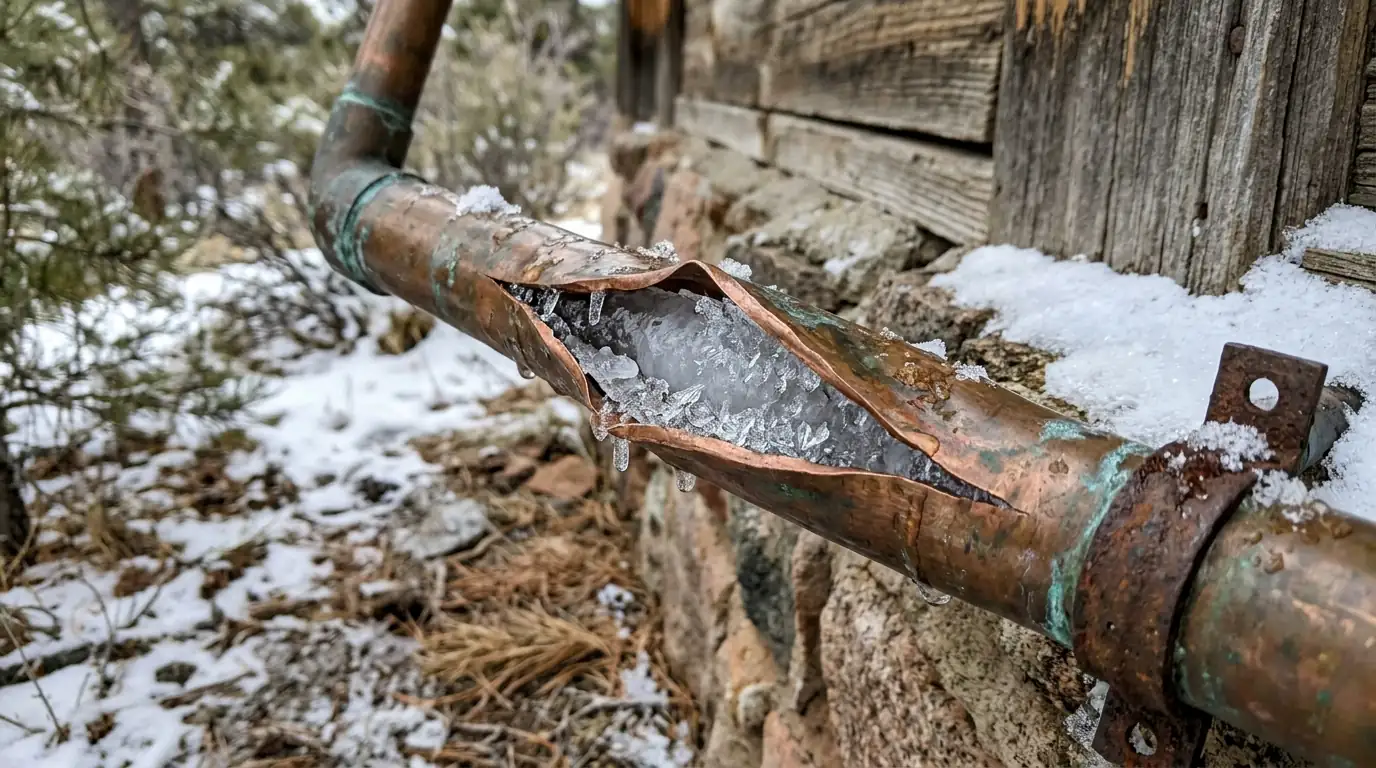
The ice plug itself rarely bursts the pipe. The damage happens between the ice and a closed faucet, where trapped water has nowhere to go and pressure climbs until copper bulges and tears along its length or a PEX fitting pushes apart. That is why a thawed line can run fine for a minute, then pour through a ceiling.
The runs that freeze are predictable: supply lines in exterior walls behind kitchen sinks, pipes in unheated garages, crawlspace lines near foundation vents, and the pipe behind a hose bib left with a hose attached. Once a section has frozen twice, we talk about insulating or rerouting it instead of patching it a third time.
How the job runs
How we handle a frozen line, first call to closed wall
Isolate
If water is escaping, we close the main or a branch valve first.
Open the faucet
An open tap gives melt water and pressure somewhere to go.
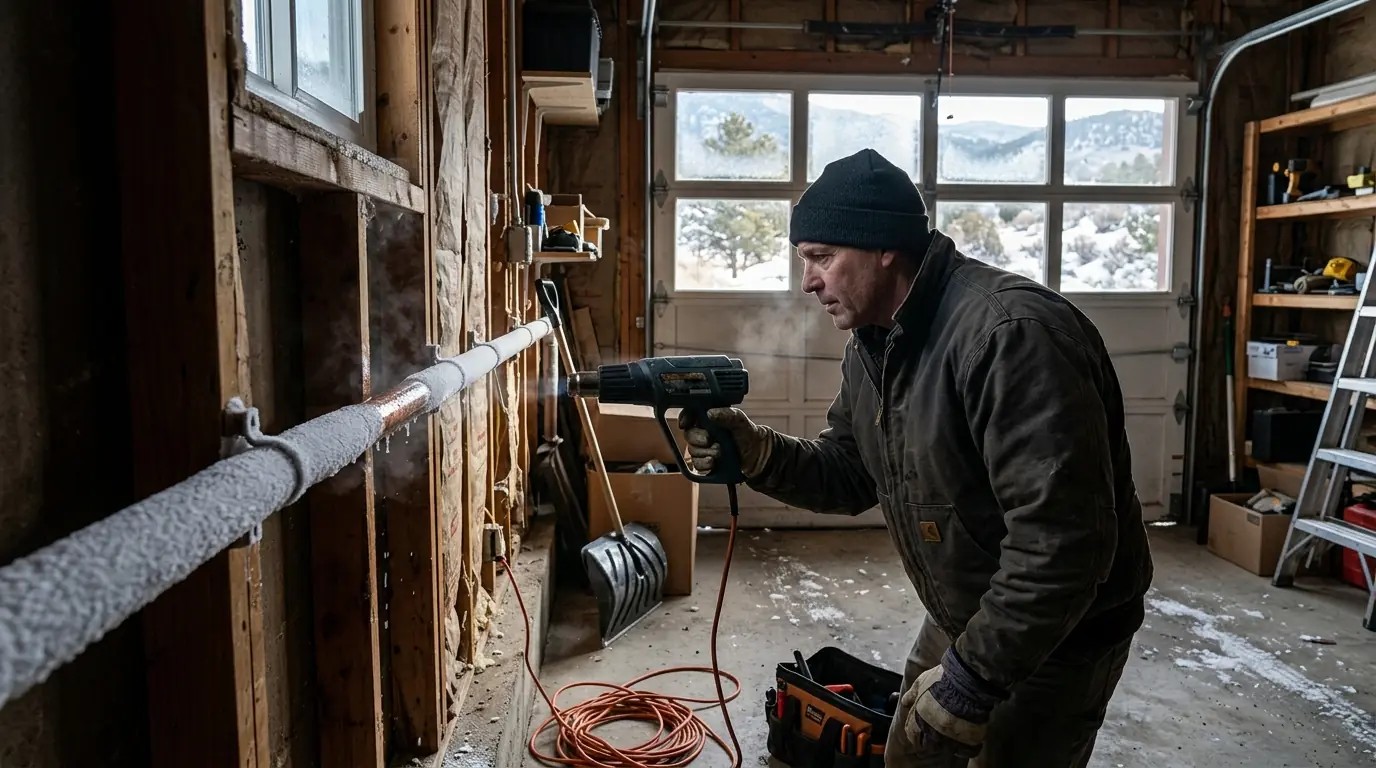
Thaw with controlled heat
Heat guns, pads or warm air, working from the open end toward the ice.
Trace and splice
We find every bulge or tear, cut back to sound pipe and join new copper or PEX.
Test and protect
The repair holds full pressure, then we insulate the run or plan a reroute.
Thawing a frozen supply line
The sign is a faucet that gives a trickle or nothing while the rest of the house works, usually on the coldest morning of a cold snap. We open that faucet so melt water and pressure can escape, then warm the run from the faucet end back toward the ice with heat guns, heat pads or warm air blown into the wall cavity. Open flame inside a wall is how framing catches fire, and boiling water can deform PEX. Once water flows, we leave it running and feel along the run for a split before we call it done.
Burst pipe inside a wall or ceiling
Spreading stains on drywall, a sagging ceiling, or the sound of running water with every tap closed. We close the main, open the drywall at the wettest point and cut back to sound pipe on both sides of the tear. Copper gets a soldered or press-fit coupling; PEX gets new tubing with crimp or expansion fittings. The repair is pressure tested before anything is covered, and we leave the cavity open to dry. Drywall patching is its own trade, so we keep the opening clean and square.
Split pipe in a garage or crawlspace
These often turn up days late, as standing water near the water heater or a soggy crawlspace vapor barrier. Garage lines are usually exposed, so once the water is off the splice goes quickly. Crawlspace runs take longer: we crawl the full length, look for a second split, and work out why it froze, whether an open foundation vent, missing insulation or a pipe lying on cold soil. Fixing the split without fixing the exposure just schedules the next one.
Local conditions
First freeze in October, worst cold in midwinter
National Weather Service records put the average first fall freeze in Colorado Springs on October 2, with the earliest on September 1 and the latest on October 31. Pueblo averages October 8. The pipe damage usually comes later, because Colorado Springs averages 5.2 nights a year below zero and has hit 27 below. A line in an exterior wall that shrugs off an October frost can still split in a January cold snap, so the time to insulate it is before the first freeze, not after.
Do it yourself?
What you can safely do before we get there
Some thawing is a fair homeowner job. A few popular tricks start fires or flood rooms.
| Task | Homeowner | Plumber |
|---|---|---|
| Frozen line, no leak | Open the faucet and cabinet doors, warm the room | Thaw the run and check it for splits |
| Torch or open flame | Do not use one on any pipe near framing | Heat guns and pads that cannot ignite wood |
| Visible split | Close the main and drain from the lowest faucet | Cut out the damage and splice new pipe |
| Crawlspace freeze | Stay out if water is pooling near wiring | Crawl the run, fix every split and the exposure |
Cost
Thawing versus burst pipe repair costs
Thawing alone is a short visit; a split behind drywall is bigger. These national figures are not our prices and leave out drywall repair.
What moves the price
- Thaw only, or a split to cut out
- How much drywall or ceiling must open
- Copper, PEX, CPVC or galvanized
- More than one split on the run
- Crawlspace clearance and access
- Insulating or rerouting to stop a repeat
Ranges are published market figures for planning, not a quote. We price your job after we see it.
FAQ
Frozen pipe questions from cold Colorado Springs mornings
Check before you relax. Run the faucet, then look and listen along the run for drips, wet drywall or hissing. Copper can tear along a seam that only opens as it warms. Nothing after an hour usually means you were lucky.
On lines that have frozen before, yes. A slow drip keeps water moving and relieves pressure between the ice and the faucet. It is a stopgap; insulation or moving the run into heated space is the fix.
Yes. PEX stretches and often survives a freeze that would split copper, but its brass or plastic fittings can still crack or pull apart. A frozen PEX line still needs every fitting checked.
An exposed garage line often thaws within an hour. Lines deep in an exterior wall take longer, and opening a small square of drywall can be quicker.
On an exposed pipe, yes, kept moving and aimed at the pipe, starting at the open faucet end.
Related services

