Well pump and pressure tank repair around Colorado Springs
On a private well, no water means no toilets, showers or dishes. We start at the pressure switch and tank, and pull the pump only when the readings point down the hole.
- Phones answered 24/7
- Switch, tank and pump testing
- Private wells across El Paso County
Updated October 2026Phones answered 24/7
Water running right now?
Close the main shut-off, then call. A person answers 24/7.
Quick answer
Well pump repair around Colorado Springs starts at the pressure tank, not the wellhead: checking the switch, the tank's air charge (about 2 psi below the switch's cut-in) and the amp draw at the pump circuit rules out the cheaper fixes first. Pulling a submersible pump is the expensive step, so it comes last.
Warning signs
Signs your well system needs service
Rapid clicking at the switch
The tank has lost its air charge.
Gauge at zero
No power to the pump, a failed switch or a failed pump.
Air spurting at faucets
A low water level or a leak in the drop pipe.
Water from the tank's air valve
A ruptured bladder or diaphragm.
Sudden sand or dirty water
A worn pump or a well screen problem.
Pump, tank or switch: finding which one quit
A residential well system has three working parts. The submersible pump hangs on drop pipe in the casing, wired straight to the switch on a two-wire pump or through a control box on a three-wire pump. The pressure switch starts and stops it. The pressure tank holds air behind a diaphragm or bladder so the pump does not start every time a faucet opens.
We diagnose top down: breaker, then switch contacts and the small tube under the switch, then the tank's air charge with the water drained, then amps and resistance on the pump wiring. That order keeps the expensive step last.
Wells carry grit that shortens fixture life, so many owners add a sediment stage after the tank and a softener if a hardness test calls for one. A house-side leak that keeps the pump cycling gets found with leak detection before anyone blames the pump.
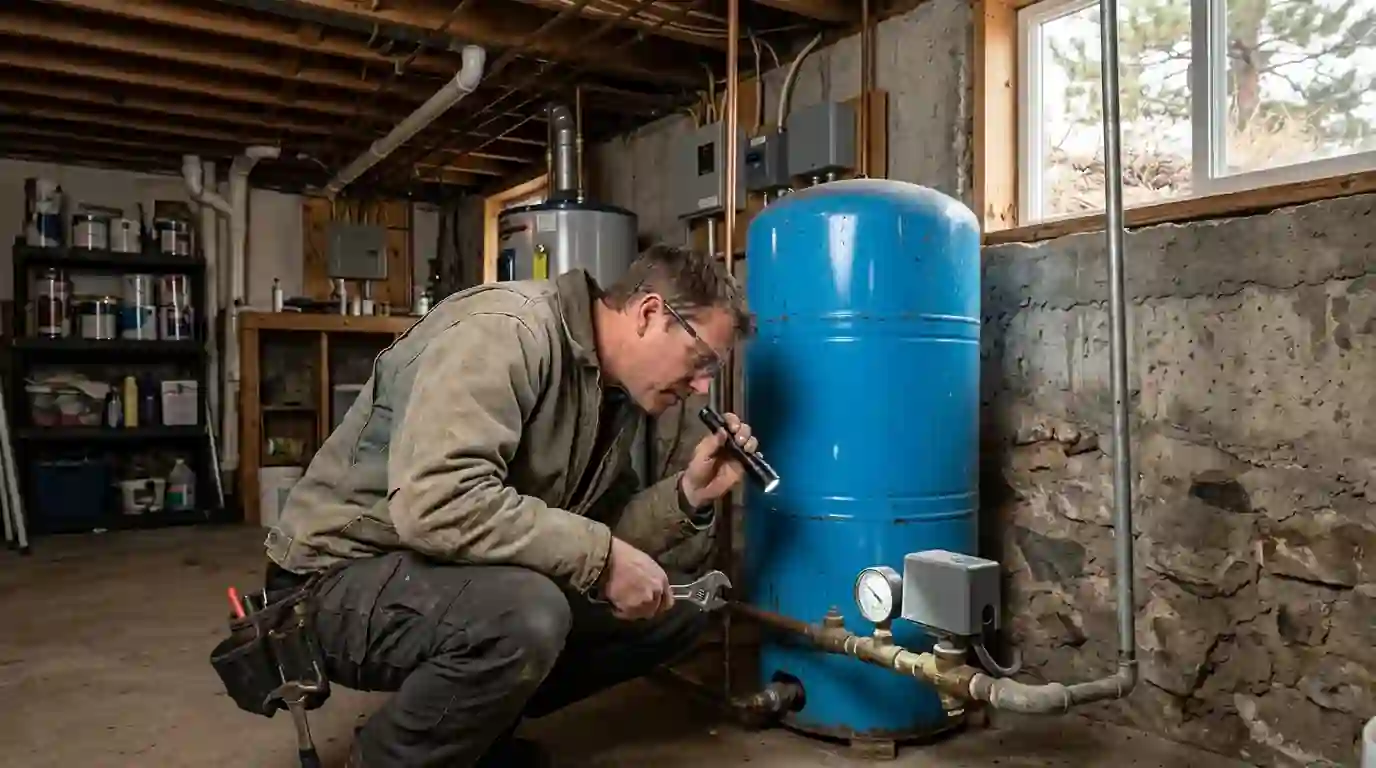
How the job runs
How we track down a well problem
Power first
Breaker, disconnect and voltage at the switch.
Watch the gauge
A full cycle shows cut-in, cut-out and how fast pressure falls.
Check the tank
Power off, tank drained, air charge measured.
Test the pump circuit
Amps and resistance tell us if the motor or wire has failed.
Repair and set
Part replaced, pressures set, a test run checked for air or sediment.
No water on a private well
Dead faucets on a well have a short list of causes: a tripped breaker, burned switch contacts, a failed capacitor or relay in a three-wire control box, a broken splice down the well, a dead motor, or a water level that has dropped below the pump so it trips on low load. In winter, add a frozen switch tube or line in a cold well house or crawlspace. We work that list in order with a meter, and when everything above ground checks out, the pump comes up.
HomeAdvisor puts national well pump replacement at $974 - $2,821, with an average of $1,897.
Short cycling and waterlogged tanks
The gauge needle swings fast, the pump clicks on every few seconds, and lights may flicker each time it starts. That usually means the tank has lost its air cushion. With the power off and the tank drained, we check pressure at the air valve: if it is low but the bladder is sound, we recharge it to just under cut-in. If water comes out of the air valve, the bladder or diaphragm has failed and the tank gets replaced, because every short cycle shortens the pump's life.
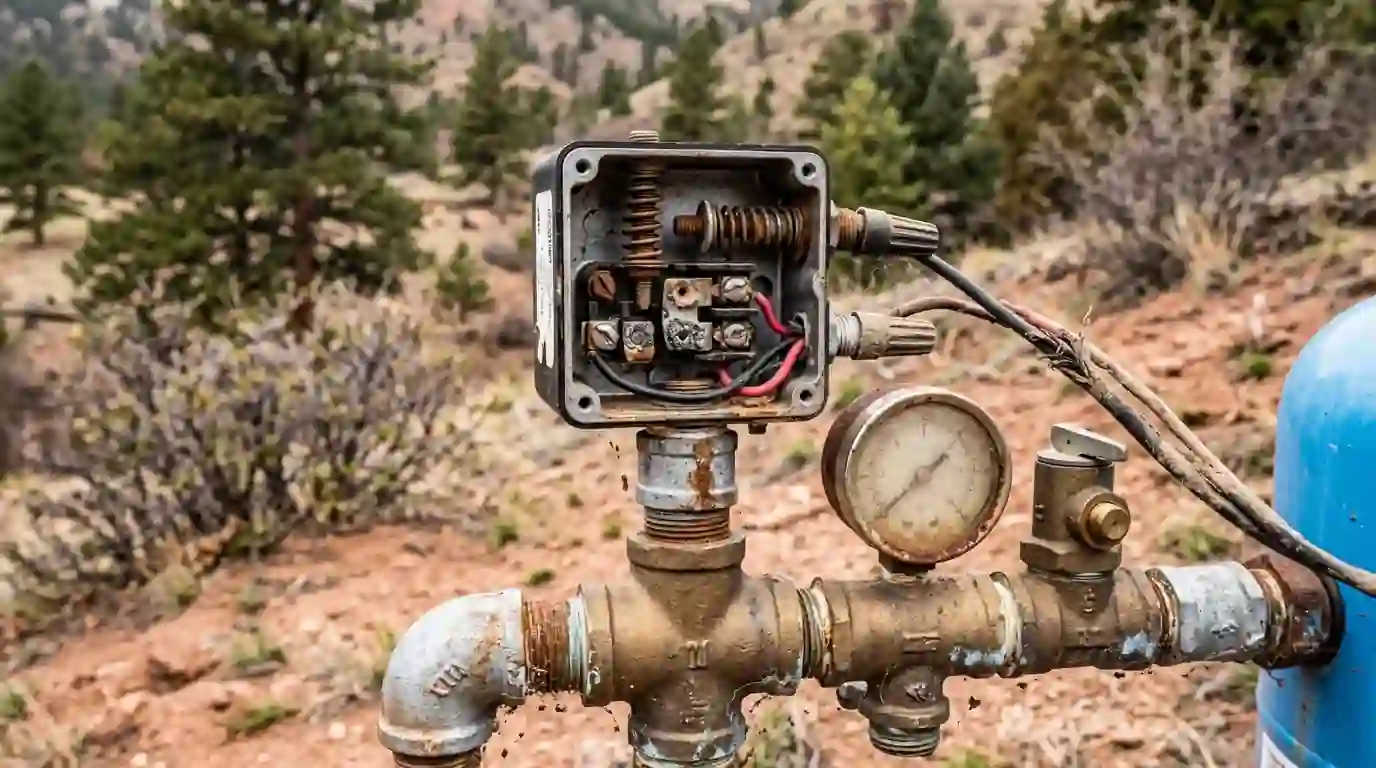
Pressure switch replacement
Switches fail from pitted contacts, a clogged pipe nipple underneath, or insects nesting between the points. Symptoms run from a pump that will not start until someone taps the switch, to one that will not shut off. We replace the switch, clean or replace the nipple and tank tee fittings, set cut-in and cut-out, and match the tank's air charge to the new setting. Where the well risks running low, a switch with a low-pressure cutoff protects the pump from running dry.
Timing
How long you may be without water
Switch, gauge and tank repairs happen above ground, so the house usually has water again before we leave. Pulling a submersible pump is a bigger job: drop pipe and wire come up section by section, the pump and often the splice are replaced, and everything goes back down and is tested before the house is repressurized. Depth, weather at the wellhead and whether the new pump matches the old one all change the timing.
Local conditions
Thinning aquifer and hard freezes north of the city
On wells in Black Forest and northern El Paso County, a falling water level is a real suspect. A March 2025 Denver Basin study for El Paso County found the Dawson aquifer thins dramatically around Black Forest, with signs of about 20-25 percent dewatering where pumping is heaviest, and notes it suits small-diameter, low-production residential wells. Winter adds its own risk: the normal January low in Colorado Springs is 18.5 F, cold enough to freeze an exposed switch tube.
Cost
Well pump and pressure tank costs to expect
Switches and gauges are small parts; pumps and tanks are where the money goes, and pump depth decides how much pipe and wire come up. National figures, not our price.
What moves the price
- Pump depth and length of drop pipe and wire
- Two-wire vs three-wire pump and control box
- Pump horsepower and flow
- Pressure tank size
- Switch, gauge and tank tee parts
- Wellhead access in snow or a tight well house
Ranges are published market figures for planning, not a quote. We price your job after we see it.
Brands we service
At the tank tee we fit Watts relief valves and gauges, run Uponor PEX where lines are replaced, and work around A. O. Smith and Rheem treatment units downstream.
- Rheem
- A. O. Smith
- Bradford White
- Navien
- Rinnai
- Noritz
- Moen
- Delta
- Kohler
- American Standard
- InSinkErator
- Uponor
- Watts
- Zurn
FAQ
Private well questions
Possibly, but not always. Air can come from a water level dropping near the pump intake, or from a leak in the drop pipe. We check run time, recovery and pump amps before drawing a conclusion.
Shut off power to the pump, open a faucet until the system drains, then read the air valve with a tire gauge. It should sit about 2 psi below the switch's cut-in. Water from the valve means a failed bladder.
Yes. The small tube under the switch and any exposed piping in a well house or crawlspace freeze first. A frozen tube leaves the switch blind, so the pump either will not start or will not stop.
Not on a standard switch-and-tank system; constant running points to a leak, a failed check valve or a pump that can no longer reach cut-out. Constant-pressure systems with variable-speed drives run differently, and we service those too.
A brief dip is normal on a large motor. Frequent flicker usually means short cycling from a waterlogged tank, which we fix at the tank.
Related services

