Protecting Colorado Springs pipes from freezing
Frozen pipes happen in the same few places: outside walls, garages, crawlspaces and floors that hang past the foundation. We protect those runs with insulation, heat cable or, best of all, a new route through heated space.
- Insulation and heat cable
- Rerouting cold runs
- Phones answered 24/7
Updated October 2026Phones answered 24/7
Want a price on this job?
Call and describe the job. We answer 24/7 and set a visit.
Quick answer
Freeze protection in Colorado Springs focuses on pipes in cold air, because service lines buried below El Paso County's 30-inch frost line, and runs inside heated rooms, rarely freeze. The weak spots are outside walls, garages, crawlspaces and attics. Insulation slows heat loss; only heat cable or a reroute actually keeps a pipe above freezing.
What is included
What our freeze-protection walk-through checks
Freeze work varies a lot between plumbers. Ours covers:
- Every supply run on an exterior wall
- Lines through the garage
- Crawlspace and cantilever runs
- Attic lines, if any
- Rim joist and penetration air leaks
- Hose bib supply lines
- Existing heat cable and its indicator light
- Water heater or laundry in unheated space
Which pipes in your house are at risk
A pipe freezes when it loses heat faster than the house can replace it. The pipes that do freeze run along an exterior wall with thin insulation behind them, through an unheated garage to a laundry or hose bib, across a vented crawlspace, or over a cantilevered floor. Air leaks matter as much as temperature: cold air pouring through a gap at the rim joist can freeze a pipe in an otherwise warm basement.
We walk the house and mark every run in those places, then match the fix to the risk. If a pipe has already split, burst pipe repair comes first and protection after. Outdoor faucets have their own answer, a properly pitched frost-free sillcock, since no amount of foam saves a standard hose bib.
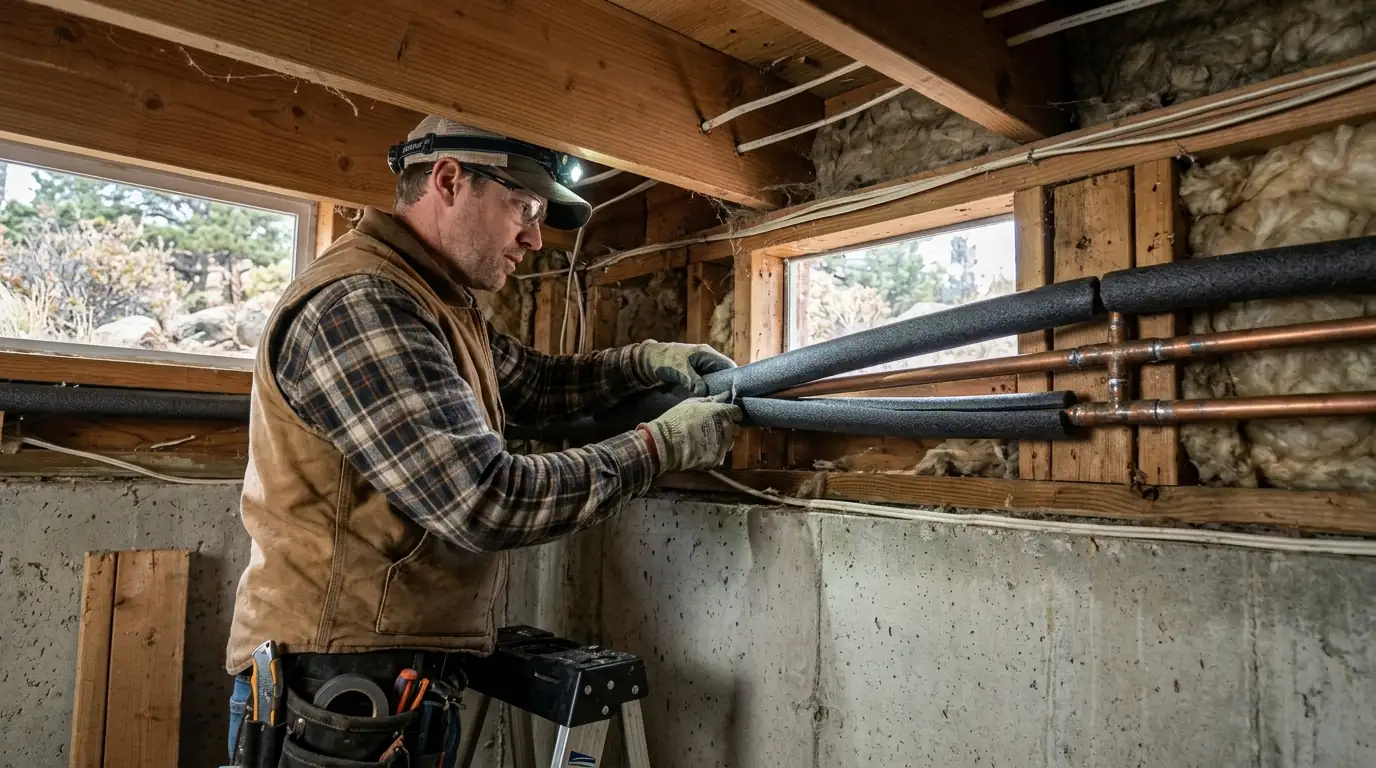
Insulating pipes on outside walls
A pipe in an outside wall freezes from the cold side, so the insulation that counts sits between the pipe and the sheathing, not wrapped around the room side. Where we can open the cavity, we pull the pipe toward the room and pack insulation behind it. In basements and crawlspaces we sleeve exposed runs in closed-cell foam of the right wall thickness, tape every seam and seal the gaps at the rim joist. Insulation only slows heat loss; it cannot add heat to a pipe in a space that stays below freezing for days.
Heat cable on vulnerable runs
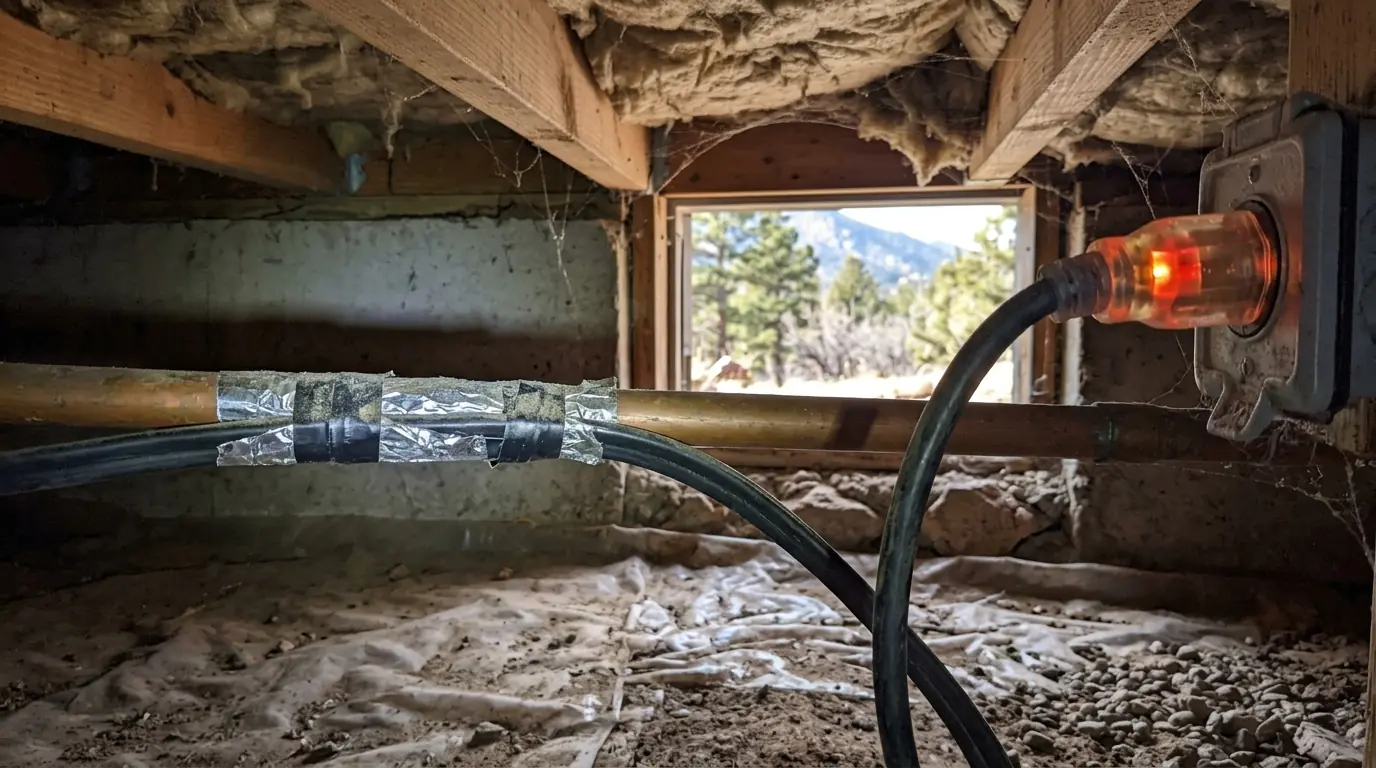
When a pipe has to stay in a cold space, like a garage wall or a crawlspace run, self-regulating heat cable adds heat right where it is needed. It is taped along the pipe, covered with insulation and plugged into a GFCI-protected outlet. Self-regulating cable adjusts its output with temperature and is safer than old constant-wattage heat tape, which could overheat where it crossed itself. On PEX we use only cable listed for plastic pipe. Every cable with an indicator light deserves a look each fall, because cables fail without any other warning.
Rerouting lines out of the cold
The permanent fix for a pipe that freezes every winter is to move it. A laundry supply running through an unheated garage wall can often be fed from the basement instead. A kitchen line inside a cantilevered floor can drop into the heated space below. Moving a pipe a few feet inward usually ends the problem for good, and with PEX it takes less wall access than people expect. We always check whether a reroute is practical before recommending cable, because cable needs power and a working light every single season.
Local conditions
Frost depth and the pipes that sit above it
El Paso County's frost line is 30 inches below grade, the depth a local contractor guide attributes to the Pikes Peak Regional Building Department as the code minimum for footings and foundations. A service line buried below that depth stays above freezing. The pipes that freeze in Colorado Springs are the ones above it: a supply line in a shallow crawlspace, a line along a garage slab edge, a hose bib run through a rim joist. Protection work goes to those runs, not to what is already safely underground.
Cost
Pipe insulation costs next to a burst pipe
Protecting a few exposed runs is a small job; a burst pipe in a finished wall is not. Angi's national figure for insulating pipes in most homes sits beside what ConsumerAffairs reports for thawing and bursts. Heat cable is not priced in these sources, and none of this is our quote.
What moves the price
- How many exposed runs and their length
- Crawlspace, attic or finished-wall access
- Insulation alone or heat cable too
- An outlet near the run for cable
- Sealing rim joist air leaks
- Rerouting through heated space
Ranges are published market figures for planning, not a quote. We price your job after we see it.
How the job runs
How we freeze-proof a house
Find the cold runs
Exterior walls, garages, crawlspaces and attics, traced end to end.
Find the air leaks
Gaps at rim joists and penetrations marked for sealing.
Pick the fix per run
Insulation, heat cable or reroute.
Install and test
Foam taped tight, cable powered and checked, new lines pressure-tested.
Leave a list
Every protected run, and what to check each fall.
Do it yourself?
Freeze prep you can do this weekend
Some of this is homeowner work. Some is not.
| Task | Homeowner | Plumber |
|---|---|---|
| Exposed basement pipe | Slip on foam sleeves and tape the seams | Insulate runs in tight crawlspaces and walls |
| Hoses | Disconnect before the first freeze | Replace split or leaking sillcocks |
| Heat cable | Check indicator lights each fall | Install listed cable on GFCI power |
| Sink on an outside wall | Open the cabinet doors in a cold snap | Reroute the line so it is not needed |
FAQ
Freeze protection questions before winter
A slow drip keeps water moving and relieves pressure between an ice plug and a closed faucet, so it helps in a cold snap. It is a stopgap. If the same faucet needs dripping every cold night, the pipe feeding it needs protection. See what to do if a pipe freezes.
Self-regulating cable listed for your pipe material is fine. Avoid cheap constant-wattage tape on plastic pipe, never overlap cable unless the maker allows it, and plug it into a GFCI outlet. Check its indicator light every fall.
It slows heat loss, which buys time in a short cold spell. In a space that stays below freezing for days, an insulated pipe with no water moving will still freeze. That is where heat cable or a reroute comes in.
Disconnect hoses before the first freeze so frost-free sillcocks can drain. A hose left attached traps water in the valve body, which is how frost-free faucets split. Our guide on winterizing hose bibs covers the rest.
In cold weather, yes, if any water line runs through the garage. A door left open on a below-zero night is one of the most common ways a laundry or hose bib line in a garage wall freezes.
Related services

