Outdoor faucet and hose bib repair around Colorado Springs
An outdoor faucet looks like the simplest fixture on the house, but the costly damage happens inside the wall when one splits. We fit properly pitched frost-free sillcocks and fix the vacuum breakers and packing that leak every spring.
- Frost-free sillcock installs
- Freeze-split repairs
- Vacuum breakers and packing
Updated October 2026Phones answered 24/7
Want a price on this job?
Call and describe the job. We answer 24/7 and set a visit.
Quick answer
Hose bib repair in Colorado Springs usually means one of three jobs: replacing a sillcock that split inside the wall after a freeze, fixing a dripping vacuum breaker or stem packing, or swapping an old compression bib for a frost-free model whose valve seat sits 6 to 12 inches inside the heated wall.
Why a hose bib splits where you cannot see it
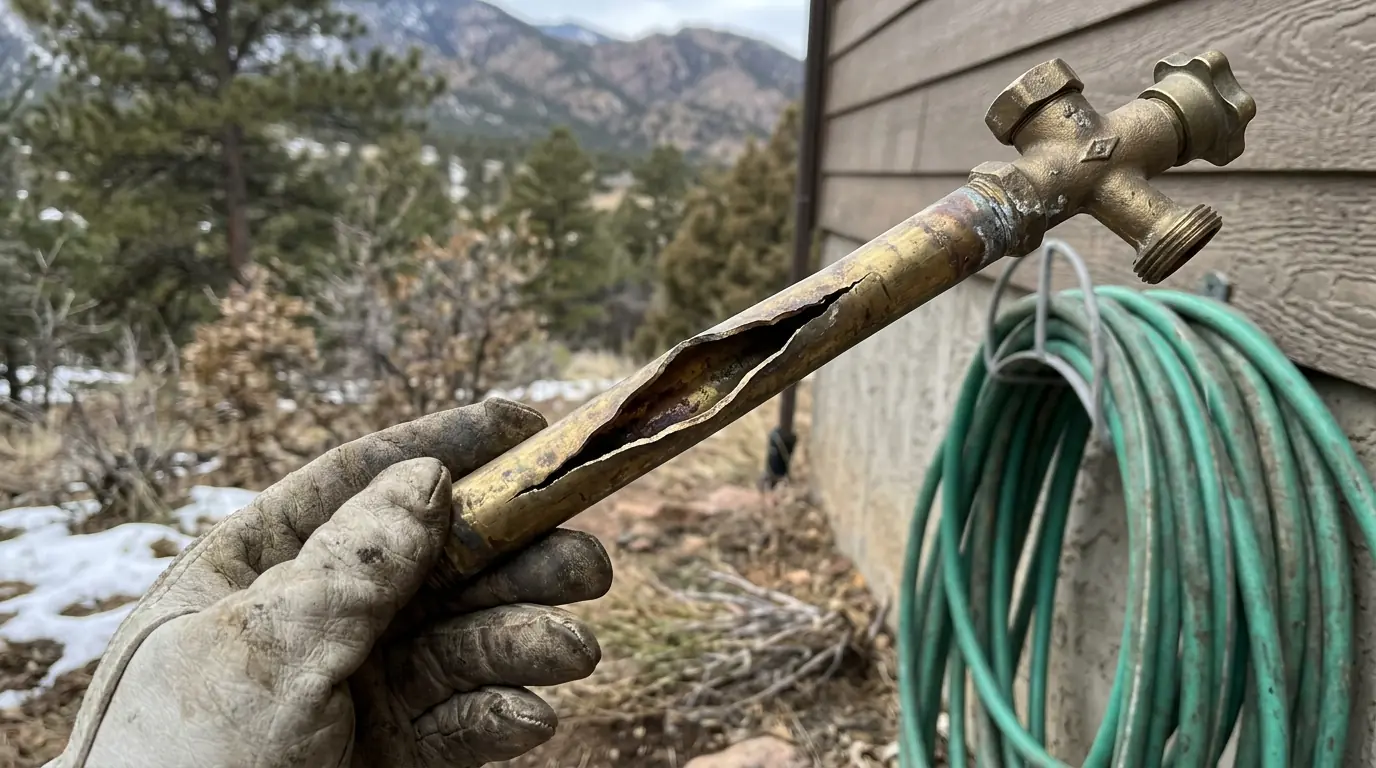
A frost-free sillcock puts its shut-off at the far end of a long stem, inside the heated wall, so the barrel drains every time you close it. That only works with the hose off. Leave a hose connected through a cold night and the water trapped in the barrel cannot drain, freezes, and splits the barrel inside the wall. Nothing leaks until the first time you open it in spring, and then the water runs into the basement or crawlspace.
Outdoor faucets rarely fail alone. If the same line feeds irrigation, the backflow assembly may have frozen too, and if the pipe froze further back, it is a burst pipe repair. Our fall winterizing guide covers the routine that prevents most of this.
Cost
Hose bib replacement costs
A sillcock swap is a small job unless the wall or the pipe behind it is damaged. This is a national figure, not our price.
What moves the price
- Standard bib or frost-free sillcock
- Wall thickness and sillcock length
- Copper, PEX or galvanized behind it
- Brick, stone or siding at the opening
- A split supply pipe inside the wall
- Access from a finished basement ceiling
Ranges are published market figures for planning, not a quote. We price your job after we see it.
Your options
Standard hose bib or frost-free sillcock?
Both are still sold. On an outside wall in this climate, only one belongs.
| Standard hose bib | Frost-free sillcock | |
|---|---|---|
| Valve location | Outside, at the spout | Inside the heated wall |
| Winter routine | Close an interior stop and drain the bib | Remove the hose |
| Freeze risk | High if the inside stop is left open | Low, unless a hose stays on |
| Install | Short pipe stub | Correct length and outward slope |
Frost-free sillcock replacement
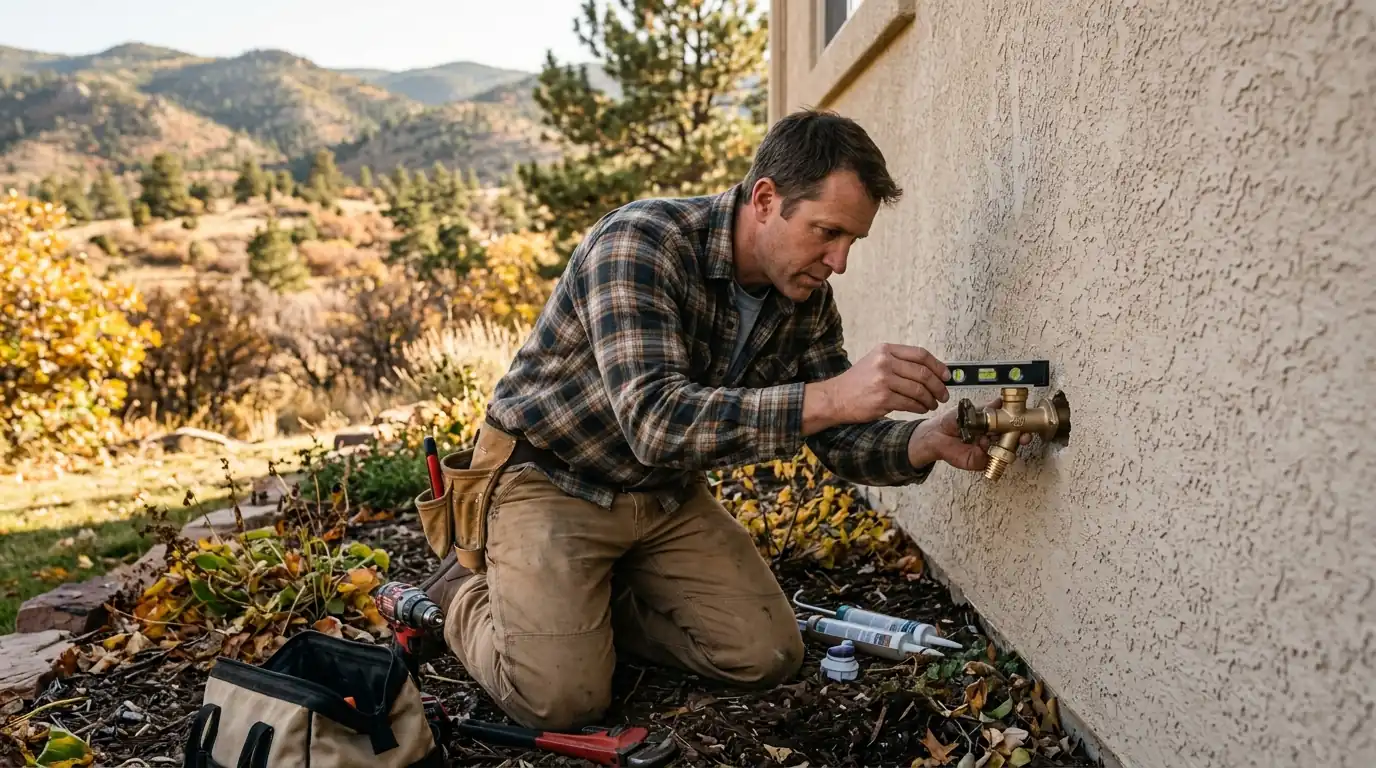
We replace old compression bibs and failed sillcocks with frost-free models sized to the wall, so the valve seat ends up inside heated space. The body has to slope slightly downward toward the outside so the barrel drains, and the flange has to be screwed to the siding or rim joist so turning the handle cannot twist the joint inside. On copper we solder or press the connection; on PEX we use a crimp or expansion adapter. Then we test with the hose on and off and confirm the vacuum breaker resets.
Hose bib that split after a freeze
The classic sign is water pouring out of the siding, or into the basement under the faucet, the first time it is opened in spring. Some only leak with a hose attached and the nozzle closed, because that is the only time the barrel is under pressure. A split barrel cannot be repaired, so the whole sillcock is replaced. While it is out, we check the supply pipe behind it, which can split too, and the joist bay for wet insulation.
Leaking vacuum breaker or packing
Water spitting from the small cap on top of the faucet when a hose is connected is the vacuum breaker, the device that stops garden hose water from siphoning back into the house. Its seal wears out and can freeze. Water seeping around the handle is the stem packing or washer. Both are often fixable with a kit on common brands. On older or off-brand sillcocks, replacing the unit is quicker and leaves you with a freeze-resistant valve.
Local conditions
Spring freezes come later than people expect
National Weather Service records put the average last spring freeze in Colorado Springs on May 8, and the latest on record came on June 18. Even the earliest last freeze on record, in 1977, fell on April 6. Pueblo averages April 29. So a warm April week does not end hose bib season. A hose left connected after the first garden watering can still freeze a sillcock barrel in May, and the split shows up the next time someone opens the faucet.
Do it yourself?
Hose bib jobs you can handle, and when to stop
Outdoor faucets are one place a homeowner fix often makes sense. The risk starts where the pipe enters the wall.
| Task | Homeowner | Plumber |
|---|---|---|
| Fall shut-down | Remove hoses and splitters before the first freeze | Add an interior stop and drain where none exists |
| Dripping vacuum breaker | Swap the seal kit if the brand is common | Replace the sillcock if parts are gone |
| Leak around the handle | Snug the packing nut a quarter turn | Replace the packing or stem |
| Water in the basement below it | Close the main or branch valve, stop using the faucet | Replace the sillcock and check the pipe |
How the job runs
How we replace an outdoor faucet
Shut off and drain
We close the branch or main and drain the line through the bib.
Check inside the wall
From the basement or crawlspace we look at the pipe and joist bay for water.
Size the sillcock
We measure the wall so the valve seat lands inside heated space.
Set slope and anchor
Pitched to drain outward, flange screwed to the structure.
Connect and test
New joint on the supply, tested with the hose on and off.
FAQ
Outdoor faucet questions before and after winter
Most frost-free sillcocks installed with the right slope do not need it, as long as the hose is off. Some homes have an interior stop anyway, and closing it adds protection on the coldest nights.
With a nozzle closed at the end of the hose, the barrel sits under full pressure. A split barrel or worn vacuum breaker leaks then and stays dry the rest of the time.
A cover helps a standard bib on a cold night, but it will not save a frost-free sillcock with a hose attached, because the water trapped in the hose and barrel freezes anyway. Removing the hose matters more.
The valve seat must sit inside the heated wall. A short sillcock on a thick wall can leave the seat in the cold zone. We measure from the outside face to the interior side.
Please do not. It keeps hose water carrying fertilizer or pool chemicals out of your drinking water. Repair or replace it instead.
Related services

