Water heater replacement cost in Colorado Springs, line by line
By Ulysses Elkins, Plumbing Guides EditorUpdated October 2026
Need a plumber, not a guide?
We answer 24/7 across Colorado Springs and the Pikes Peak region.
Quick answer
ConsumerAffairs lists tank water heater installation in Colorado Springs at $1,400 to $3,000, and HomeGuide's national range for standard tanks runs $600 to $3,100. Where a job lands depends on fuel type, tank size, venting, the expansion tank and code fittings, and whether the burner is set up correctly for the city's 6,035 foot elevation.
Three published numbers worth knowing before you call
ConsumerAffairs, in its 2026 guide to Colorado Springs plumbers, puts tank water heater installation at $1,400 to $3,000. HomeGuide's national installation guide gives $600 to $3,100 on average for standard tank models. HomeServe reports a Colorado statewide average of $1,801 for a water heater replacement. None of these is a quote and none of them is our price. They are useful because they bracket a normal swap, so you can spot an estimate that is padded or one that quietly leaves out parts the job needs.
The gap between the low and high ends is not mystery margin. It is mostly the difference between a like-for-like electric tank in an open basement and a gas tank in a tight closet that also needs a new vent connector, a new gas flex line, an expansion tank and a drain pan. The rest of this guide walks through those line items so you can read an estimate the way a plumber writes one.
Gas or electric, 40 or 50 gallons: pricing the tank itself
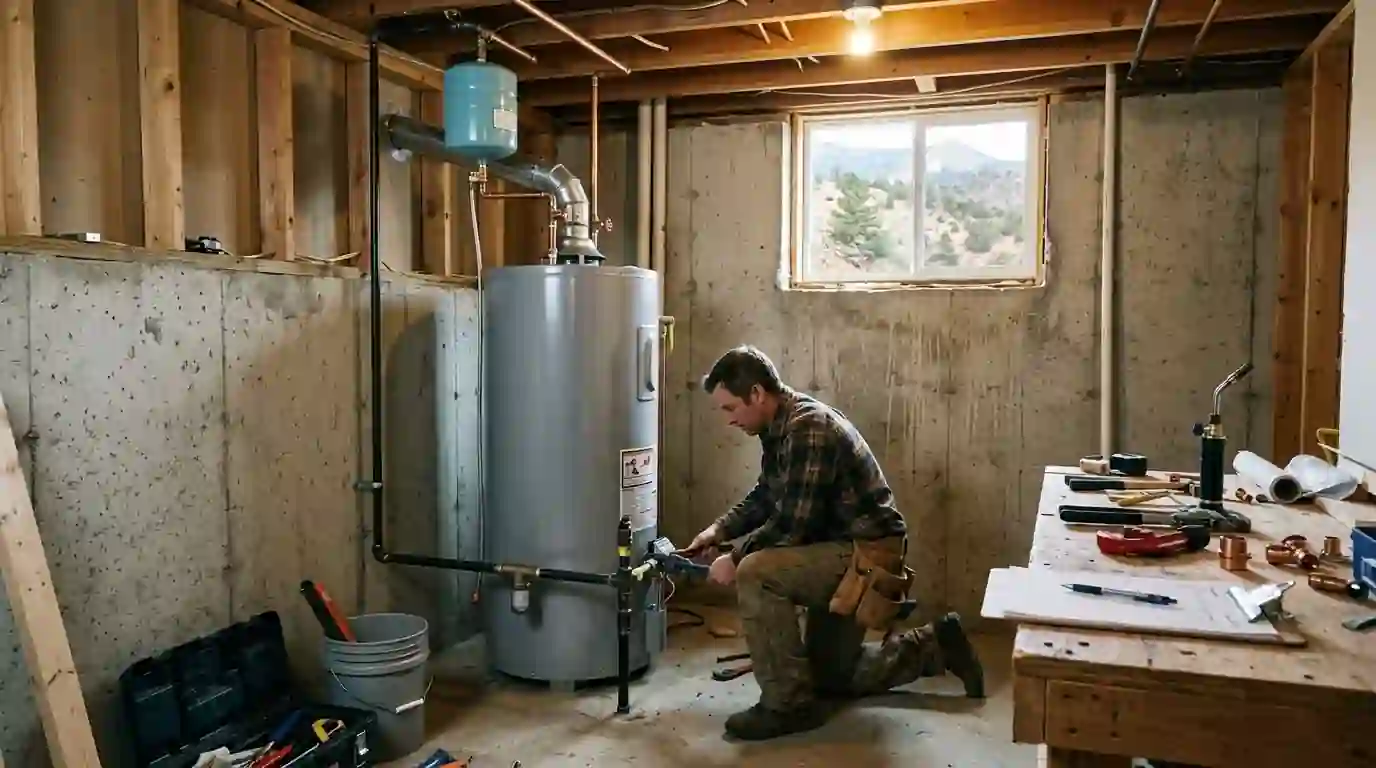
The heater is usually the biggest single item. A gas tank costs more than an electric tank of the same size, and a 50 gallon model costs more than a 40. Most of the replacements we price here are gas tanks in a basement, utility closet or garage, which fits a housing stock where the median home was built in 1990. Many of those houses are on their second or third heater.
Bigger is not automatically better. An oversized tank burns gas all day keeping water hot that nobody uses. Size the new heater by how many showers run back to back on a busy morning and whether a large soaking tub gets filled, not by the label on the old tank. Rheem, A. O. Smith and Bradford White all build tanks that work well in this climate when the gas pressure, venting and burner are set up correctly, so the install matters more than the logo.
Why a 6,035 foot elevation shows up on the estimate
Colorado Springs sits at 6,035 feet. A water heater technical service bulletin notes that altitude affects gas water heaters from about 2,000 feet up, and that the main burner orifice must be reduced by four percent for every 1,000 feet. By that rule a heater here needs an orifice roughly 24 percent smaller than the sea-level setup. A burner that gets too much gas for the thin air runs rich, soots the flue and can trip its own safety controls.
Some manufacturers ship high-altitude versions; others rely on the installer to confirm the setup. Either way, someone has to check the rating plate, watch the flame and confirm the draft before walking away, and that time belongs on an honest estimate. Our guide to setting up water heaters at altitude explains the burner and venting side in more detail.

Rather have a plumber look at it?
Call any hour. A person answers.
The parts that separate a complete estimate from a lowball
A low number often means one of these items was left off and will come back later as a change order. A complete estimate names each one, or says plainly why your house does not need it:
- Expansion tank, needed when a check valve or pressure reducing valve closes the system
- New gas flex connector and a sediment trap ahead of the gas valve
- Relief valve discharge pipe run full size to a safe spot near the floor
- Vent connector checked for slope, fit and corrosion, replaced if needed
- Drain pan with a drain line where a leak would reach finished space
- Removal and disposal of the old tank
When a repair is the smarter spend
Not every cold shower means a new heater. HomeServe lists an average water heater repair in Colorado at $334, and HomeGuide's national range for tank repairs is $150 to $700. A failed thermocouple, flame sensor, gas valve, electric element or thermostat is a repair. So is a leaking drain valve. A leak from the tank body itself is not: once the steel shell rusts through, the only fix is a new heater, and our water heater repair visits start by telling you which of the two you have.
Water quality changes the math a little. Utility data puts Colorado Springs tap water at 2.1 grains per gallon, which is classed as soft, compared with 8.1 in Pueblo. City tanks build less scale than tanks on hard water, but sediment still settles and the anode rod still wears away, so a yearly flush and anode check keeps an older tank in service longer.
Tank, tankless or heat pump: how the price changes
Switching types costs more than swapping like for like. ConsumerAffairs lists tankless installation in Colorado Springs at $3,000 to $6,500, mostly because a conversion usually needs a larger gas line and new venting. HomeGuide puts a heat pump water heater at $2,000 to $4,600 installed, and that type needs room for air around the unit plus a condensate drain. A tankless conversion can make sense for a household that runs long, steady draws; our tank versus tankless comparison covers who benefits.
Questions to ask before you approve a water heater estimate
Use these to compare two estimates on equal terms. If a plumber cannot answer them on the spot, that tells you something too. When you are ready for a water heater replacement, we answer the phone 24/7 and walk through the same list with you before any work starts.
- What size and fuel type, and why that size for this household?
- Is the model listed for this altitude, or will the burner be converted?
- Is an expansion tank included, and at what pre-charge?
- Does the vent connector, gas line or relief valve piping need changing?
- Is haul-away of the old tank included?
FAQ
Questions readers ask
When a pressure reducing valve or a check valve at the meter closes the system, heated water has nowhere to expand. Pressure spikes every heating cycle, which strains the relief valve, faucets and toilet fill valves. The expansion tank absorbs that growth. Older installs often skipped it; a correct new install sizes it and sets its pre-charge to match house pressure.
Sometimes slightly, depending on the brand. Some models are built for altitude, others take a conversion kit or an orifice change. The bigger cost is skipping it: a heater burning rich at 6,035 feet soots its flue, loses efficiency and tends to shut itself down, which turns into repair visits later.
Not really. ConsumerAffairs puts local tank installs at $1,400 to $3,000, which sits inside HomeGuide's national $600 to $3,100 range. The national low end includes small electric tanks with no extra parts. Most gas jobs here need a flex connector, sediment trap and altitude check, which lifts the starting point.
Usually, if there is physical room and the vent and gas line suit the new burner input. A taller or wider tank can mean moving the water connections and redoing the vent connector. We measure the space and read the new rating plate against the existing piping before calling it a straight swap.
A leak from the shell only grows, and some fail all at once. Shut off the cold supply valve above the heater, turn the gas control to off or switch off the breaker, and put a pan or towels down. A small drain valve drip can wait for a repair; a rusted-through tank should be replaced soon.
It is drained, disconnected and hauled out as part of the job. Ask any plumber whether removal is in the price, because it is one of the line items that differs between estimates. Steel tanks are heavy and awkward on basement stairs, so removal is real labor, not a formality.
Related