Hot water recirculation pumps for Colorado Springs homes
If you run the shower for a minute before it warms up, a recirculation pump keeps hot water close to the tap. We fit the pump to your piping.
- We answer 24/7
- Crossover valve or return line
- Timer and button controls
Updated October 2026Phones answered 24/7
Want a price on this job?
Call and describe the job. We answer 24/7 and set a visit.
Quick answer
A hot water recirculation pump in a Colorado Springs home moves cooled water out of the hot line so the far tap runs hot in seconds instead of after a long wait. Which kind fits depends on one thing: whether a dedicated return pipe runs back to the heater. Most homes lack one.
Why the far bathroom takes so long to run hot
Hot water in a pipe starts cooling the moment the tap closes. Next time, everything between heater and faucet runs out before hot arrives, and the longer and wider that run, the longer you wait. A recirculation pump keeps the pipe primed, either on a schedule, when the loop cools, or when someone presses a button.
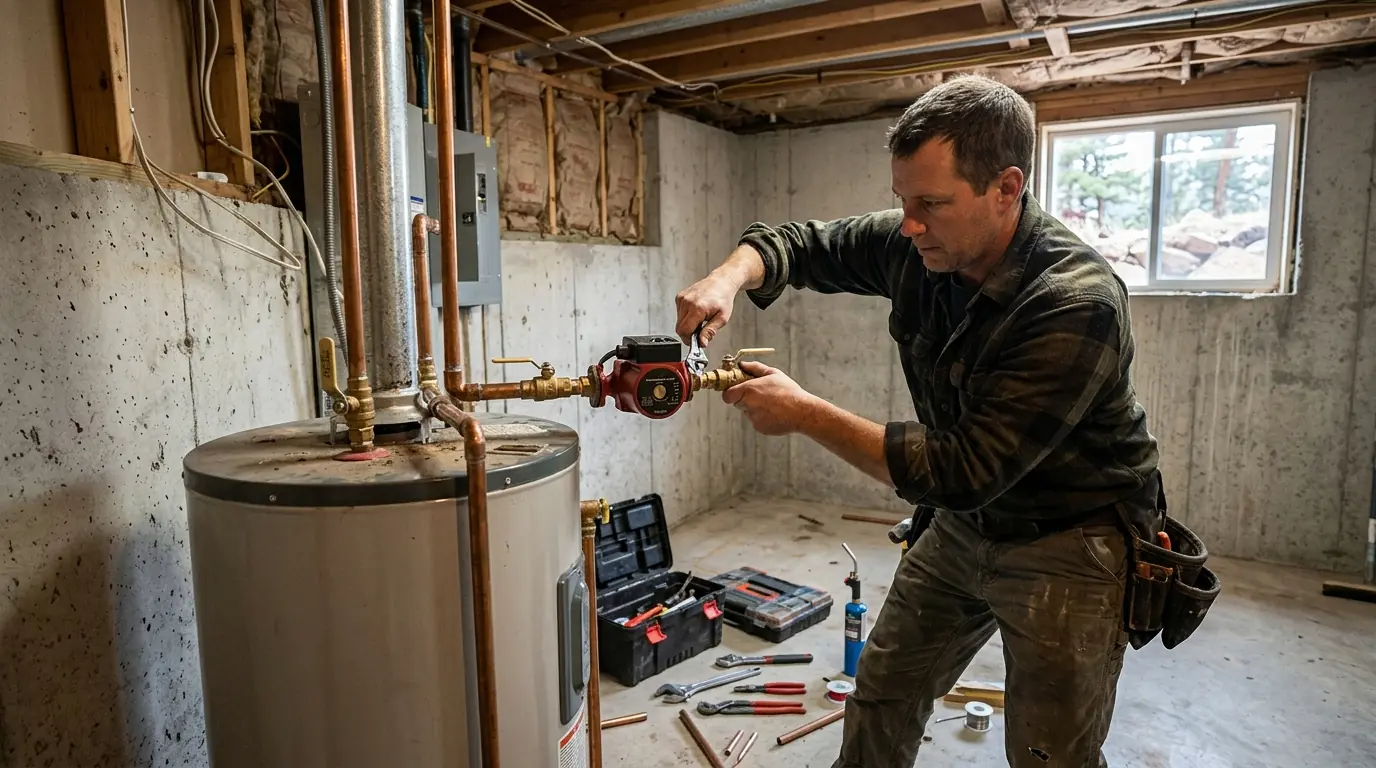
The job is really about the loop. Water has to get back to the heater, through a dedicated return or by borrowing the cold line at the farthest fixture, and each path trades comfort, energy and wall openings. Some gas tankless heaters have a pump built in, so if yours is due anyway, a tankless unit with built-in recirculation can solve both problems at once.
Cost
What goes into the price of a recirculation setup
We know of no published cost survey for recirculation pumps worth quoting. A retrofit is mostly labor plus the pump and valve, so labor figures are the useful benchmark. A new return line is priced after we see the route.
What moves the price
- Crossover valve retrofit or a true return loop
- Timer, aquastat or on-demand control
- Outlets near the heater and the far sink
- Length of hot line that needs insulation
- Wall and ceiling access for a new return
Ranges are published market figures for planning, not a quote. We price your job after we see it.
Your options
Crossover valve or a dedicated return line?
Both deliver faster hot water. They differ in what you give up.
| Under-sink crossover valve | Dedicated return line | |
|---|---|---|
| New pipe needed | None | A return run back to the heater |
| Cold tap at the far sink | Runs warm briefly | Stays cold |
| Best time to install | Any time | During a remodel or repipe |
| Coverage | Fixtures on that hot line | Every fixture on the loop |
Under-sink recirculation valves
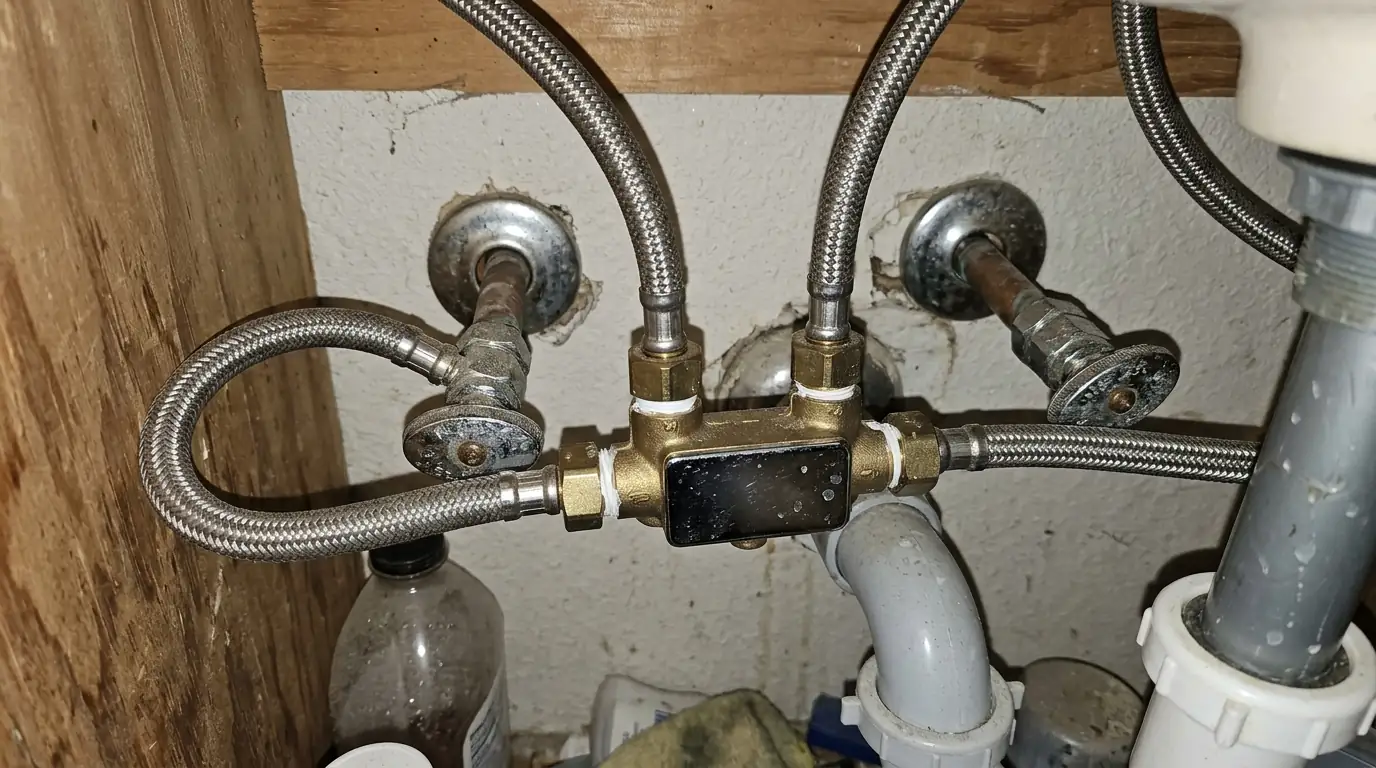
This is the retrofit most homes get. A pump mounts at the water heater and a thermostatic crossover valve goes under the sink farthest from it. When the hot side cools, the valve lets that water bleed into the cold line and back to the heater, so no new pipe is needed. The tradeoff is the cold tap at that sink, which runs lukewarm for a few seconds after the pump cycles. We put the valve where the wait is worst and test both taps before leaving.
Dedicated return lines
Some houses already have a third pipe at the heater that nobody connected, or a pump that died years ago. If that return exists, a pump, check valve and isolation valves give the best result: hot at every fixture on the loop and a cold tap that stays cold. Where there is no return, the time to add one is while walls are open for a remodel or a repipe, since running new PEX through finished drywall gets expensive. We insulate the loop so the pump is not reheating bare pipe.
Timers and on-demand controls
A pump running around the clock wastes the most energy, both in heating and in heat lost through the pipe walls. A timer limits it to mornings and evenings. An aquastat shuts the pump off once the return reaches temperature. On-demand controls go furthest: a push button, motion sensor or app starts the pump only when someone is about to use water, and it stops once hot arrives. Most families do well with a timer plus an aquastat, and a button at the primary bath for irregular schedules.
Local conditions
Long runs and cold walls in Colorado Springs houses
In plenty of Colorado Springs houses the water heater sits in a basement or garage at one end and the primary bath is at the other. Hot lines that pass through a garage ceiling, a crawlspace or an outside wall shed heat fast in winter, so the wait gets longest just when the house is coldest. Insulating those runs is the first thing we look at, before deciding how long the pump needs to run.
Do it yourself?
What you can adjust yourself and where we come in
Pump kits are sold for homeowners, and parts of the job are fair to try.
| Task | Homeowner | Plumber |
|---|---|---|
| Timer settings | Set run windows to your mornings and evenings | Add an aquastat or button if the schedule keeps changing |
| Warm cold tap | Note how long it stays warm after the pump runs | Adjust or replace the crossover valve |
| Mounting the pump | Plug-in kits on accessible lines | Pump with isolation and check valves on the heater or return |
| Insulating hot lines | Foam sleeves on exposed basement runs | Runs in garages, crawlspaces and ceilings |
How the job runs
How we set up a recirculation loop
Time the wait
We run the farthest fixture and time it, so the result can be measured.
Trace the hot line
Where the run goes and whether a return already exists.
Pick the loop
Crossover valve at the far sink, or pump and check valve on a dedicated return.
Mount the pump
Isolation valves on both sides, so it can be changed later without draining.
Set the control
Timer windows, aquastat or button, matched to your household.
Retest every tap
We rerun the far fixture and check the cold side at the crossover.
Brands we service
We install Watts pumps and crossover valves, Uponor PEX for return lines, and set up the built-in pumps on Navien and Rinnai tankless units.
- Rheem
- A. O. Smith
- Bradford White
- Navien
- Rinnai
- Noritz
- Moen
- Delta
- Kohler
- American Standard
- InSinkErator
- Uponor
- Watts
- Zurn
FAQ
Questions about getting hot water to the tap faster
It saves the water you used to run down the drain while waiting, and costs some energy, because the warm pipe loses heat. A timer, aquastat or button keeps that loss small, and insulating the hot line helps most.
That is the crossover valve at work. It sends cooled hot water back through the cold line, so that cold tap runs lukewarm for a few seconds. A lower valve setpoint reduces it, and a dedicated return avoids it.
Yes, with care. Tankless units need a minimum flow to fire, and some limit how a pump may cycle them. Several Navien and Rinnai models have recirculation built in, and we follow what the heater manual allows.
A crossover valve at the farthest fixture speeds every tap along that same hot line, while branches that split off elsewhere may still wait. A full return loop covers each fixture tied into it.
Small circulators are close to silent once air is purged. Ticking or grinding usually means air or a worn cartridge. We bleed the line at startup and mount the pump so it does not hum through a joist.
Related services

