Water softeners for wells and hard-water towns around Colorado Springs
City water in Colorado Springs tests soft, and we will tell you so before selling anything. On a private well or a harder town supply, we size, plumb and repair softeners with a proper bypass and drain.
- Phones answered 24/7
- Hardness test before sizing
- Bypass and drain set up right
Updated October 2026Phones answered 24/7
Want a price on this job?
Call and describe the job. We answer 24/7 and set a visit.
Quick answer
A water softener in Colorado Springs city limits rarely earns its keep: utility data puts city tap water at 2.1 grains per gallon, which is classed as soft. Softeners make sense on private wells and in towns with harder supply, such as Pueblo at 8.1 grains. We test first, then size the unit to hardness and household use.
When a softener is worth installing, and when it is not
A softener trades calcium and magnesium for sodium or potassium as water passes through a tank of resin beads, then backwashes and recharges from a brine tank. The payoff is less scale in water heaters, tankless heat exchangers, faucet cartridges and dishwashers. If the water reaching the house is already soft, most of that payoff disappears and the salt and regeneration water become pure cost.
So we test hardness at the tap first. On a well we also look for iron and sediment, which foul resin and call for a sediment or iron stage ahead of the softener. If the complaint is chlorine taste or odor, a softener will not touch it.
Where hardness is real, a softener stretches the time between tankless descaling visits and keeps scale out of faucet cartridges. Our guide on whether you need a softener walks through the decision.
Cost
Softener installation price ranges
Capacity, valve type and how much plumbing has to change move the price most; a well setup with prefiltration costs more than a like-for-like swap. Published ranges below, not our price.
What moves the price
- Grain capacity sized to hardness and use
- Metered valve vs timer valve
- Iron or sediment prefiltration on a well
- New bypass loop and piping changes
- Drain and overflow routing
- Outlet near the unit for the control valve
Ranges are published market figures for planning, not a quote. We price your job after we see it.
Your options
Salt-based softener or salt-free conditioner?
Both get pitched for hard water. They do different things.
| Ion-exchange softener | Salt-free conditioner | |
|---|---|---|
| What it does | Removes calcium and magnesium | Changes how scale forms; minerals stay |
| Soft-feeling water | Yes | No |
| Salt and drain needed | Yes, brine tank and drain | No |
| Best fit | Measured hard water, especially wells | Moderate hardness where salt or a drain is a problem |
Softener installs on well or hard water
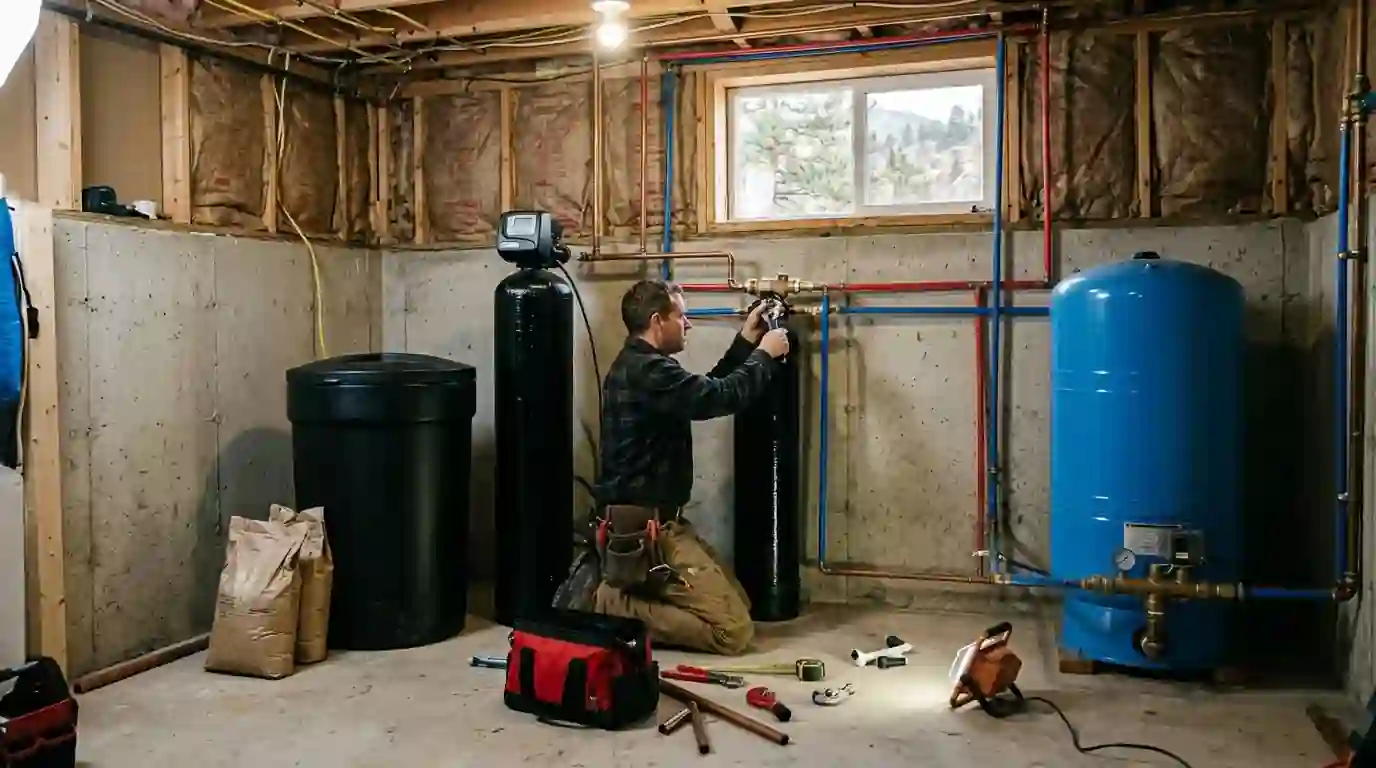
Sizing starts with arithmetic: grains of hardness times gallons used per day gives the grain capacity the resin has to handle between regenerations. We favor a metered, demand-initiated valve over a clock timer, so the unit regenerates only after the water has been used. On a well, the softener goes after the pressure tank and any sediment filter, before the water heater. Many owners leave the outside hose bibs on unsoftened water, since the lawn does not need it.
Bypass and drain line setup
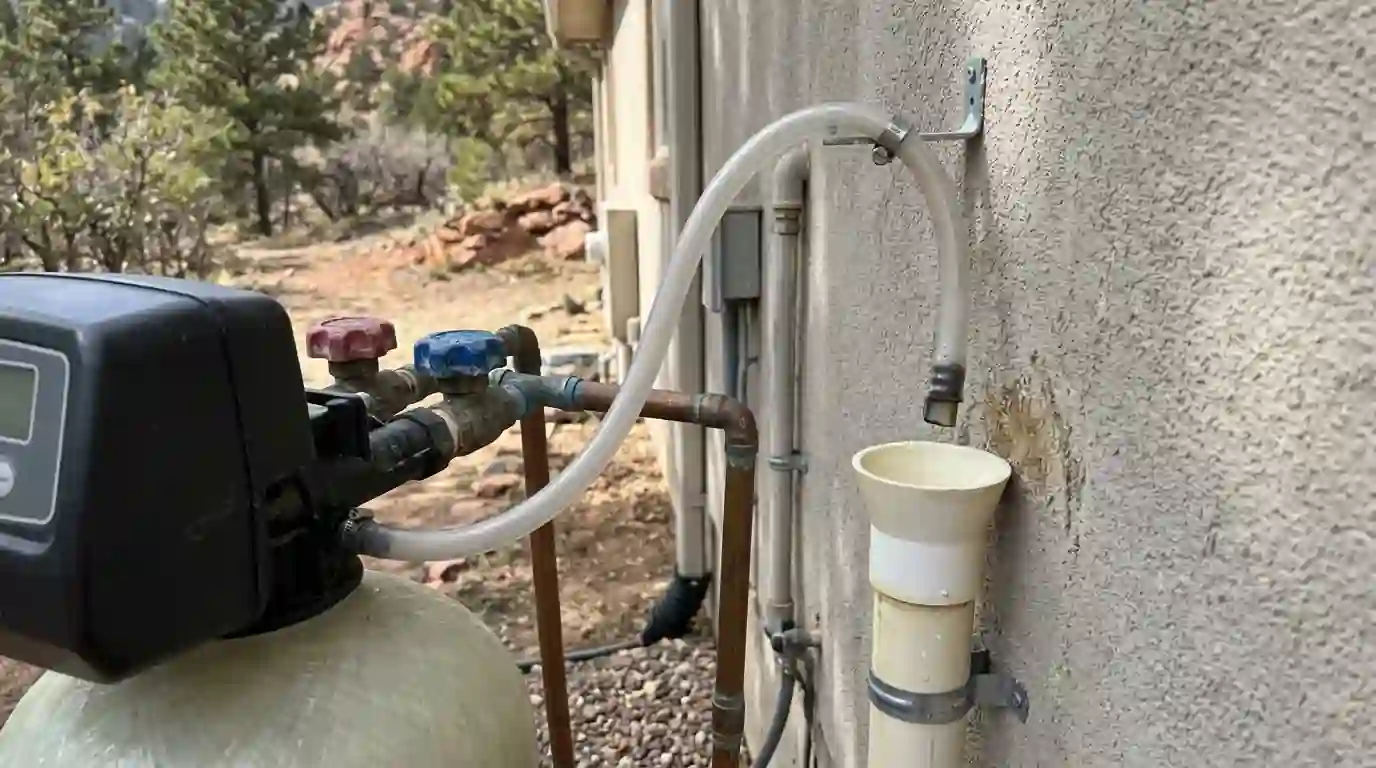
Every install gets a bypass, either the valve's built-in one or a three-valve loop, so the softener can be isolated for repairs without shutting off the house. The regeneration drain runs to a floor drain, laundry standpipe or similar receptor with an air gap, never solid-piped into a drain where sewage could back into the resin. The brine tank overflow gets its own line. In a garage or crawlspace, we keep both drains away from spots that freeze.
Resin and valve repairs
The signs: hard water spots return, salt never goes down, the brine tank fills with water, or the unit drains nonstop. Causes range from a salt bridge crusted over the brine, to a clogged injector or venturi, to worn piston seals and spacers in the control valve, to a stuck drive motor. Resin itself wears out, and tiny amber beads in faucet aerators mean the distributor tube has cracked. We rebuild the valve or replace resin depending on what the test run shows.
Local conditions
Soft city water, harder water down the road
Utility-reported data puts Colorado Springs tap water at 35.8 mg/L, or 2.1 grains per gallon, which is classed as soft. The same reports rate Pueblo hard at 139.0 mg/L (8.1 grains per gallon), and county estimates put Fountain at 140.0 mg/L (8.2 grains). That spread is why one address needs a softener and the next one does not. We check which supply reaches your meter, or test the well, before talking equipment.
Do it yourself?
Softener upkeep you can handle
Many softener calls start with something an owner can catch early.
| Task | Homeowner | Plumber |
|---|---|---|
| Salt level | Keep salt a few inches above the water line | Check the brine draw if salt never drops |
| Salt bridge | Break the crust with a broom handle | Clean the brine tank and well |
| Leak at the head | Turn the bypass | Replace O-rings or the valve |
| Blank display after an outage | Check the outlet and reset the clock | Replace the transformer, board or motor |
How the job runs
From hardness test to first regeneration
Test the water
Hardness at the tap, plus iron and sediment on a well.
Size and place it
Capacity from hardness and use; location after the pressure tank, before the heater.
Plumb the bypass
Built-in or three-valve loop so the unit can be isolated.
Run the drains
Regeneration drain with an air gap, separate overflow line.
Program and flush
Hardness and regeneration time set, then a manual cycle to prove it.
Brands we service
We install and repair softeners from A. O. Smith, Rheem and Watts, and service the bypass valves and drain fittings on other common makes.
- Rheem
- A. O. Smith
- Bradford White
- Navien
- Rinnai
- Noritz
- Moen
- Delta
- Kohler
- American Standard
- InSinkErator
- Uponor
- Watts
- Zurn
FAQ
Softener questions, answered straight
Not necessarily. Colorado Springs city water tests soft, so in town a softener usually adds cost without much benefit. If you are on a well or a harder town supply, the answer can change. A hardness test settles it.
Softening adds a small amount of sodium. Owners who want to avoid it often leave one cold kitchen line unsoftened or add a reverse osmosis faucet for drinking water.
Both regenerate the resin. Potassium costs more and may need a higher dose setting to do the same job, but it keeps added sodium out of the water.
Usually a clogged injector, a stuck brine valve or a kinked drain line, so the unit fills the tank but cannot draw the brine back out. It needs a service visit, not more salt.
No. A properly sized softener causes little pressure loss. Low pressure on a well points to the pressure switch or tank; in town, to the PRV or old piping.
Related services

