Where our plumbers work across the Pikes Peak region
Colorado Springs first, then the towns and counties around it. Each place gets its own page because plumbing really does change from the Old North End to Black Forest.
- 28 area pages
- 3 counties
- Phones answered 24/7
Not sure we cover you?
Call and tell us where you are. We will say yes or no on the spot.
Regions
How the coverage breaks down
Four regions, each with its own mix of housing, water source and winter exposure.
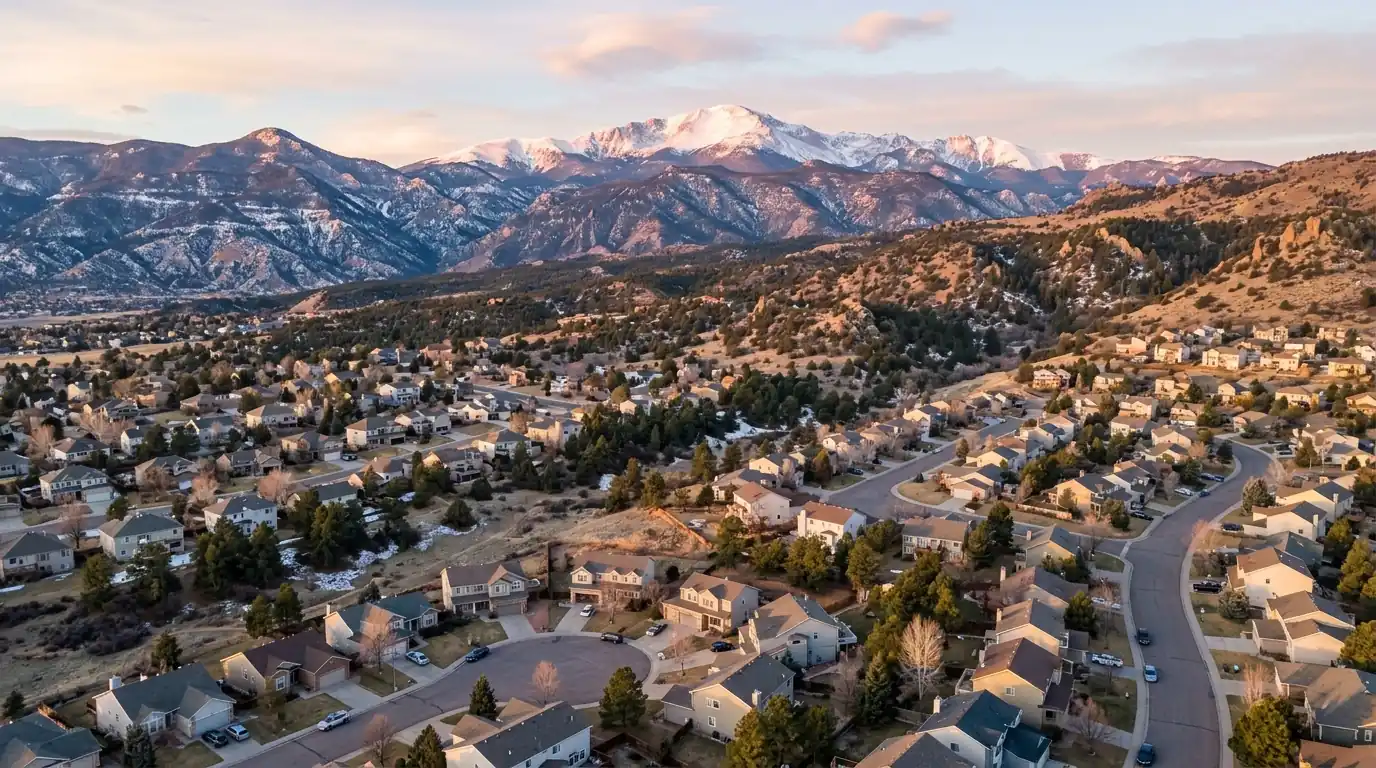
Colorado Springs, all of it
The city is home base. Older streets in the Old North End and Knob Hill bring galvanized pipe and clay sewer laterals; newer north and east side tracts like Briargate and Flying Horse bring builder-grade water heaters reaching replacement age. The citywide page covers what every part of the city shares: altitude, freezes, soft water and owner-responsibility rules for service lines.
North along I-25 and the Palmer Divide
Monument, Woodmoor and Palmer Lake sit higher and colder than the city, and Black Forest and Falcon to the east lean on private wells and septic, so well pumps, pressure tanks and freeze calls make up more of the work up there.
South toward Fountain and Pueblo
Security-Widefield and Fountain are close to the city line and have their own water history, including the PFAS findings that changed how those water districts supply homes. Farther south, Pueblo and Pueblo West run on harder water, which changes how fast tanks scale and whether a softener makes sense.
West and up the pass
Manitou Springs has one of the region's larger historic districts and the old plumbing that comes with it. Woodland Park in Teller County is colder again, and frozen lines there are a winter routine.
Area pages
Find your area
Colorado Springs neighborhoods
Colorado Springs, citywide
From Old North End houses to Flying Horse tract homes, we fix leaks, drains, water heaters and yard lines across Colorado Springs, with the altitude, the cold and city code in mind. Phones are answered 24/7.
Pulpit Rock & Austin Bluffs
Most houses around Pulpit Rock, Cottonwood Creek and Dublin went up in the late 1980s, so the original plumbing is reaching the age where one failure tends to bring two more. We answer the phone 24/7.
Broadmoor & Cheyenne Mountain
The Broadmoor area was laid out in large lots well over a century ago, and that shape still drives the plumbing: long service lines, long sewer runs, and a ZIP split between two water providers.
Briargate
Briargate and Pine Creek look uniform from the street, but the plumbing behind the drywall spans four decades. Knowing which decade your house came from tells us where a leak is most likely to start.
Rockrimmon & Mountain Shadows
On the same Mountain Shadows block you can find a 1980s original and a house rebuilt after the 2012 fire. They share a street and a water main, and almost nothing behind the walls.
Knob Hill
Knob Hill houses from the early 1960s were plumbed with the materials of their day. Sixty-odd years on, galvanized supply, cast iron drains and old sewer laterals are where most of the bigger calls here start.
Stetson Ridge & Ridgeview
Stetson Ridge, Ridgeview, Old Farm and Wagon Trails are newer tract neighborhoods. The plumbing is modern, but it all started its clock in the same few years, and it is reaching the same milestones together.
Deerfield Hills
Deerfield Hills is a southeast neighborhood with a median home age near 33 years and close to half its households renting. The calls are practical: a slow drain, a running toilet, a leak under a sink, a main line that backed up.
Stetson Hills & Springs Ranch
Homes in Stetson Hills and Springs Ranch date mostly from around the turn of the century. Twenty-odd years in, owners are finishing lower levels, replacing first water heaters and finding valves nobody has turned since closing.
Village Seven
Much of Village Seven was built around the 1970s and early 1980s, and its sewer laterals have spent four decades in Front Range clay. When a basement drain backs up here, the cause is often outside the foundation.
Flying Horse & Northgate
Flying Horse and Northgate are newer planned neighborhoods inside the city. Gleneagle, in the same ZIP just outside city limits, draws its water from a different source. That one difference shapes how we set up heaters and treatment.
Old North End & Patty Jewett
The Old North End holds some of the oldest houses in the city, with listings from 1898, 1909, 1924 and 1926. Patty Jewett adds bungalows and mid-century homes. Each era hides a different kind of pipe.
Pikes Peak Park
Along South Circle Drive and Chelton Road, most houses were built in the 1970s and early 1980s. Close to half a century on, valves, supply lines and water heaters are the parts that give out first.
Towns around the city
Pueblo
Pueblo Water mailed 22,000 letters telling customers their service line material is unknown and could be lead. We help Pueblo homeowners find out what is in the ground, and deal with water hard enough to scale everything it touches.
Security-Widefield
Security-Widefield is about 12 miles south of downtown Colorado Springs, with 38,639 residents and 87.2 percent owner-occupied homes. Many were built in the mid-1980s, and the water history here still shapes what homeowners ask us.
Pueblo West
Pueblo West is about 41 miles south of downtown Colorado Springs, with 33,086 residents on Pueblo West Metropolitan District water. That water is harder than Pueblo's and nearly five times the Colorado Springs figure, and it shows in every heater and faucet.
Fountain
Fountain is about 14 miles south of downtown Colorado Springs, with roughly 29,800 residents and a median home built in 1995. Its water changes character twice a year, and the plumbing feels it.
Falcon
Falcon sits about 15 miles from downtown Colorado Springs, out east on the plains, with roughly 23,000 people and far more owners than renters. Most homes run on metropolitan district water drawn largely from wells.
Cimarron Hills
Cimarron Hills sits about 8.5 miles east of downtown Colorado Springs, an unincorporated community of 19,311 people with its own water and sewer district. The median home here was built in 1996.
Black Forest
Black Forest is about 25 miles north of downtown Colorado Springs, a wooded area of 15,097 people where homes draw water from private wells. More than 91 percent of homes here are owner-occupied.
Monument
Monument is about 20 miles north of downtown Colorado Springs, a town of roughly 13,800 people with a median home built in 2002. Its water comes mostly from deep wells, and it is hard.
Woodmoor
Woodmoor is about 21 miles north of downtown Colorado Springs, an unincorporated community of about 9,500 people at 7,294 feet. Most homes date from the 1990s and run on Woodmoor Water and Sanitation District water.
Woodland Park
Woodland Park is about 19 miles west of downtown Colorado Springs and roughly 2,450 feet higher. Its 8,000 residents live with thinner air, deeper cold and harder water than the city below.
Manitou Springs
Manitou Springs sits about 6.6 miles west of downtown Colorado Springs, a town of 4,858 people that grew as a resort in the late 1800s and early 1900s. Old houses here need plumbers who expect surprises in the walls.
Palmer Lake
Palmer Lake is a town of about 2,600 people roughly 24 miles north of downtown Colorado Springs, set below the mountains that feed its water. Small town, high elevation, and its own water system.
Counties
El Paso County
El Paso County holds about 757,000 people on a patchwork of city utilities, special districts, private wells and septic systems. We work across that mix, from Colorado Springs out to Fountain, Falcon, Black Forest and Monument.
Pueblo County
Pueblo County sits about 43 miles south of downtown Colorado Springs, with harder water and a slightly longer frost-free season. We cover Pueblo and Pueblo West, the county's two main communities.
Teller County
Teller County homes sit higher and colder than anything in Colorado Springs, and 81 percent of them are owner-occupied. We cover Woodland Park and Divide, west of the city.
Where coverage ends
Where coverage ends: we do not take regular work in Cañon City, Florence or Penrose in Fremont County, or north into Castle Rock and Parker in Douglas County. If you are on the edge of the map, call and ask; we will tell you straight whether we can get there.
FAQ
Questions about where we work
Pricing depends on the job, not the zip of the house, but travel time is part of how any plumber prices a visit far from the city. Ask on the phone and we will tell you before anyone drives out.
Yes. Well pumps, pressure tanks and switches, and the filtration that often goes with a well are regular work for us in the county's well areas.
Yes, and winter is when most Woodland Park calls happen. Frozen and split lines are the common ones, so tell us whether water is still running when you call.
Pueblo is about 48 minutes south of downtown Colorado Springs on I-25 when traffic is moving. Call any hour; we will be honest about timing so you can decide.

Tell us where you are
Call any hour and a person answers.
American Plumbing Service service area, Colorado Springs, CO
Map loads only when you ask for it.
