Gas line repair for Colorado Springs homes
When a fitting weeps or a line takes a hit, we isolate the branch, find the exact joint, repair it with matching parts and hold a pressure test before anything is relit.
- Phones answered 24/7
- Black iron and CSST
- Pressure test before relighting
Updated October 2026Phones answered 24/7
Water running right now?
Close the main shut-off, then call. A person answers 24/7.
Quick answer
Gas line repair in Colorado Springs starts with one rule: if the smell is strong, leave the house and call the gas utility or 911 from outside. Once the area is safe, we pinpoint the leaking joint, repair it, and hold the line on a test gauge before any pilot is relit.
Warning signs
Signs a gas line needs attention now
Rotten-egg smell at one appliance
Strongest behind the range, dryer or water heater, often after it moves or runs.
Hissing at a fitting
Audible gas is a real leak; leave and call.
Bubbles in a puddle over a buried line
Escaping gas shows up when the ground is wet.
A dead strip of grass
Grass dying in a line across the lawn can trace a leaking buried pipe.
What actually leaks on a household gas line
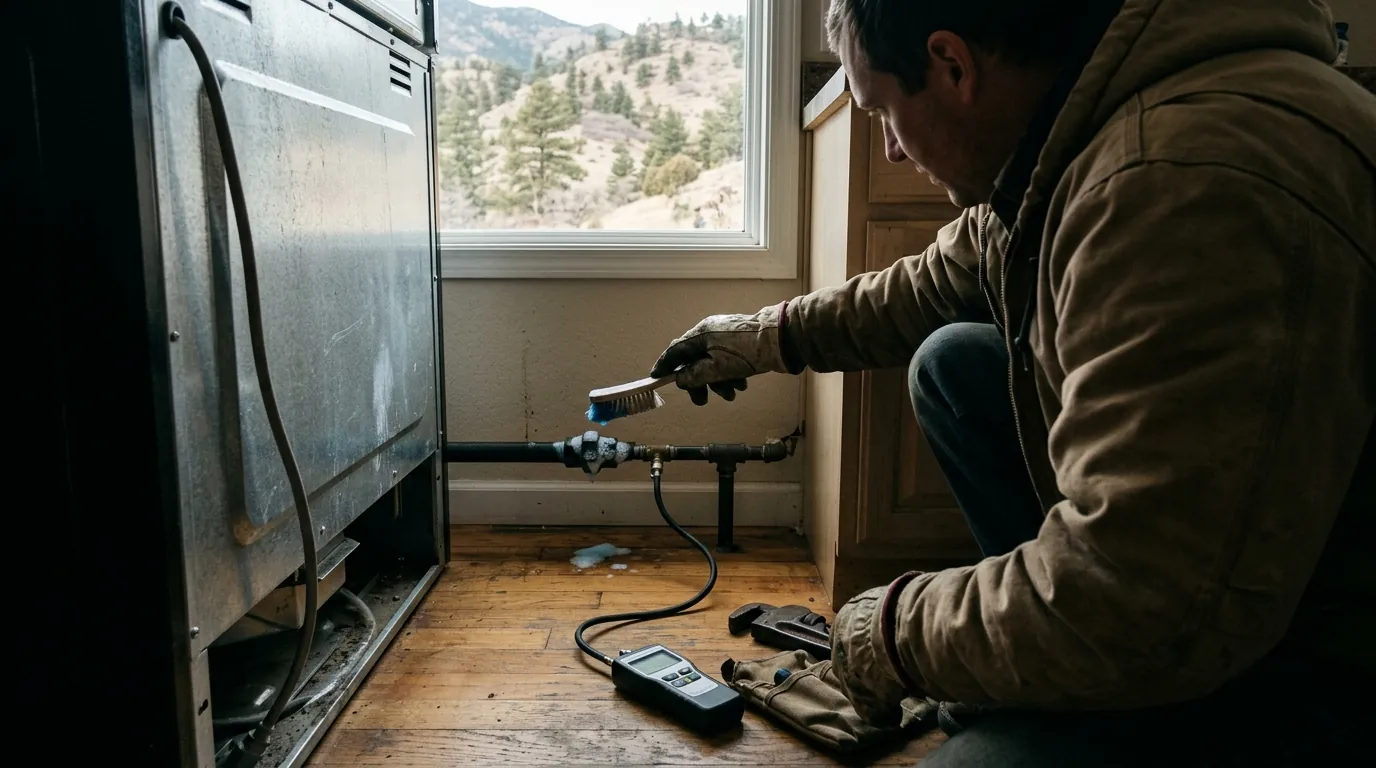
Most leaks are not in the middle of a pipe. They sit at joints: a black iron union that loosened when a dryer got shoved back, a flare nut on an aging appliance connector, a gas cock with dried packing, or the brass fitting where yellow CSST meets its manifold. Leak solution or an electronic detector finds the bleeding joint; a manometer on a test port tells us whether it was the only one.
Repairs match what is already there. On black iron we cut back to clean threads and make up new fittings with gas-rated sealant. On CSST we use the same manufacturer's pipe and fittings, because flexible gas pipe brands do not mix. If a new appliance is going in anyway, that becomes a properly sized new branch instead of a patch.
Not every gas smell is a piping leak. Odor only when the water heater lights can be a lazy pilot or delayed ignition, a water heater repair instead.
How the job runs
From the first call to relit pilots
Make it safe
Strong smell: you leave and call the utility or 911 first; we work once the area is cleared.
Isolate the branch
We close the right valve and confirm on a gauge which section loses pressure.
Find the joint
Leak solution and a detector on every fitting in the suspect run.
Repair with matching parts
New iron fittings, the same CSST system, or coated pipe at masonry and soil.
Test, purge, relight
No drop on the gauge, then air bled out, pilots relit and every flame checked.
Leaking gas fittings
The usual report is a faint rotten-egg smell behind the stove or dryer, strongest right after the appliance moves or runs. We close that appliance's shutoff and test every joint from the branch tee to the appliance inlet. Loose unions get remade, not cranked tighter. Cracked flares get cut out. Old uncoated brass connectors, the thin gold-colored kind with no plastic jacket, are replaced outright, because their flare joints are known to crack with age and movement.
Corroded or damaged lines
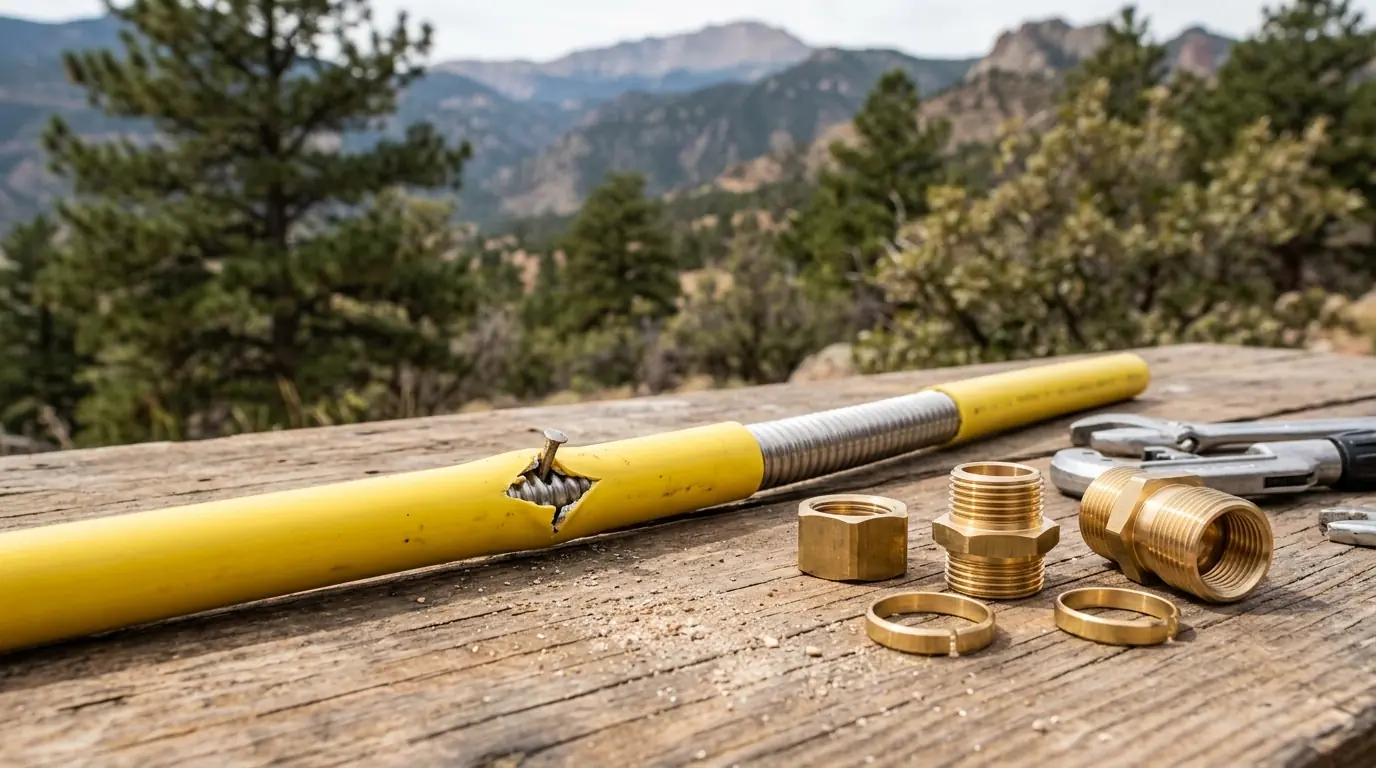
Damage turns up in predictable places. Black iron along a foundation rusts where soil or a sprinkler keeps it wet. A buried line to a grill or shop meets a shovel or a post auger. CSST takes a drywall screw during a remodel and leaks only inside the wall. We cut out the bad length, use coated pipe where the line passes masonry or soil, polyethylene with tracer wire for buried runs, and the maker's repair fittings on CSST.
HomeAdvisor lists $270 to $760 nationally for leaks in walls or crawl spaces, before any digging.
Pressure testing after repairs
A repaired joint is not done until the line proves it. We close off every appliance on the section, pressurize it with air through a test fitting and watch the gauge through the hold period. If the needle moves, leak solution goes back on every joint until we find why. Once it holds, we purge air at each appliance, relight, and watch the flames: steady blue with no lifting or yellow tips means gas is flowing as it should.
Local conditions
Gas piping in a Colorado Springs house
In Colorado Springs we work on both ends of residential gas piping. Older houses tend to carry threaded black iron, with fittings added one appliance at a time, while newer homes often run yellow CSST from a manifold near the meter. Iron fails at threads and wherever it rusts outdoors; CSST fails wherever a nail or sharp edge finds the jacket. We check the whole run, not only the joint you smelled.
Do it yourself?
What you can safely do before we arrive
Gas is one job where a do-it-yourself repair is the wrong move.
| Task | Homeowner | Plumber |
|---|---|---|
| Strong gas smell | Leave, then call the utility or 911 from outside | Find and repair the leak once it is safe |
| One appliance smells | Turn its valve handle across the pipe | Test what is still live and fix the joint |
| Tightening a fitting | Leave it; overtightening cracks flares | Remake the joint with new fittings |
| Relighting pilots | Wait until the leak is fixed | Purge the line, relight and check flames |
Cost
What gas leak repairs usually cost
Access sets the price more than parts do. A loose union behind a range is a short visit; a leak inside a finished wall means opening, repairing and patching. These are national reference points, not our price.
What moves the price
- Exposed, in a wall, in a crawlspace or buried
- Black iron, CSST or buried polyethylene
- How many joints fail the test
- Drywall, stucco or masonry to open and patch
- Old connectors to replace
Ranges are published market figures for planning, not a quote. We price your job after we see it.
FAQ
Gas leak questions we hear on the phone
No. Do not light burners or flip switches near a gas smell. A faint odor at one appliance usually means a fitting or connector, and closing its shutoff stops it; a strong or spreading smell means get out.
In general the utility handles the meter and the service pipe feeding it, and piping on the house side of the meter belongs to the owner. A leak at or before the meter is the utility's repair; from the first fitting after it to the appliances is ours.
Usually not. The damaged length is replaced with matching pipe and the manufacturer's own fittings. We read the jacket markings to identify the system before ordering parts, since brands cannot be mixed.
Makers of yellow CSST require bonding the gas piping to the home's electrical grounding, usually with a clamp near where gas enters. When we repair CSST we check for that clamp and tell you if it is missing.
Usually only the branch we are working on, so the furnace and water heater keep running. If the leak sits upstream of every branch, everything goes off and we relight each pilot before we finish.
Related services

