Leaking pipe repair for Colorado Springs homes
Most pipe leaks start small: green crust on copper, a drip at a crimp ring, a brown ring on the ceiling below a bathroom. We cut back to sound pipe, make a proper joint and test it before anything gets covered.
- Copper, PEX and CPVC
- Pressure tested before close-up
- Phones answered 24/7
Updated October 2026Phones answered 24/7
Water running right now?
Close the main shut-off, then call. A person answers 24/7.
Quick answer
Pipe leak repair in Colorado Springs is usually a one-joint job: we cut out a few inches either side of the leak and splice in new copper or PEX. The harder question is whether that leak is a one-off or the first of several pinholes in the same run, because that decides between a patch and a new section.
Warning signs
How a pipe leak announces itself
Green or white crust on copper
Corrosion and mineral deposits mark a slow weep.
Drip at a PEX ring
Usually a joint made off-gauge or under strain.
Ceiling stain that grows after showers
Points to a drain or wax ring rather than supply pipe.
Damp cabinet floor
Check the angle stops and compression nuts first.
Musty closet beside a bathroom
Water may be feeding the wall cavity.
Fix the joint, then ask why it leaked
A leak at one badly made fitting is one repair. A pinhole in the middle of a straight copper run is different: the wall has usually been thinning from the inside, and the next hole is often within a few feet. We look at the piece we cut out. If the bore is pitted or the wall is paper-thin, we say so and price the run rather than sell you a patch every few months.
We repair in the existing material or transition cleanly to PEX with proper fittings. Clamps and epoxy putty are for getting through one night. Where several runs have failed, repiping can cost less over time, and when the leak cannot be seen, we locate it first so the drywall opening is a single small square.
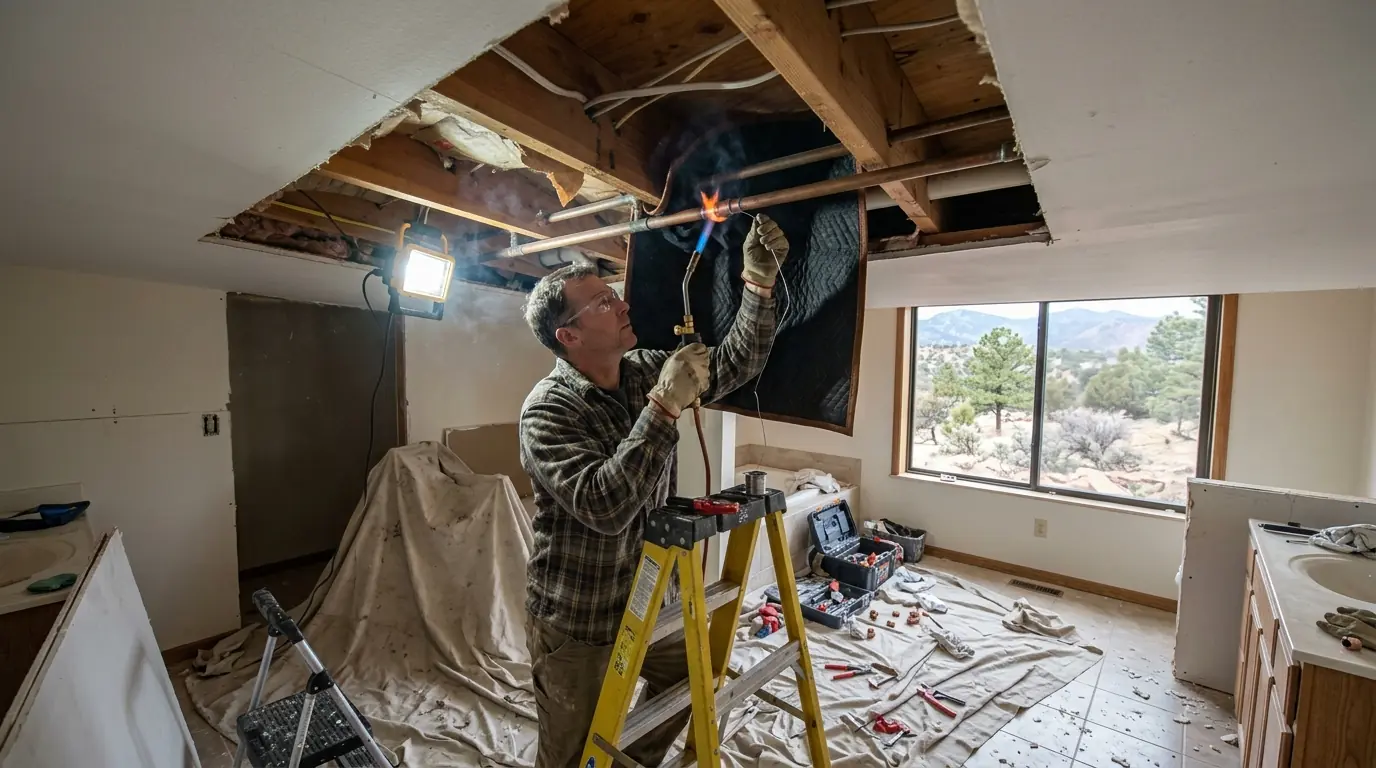
How the job runs
Our repair sequence for a leaking pipe
Shut and drain
We close the nearest working valve, or the main, and drain the line so we can cut dry.
Open only what is needed
One small, square opening at the leak, sized for the fitting tools.
Cut back to sound pipe
Enough comes out to get past thin or pitted wall, and we inspect it.
Make the joint
Soldered or press copper, or expansion or crimp PEX, matched to the system.
Pressure test
The joint is watched under full house pressure before the wall is closed.
Pinhole leaks in copper
The first sign is often a fine mist or a blue-green crust on the pipe, sometimes just a damp spot on drywall with no obvious source. Pinholes form from the inside out, driven by water chemistry, high velocity at elbows, leftover flux or stray electrical current on the piping. We cut out the affected length, fit new type L copper with soldered or press couplings, and split the old piece to look inside. One pinhole beside a fitting can be a local defect; several along a run means the pipe is wearing out.
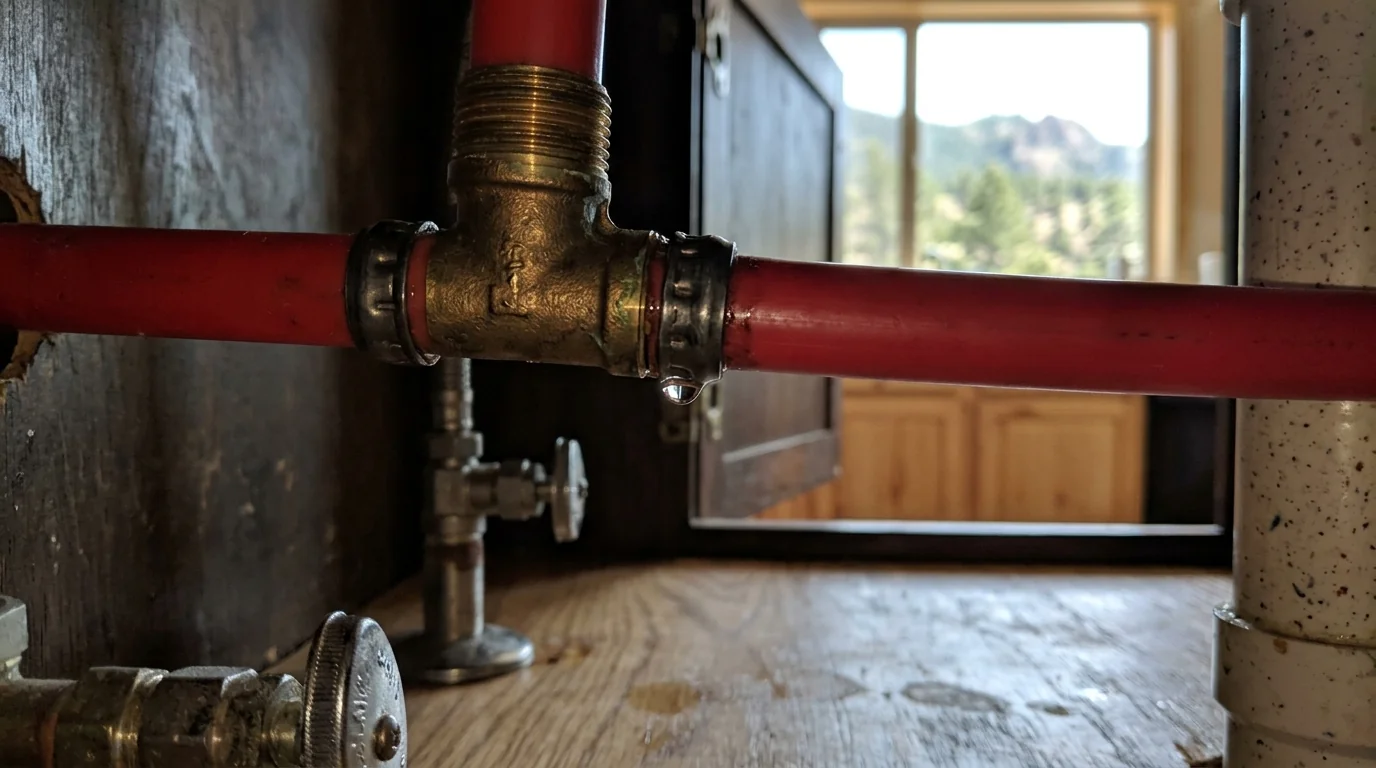
PEX fitting and crimp ring leaks
PEX tubing rarely fails in a house. The joints do: a copper crimp ring that was never squeezed fully, a ring set too close to the end of the barb, a plastic elbow cracked by a freeze, or a fitting stressed by tubing pulled tight against a stud. These show as a slow drip at one connection, often under a sink or at a manifold. We cut the joint out, remake it with the correct tool, check it with a go/no-go gauge, and look over neighboring joints made by the same hands.
Ceiling stains under a bathroom
A brown ring on the ceiling under a bathroom can come from a supply line, a drain joint, a failed wax ring under the toilet or water getting past shower grout. Supply leaks drip all the time; drain and wax ring leaks only show when the fixture is used. We run each fixture in turn while watching the stain, and open the ceiling only once we know which one it is. A toilet that rocks on the floor is a frequent culprit, handled under toilet repair.
Local conditions
Cold snaps find the weak joints first
Colorado Springs averages 5.2 nights a year below zero, and its record lows of 27 below came in 1919 and 1951. Those nights do more than freeze pipes solid. A copper run in an exterior wall with a thin spot, or a PEX fitting already under strain, expands and contracts hard as the temperature swings, and a slow weep can become a steady drip within days. After a deep cold spell, it is worth looking under sinks on outside walls even if nothing froze.
Your options
Patch the leak or replace the run?
The right answer depends on the pipe we cut out, not on the price of the first visit.
| Spot repair | Replace the run | |
|---|---|---|
| Best for | One failed joint or a lone pinhole | Several pinholes or a pitted bore |
| Opening needed | One small access hole | Several openings along the run |
| Risk afterward | Another leak nearby if the pipe is thin | Low on the new section |
| Material | Matches what is there | Often PEX, with transitions at each end |
Cost
Pipe leak repair costs, and what is left out
Published averages cover the plumbing only; patching and painting an opened wall or ceiling is extra. These are national figures, not our prices.
What moves the price
- Copper, PEX, CPVC or galvanized
- Exposed pipe or behind finished drywall
- One joint or several pinholes on a run
- Access above a finished ceiling or in a crawlspace
- Shut-off valves that work, or need replacing first
- Transition fittings between materials
Ranges are published market figures for planning, not a quote. We price your job after we see it.
FAQ
Pipe leak questions, answered plainly
A repair clamp can hold for a night until the water can be shut off for a proper repair. Inside a wall it is not a permanent fix, because a slow weep around the clamp can go unnoticed for months.
Aggressive water chemistry, high velocity around elbows, flux left inside from the original install and stray electrical current are the usual causes. The inside of the cut section usually tells us which.
Yes, with proper transition fittings. Many repairs on copper systems use PEX because it bends around framing and needs fewer joints.
Watch it. A supply leak keeps a stain wet all the time. A wax ring or drain joint leak gets worse right after the fixture upstairs is used and dries out between uses.
If it was wet for long or is stained, usually yes. We keep the opening clean and square so it patches easily.
Related services

