Installing tankless water heaters in Colorado Springs homes
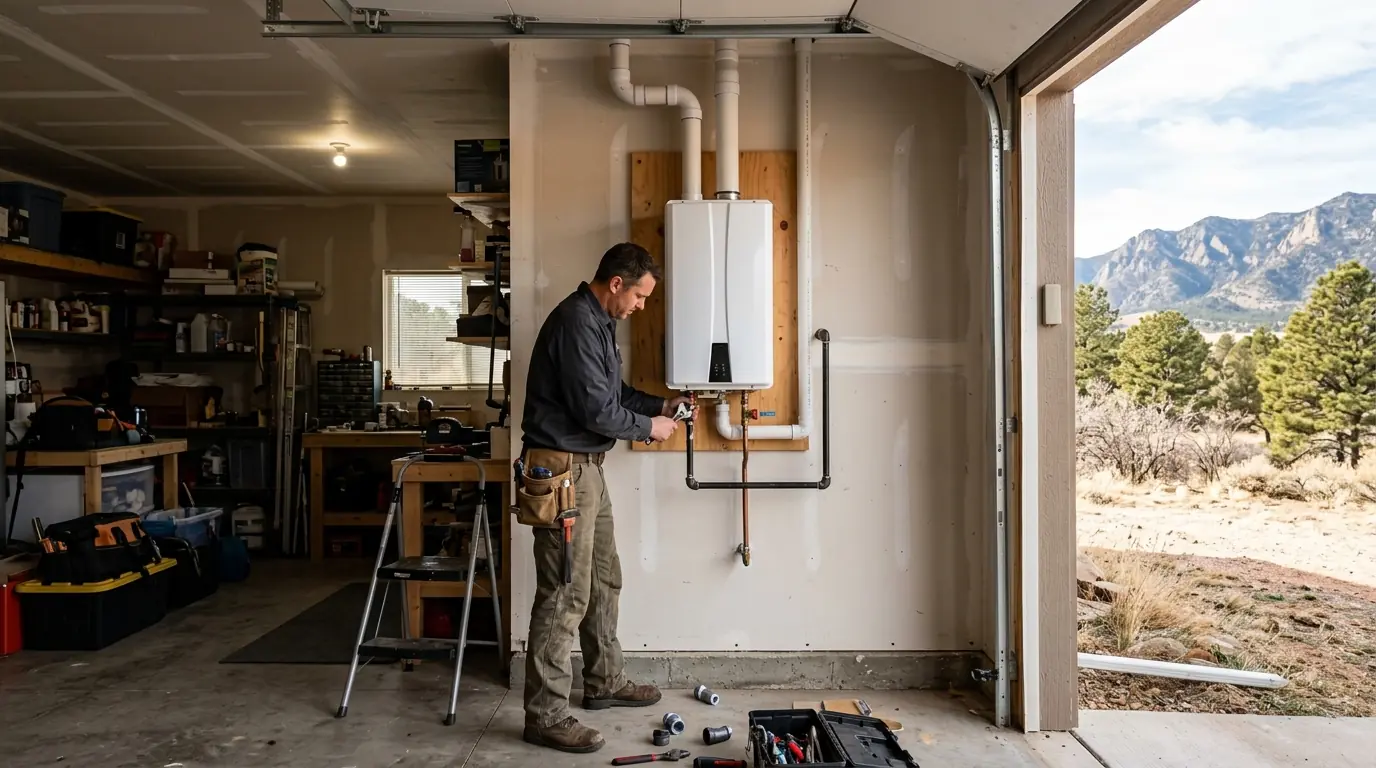
A tankless heater is a different machine from a tank, and most of the install is about feeding it: a gas line big enough for full fire, a dedicated vent, a condensate drain and service valves for descaling.
- Gas line sized for the unit
- Tank-to-tankless conversions
- Phones answered 24/7
Updated October 2026Phones answered 24/7
Want a price on this job?
Call and describe the job. We answer 24/7 and set a visit.
Quick answer
Tankless water heater installation in Colorado Springs runs $3,000 to $6,500 on ConsumerAffairs' local estimate, roughly double a tank, because most conversions need a bigger gas line and new venting. A whole-house unit can fire at close to 200,000 BTU per hour, several times the input of a typical 40,000 BTU tank burner.
Endless hot water comes with conditions
Tankless heaters warm water only as it flows, so they do not run out the way a tank does. Their limit is flow: each unit can raise so many gallons per minute by so many degrees, and that number drops in winter when the incoming water is colder. We size for the fixtures you actually run at once, two showers and a dishwasher, say, and pick a model whose output holds up on a January morning.
Then come gas, venting and water. Condensing models vent in PVC and drain acidic condensate that needs a neutralizer. Isolation valves go on every install so the unit can be flushed during descaling and service without cutting pipe. If you are not sure tankless fits, our tank vs tankless guide walks through it, and a new tank remains a fair choice.
Cost
Tankless installation price ranges
Tankless pricing depends mostly on how much gas and venting work the conversion needs. These published estimates are context, not our price.
What moves the price
- Gas line upsizing from the meter
- Condensing or non-condensing unit
- Vent route and length
- Condensate drain and neutralizer
- Rerouting water lines to the new spot
- Capping or relining the old flue
Ranges are published market figures for planning, not a quote. We price your job after we see it.
Your options
Tankless or a new tank for your house
Both suit different households. Here is how they differ day to day.
| Gas tankless | Gas tank | |
|---|---|---|
| Hot water supply | Continuous, limited by flow | Limited by tank size |
| Space | Wall-mounted | Floor footprint |
| Install cost | Higher, often gas and vent work | Lower |
| Power outage | No hot water | Often still heats |
| Upkeep | Descaling and inlet filter cleaning | Flushing and anode checks |
Gas tankless installs
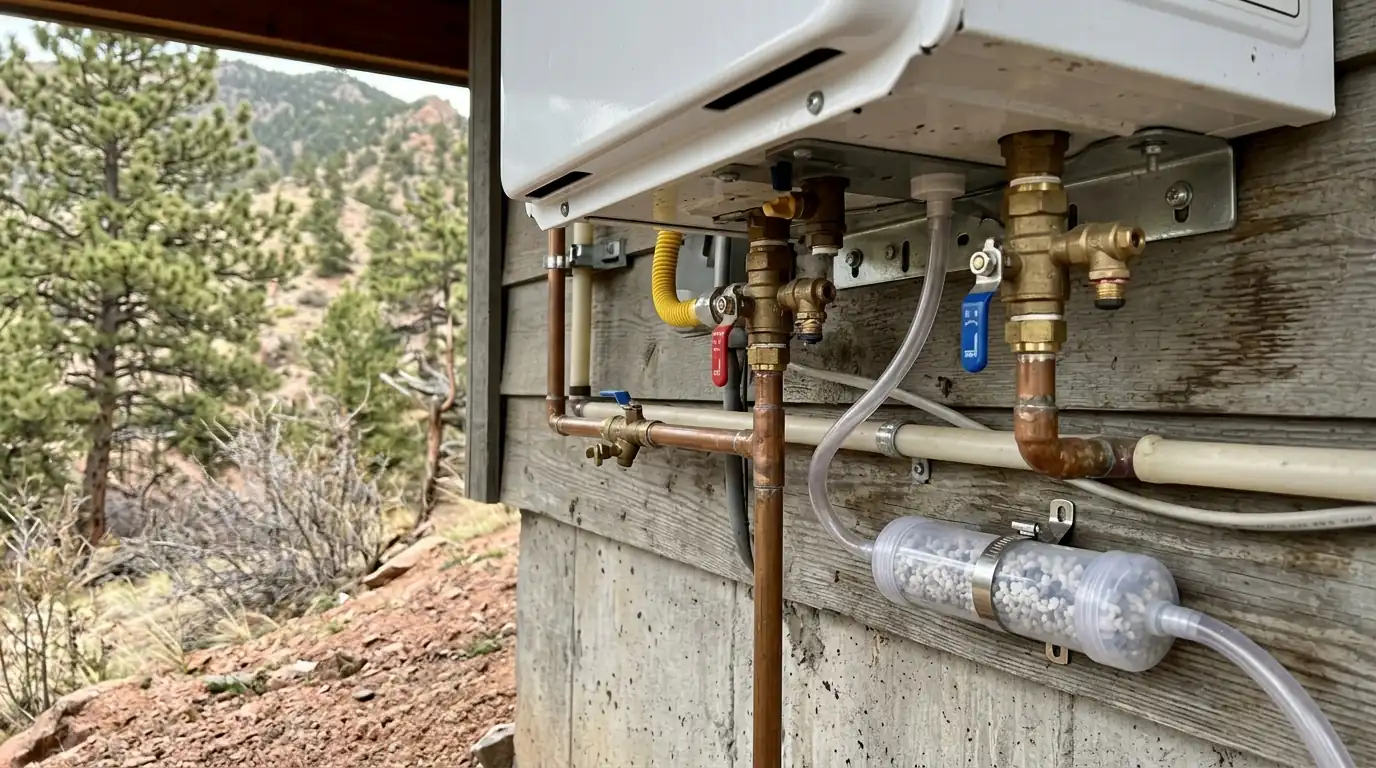
Most of our tankless installs are gas, either condensing units that vent in PVC or non-condensing units that need stainless vent pipe. Condensing models cost more but run more efficiently and are easier to vent through a side wall. We mount the unit with service clearance, pipe in the gas shutoff, sediment trap and isolation valves, and configure the high-altitude setting, usually a dip switch or a control parameter. Then we measure gas pressure at full fire with every hot tap open.
Converting from a tank
Converting means more than swapping one appliance for another. The tank's floor space frees up, the unit hangs on a wall, and the hot and cold lines are rerouted to it. The old flue is often capped, and if the furnace shared it, we confirm the furnace still vents correctly on its own. Tankless does not shorten the wait for hot water at a distant bathroom, and can add a few seconds, so long runs can benefit from a recirculation setup designed for tankless.
Gas line and venting changes
A gas line sized for a furnace, a range and a tank heater often cannot feed a tankless unit at full fire while the furnace runs. We total the appliance loads, measure the run from the meter, size the new pipe from the code tables and pressure test it. Undersized gas is the most common reason tankless units throw ignition codes or deliver lukewarm water on cold mornings. Venting must be the material the manufacturer lists, with termination clearances from windows, doors and the gas meter.
HomeAdvisor reports a normal range of $1,406 to $3,902 for tankless installs, with an average of $2,641.
Local conditions
Programming a tankless unit for 6,035 feet
The body text of the Colorado Springs encyclopedia entry puts the city at 6,035 feet, which places every gas appliance here in the range where manufacturers call for burner adjustment. On a tankless unit that adjustment is usually electronic: a dip switch or menu setting changes fan speed and gas input so combustion stays clean in thinner air. A unit left at its factory setting in Colorado Springs can throw flame and combustion codes on a brand-new install, so we set and verify it before we leave.
What is included
What a complete tankless install includes
Tankless quotes vary more than tank quotes because so much can be skipped. Ask for each of these.
- Sizing from peak flow and winter inlet temperature
- Gas line sizing calculation
- Vent material listed by the manufacturer
- Termination clearances checked
- Condensate drain with neutralizer
- Isolation valves for descaling
- High-altitude setting configured
- Full-fire test with every hot tap open
How the job runs
How a tankless conversion goes
Measure demand
Count the fixtures that run together and check inlet temperature to size the unit.
Check the gas
Total the appliance load and pipe lengths to see whether the line needs upsizing.
Plan the vent
Choose a side wall or roof route that meets the manufacturer's clearances.
Mount and pipe
Hang the unit, add isolation valves, gas shutoff and condensate drain, and set it for altitude.
Fire and test
Open every hot tap, check gas pressure at full fire and confirm a steady outlet temperature.
Brands we service
We install Navien, Rinnai and Noritz tankless water heaters, and Rheem models when you prefer them.
- Rheem
- A. O. Smith
- Bradford White
- Navien
- Rinnai
- Noritz
- Moen
- Delta
- Kohler
- American Standard
- InSinkErator
- Uponor
- Watts
- Zurn
FAQ
Questions before going tankless
Not the way a tank does, but it has a flow limit. Open more hot taps than it can heat and the temperature drops. Sizing it to your real peak use prevents that.
Often yes. A whole-house unit can draw several times the gas of a tank heater. We measure and calculate before quoting, and tell you if the existing line will carry it.
Usually, if an outside wall is close for venting or there is a clear route to the roof. A closet in the middle of the house can need a long vent run, which adds cost.
No. The fan, controls and igniter need electricity, so an outage means no hot water. Many atmospheric tank heaters keep heating without power, which matters to households that lose power often.
The tank's whole footprint. A wall-hung unit is roughly the size of a carry-on suitcase, which often gives back a closet corner or room for storage, as long as service clearance around it stays open.
Related services

