Whole-house water filters for Colorado Springs homes and wells
Most filter calls start with a smell, a taste or grit in an aerator. We match the filter to that complaint, size it so it does not choke your water pressure, and plumb it with a bypass so cartridge changes take minutes.
- Phones answered 24/7
- Sized to whole-house flow
- Bypass on the install
Updated October 2026Phones answered 24/7
Want a price on this job?
Call and describe the job. We answer 24/7 and set a visit.
Quick answer
Whole-house filtration in Colorado Springs is usually about chlorine taste or well sediment rather than contamination: Colorado Springs Utilities tested for 29 PFAS compounds in late 2024 and early 2025 and found none above reporting limits. A carbon stage handles taste and odor; a sediment stage protects fixtures on a well. We size both to peak flow.
Matching the filter to the actual complaint
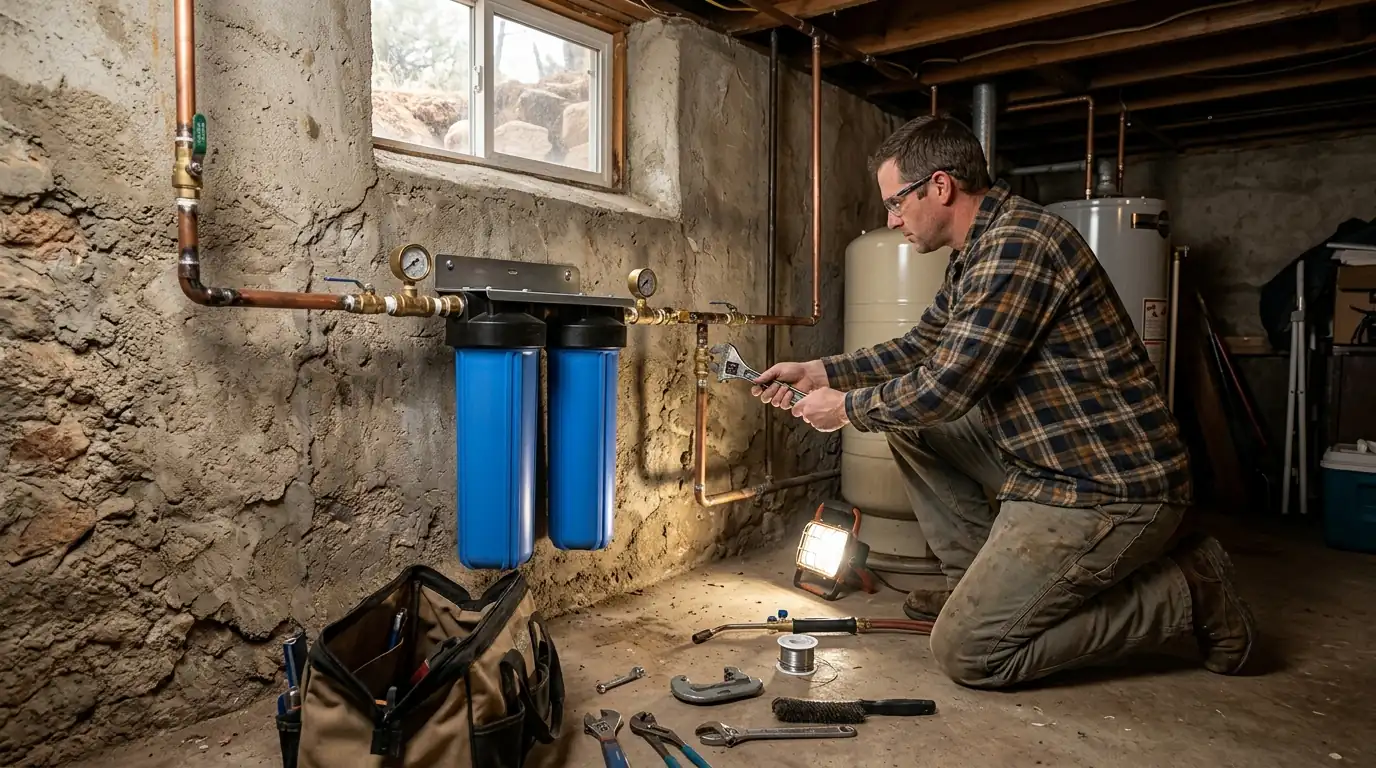
A whole-house system sits where the main enters, after the shutoff and any pressure reducing valve, and treats every tap. Carbon adsorbs chlorine taste and odor. Sediment cartridges or a spin-down screen catch sand, scale flakes and rust before they reach valve cartridges. Neither softens water, and neither is a fix for bacteria, which calls for disinfection.
Sizing matters more than the label. An undersized cartridge housing drops pressure when two showers run, and a small carbon tank exhausts early. We look at the bathrooms, the main line size and, on a well, how the pump and pressure tank are set before choosing.
For drinking water alone, a point-of-use reverse osmosis unit is often the better buy. If scale is the real problem, filtering will not stop it; a softener does.
Cost
Whole-house filter costs
The format and flow rate drive price: a pair of cartridge housings on a small main costs far less than a backwashing tank sized for a large home. National range below, not our price.
What moves the price
- Cartridge housings vs a backwashing tank
- Main line size and peak flow
- Number of stages
- Bypass loop and space at the main
- Drain and outlet for backwashing units
- Replacement cartridges or media over time
Ranges are published market figures for planning, not a quote. We price your job after we see it.
Your options
Whole-house filter or one at the kitchen sink?
The right choice depends on whether the complaint is at every tap or only in the glass.
| Whole-house | Point-of-use under the sink | |
|---|---|---|
| Treats | Every tap, shower and appliance | One faucet, sometimes the ice maker |
| Best for | Shower odor, well sediment | Drinking and cooking water |
| PFAS reduction | Possible with a large certified carbon system | The usual route, with RO or certified carbon |
| Pressure effect | Must be sized to whole-house flow | None at other fixtures |
Carbon filtration for taste and odor
The complaint is a pool smell in the shower or a flat, chemical taste in coffee. Two formats do the job. A large cartridge housing is cheaper up front and needs cartridges swapped on a schedule. A backwashing carbon tank costs more, needs a drain and an outlet, and runs much longer between media changes. Either way, the carbon goes ahead of the water heater and the softener, and we flush the fine black carbon dust out before the house goes back into service.
Sediment filters for well water
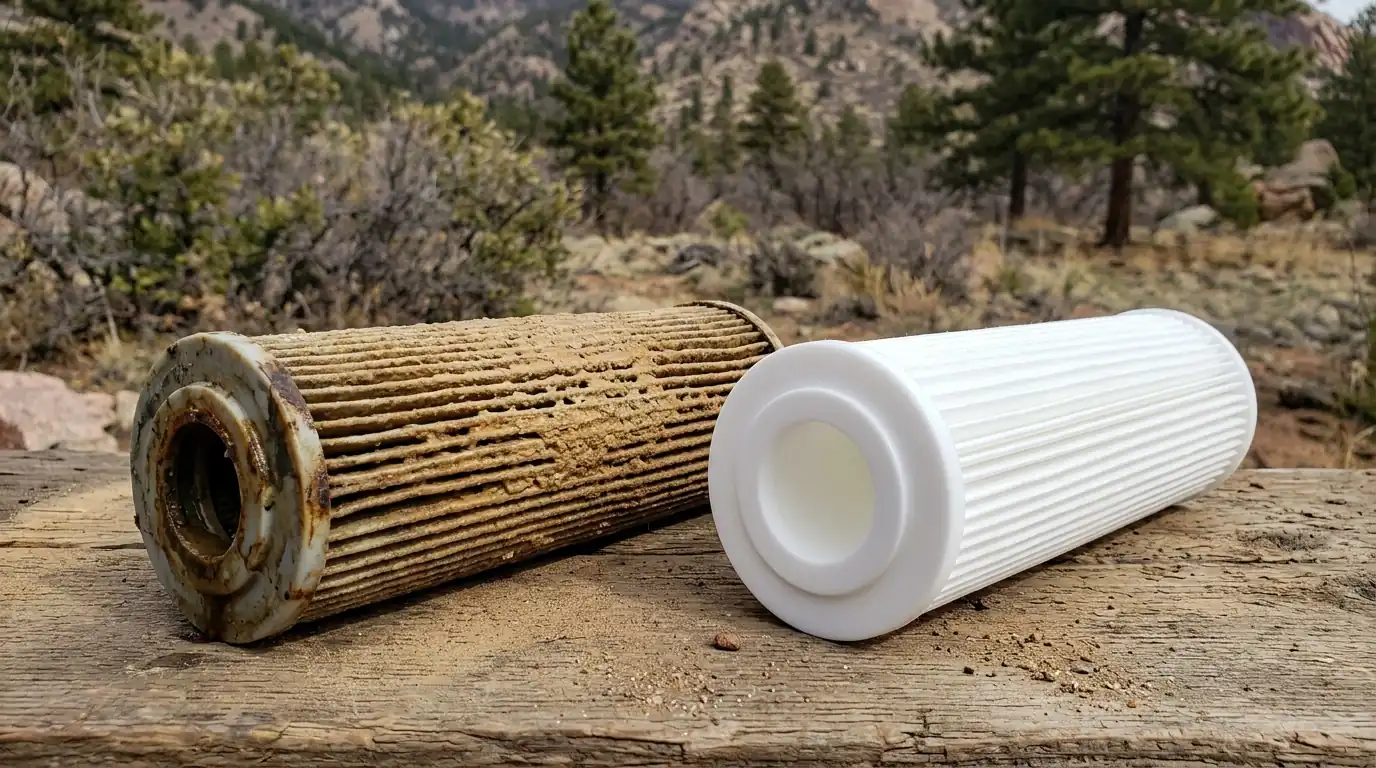
Well homes see grit in toilet tanks, aerators that clog every few weeks, and valve cartridges that fail early from scoring. A spin-down screen with a flush valve catches the coarse sand, and a finer pleated cartridge behind it handles the rest. The filter goes after the pressure tank. If sand shows up suddenly or in volume, the filter is treating a symptom: the pump or well screen may be the cause, and we check that before adding stages.
Filters for PFAS concerns
We start with what your water source has actually reported. For drinking and cooking water, the usual route is a point-of-use reverse osmosis or carbon unit certified to NSF/ANSI 53 or 58 for PFOA and PFOS reduction. Whole-house carbon can be built for PFAS too, but it has to be sized for contact time at full flow, which makes it a larger tank and a bigger budget. On a private well, testing comes before any purchase.
Local conditions
Where our water comes from, and what was found to the south
Colorado Springs Utilities says almost 75% of its water comes from mountain streams carried through the Homestake, Fryingpan-Arkansas, Twin Lakes and Blue River systems, and its testing in late 2024 and early 2025 found no PFAS above reporting limits. The history south of town is different: in 2016, perfluorinated chemicals were found in wells in Security and Widefield after federal and state limits were lowered. Owners on private wells anywhere in that direction should test before choosing a filter.
What is included
What a proper filter install includes
Filters get sold off a shelf; installs are where they succeed or fail.
- A water test or a clear complaint to match
- Housing or tank sized to the main
- Bypass valves for service
- Pressure gauges before and after
- Sediment ahead of carbon on a well
- Drain and outlet for backwashing tanks
- Carbon flushed before use
- Changeout date on the housing
How the job runs
How we set up a whole-house filter
Pin down the complaint
Taste, odor, grit or a test result, so the media matches.
Size to flow
Housing or tank chosen for the main and the bathrooms.
Place it
After the shutoff and PRV, ahead of the softener and water heater.
Plumb bypass and gauges
Isolation valves plus gauges before and after the filter.
Flush and label
Carbon fines flushed out; changeout date written on the housing.
Brands we service
We install and service A. O. Smith, Watts and Rheem whole-house filtration, plus standard large-format housings that take common replacement cartridges.
- Rheem
- A. O. Smith
- Bradford White
- Navien
- Rinnai
- Noritz
- Moen
- Delta
- Kohler
- American Standard
- InSinkErator
- Uponor
- Watts
- Zurn
FAQ
Filter questions from Colorado Springs homeowners
Colorado Springs Utilities publishes its own water quality reports, and its PFAS testing found nothing above reporting limits. Most filters we install on city water are about taste and odor, which is a preference rather than a safety fix.
A correctly sized one causes little loss when new. Pressure drops as a cartridge loads up, which is why we put gauges on both sides: when the gap widens, it is time to change it.
It depends on the water and how much you use. Sediment cartridges on a sandy well may need changing far sooner than carbon on city water. The gauges tell you better than the calendar.
Before. Sediment and carbon stages protect the softener's valve and resin from grit and chlorine.
No. Carbon and sediment media do not remove calcium and magnesium. Measured hard water needs a softener.
Related services

