Reverse osmosis drinking water systems in Colorado Springs kitchens
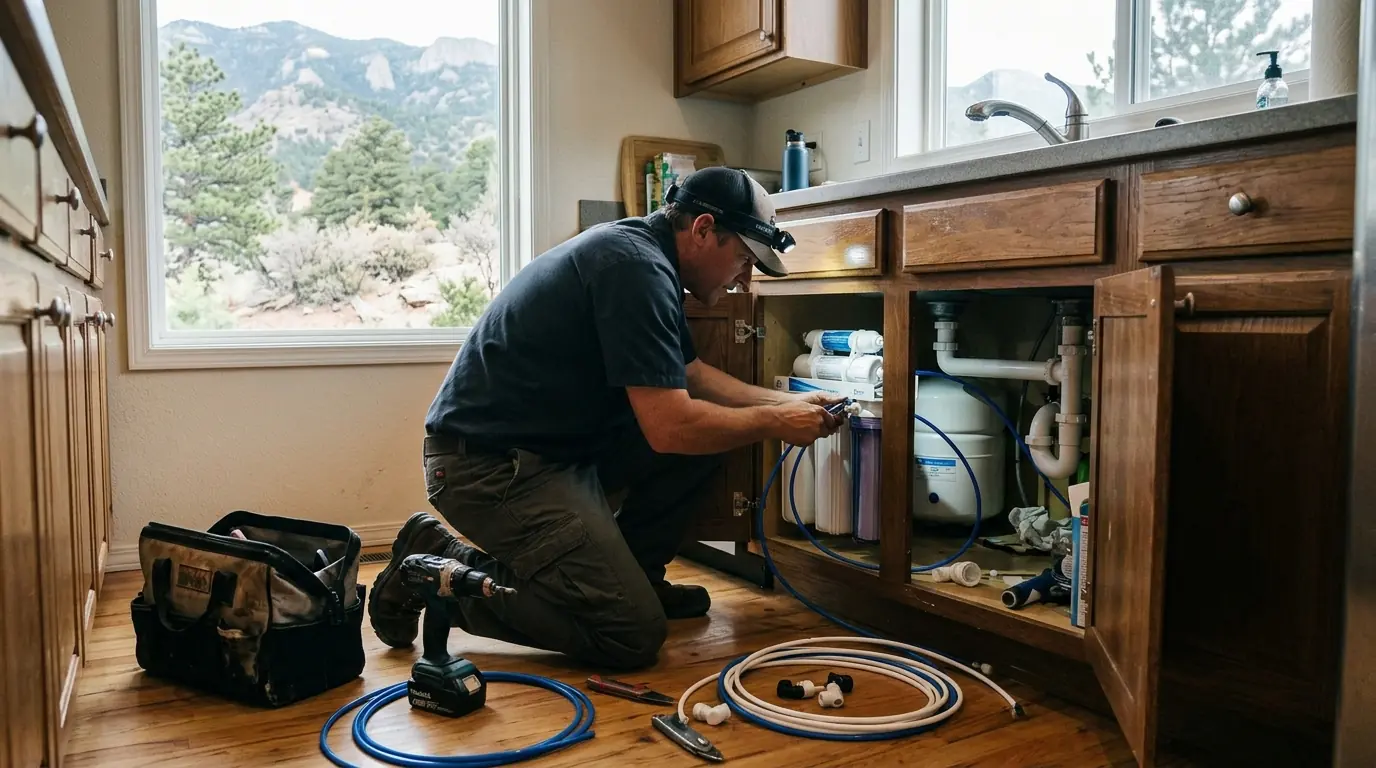
An RO unit gives you one faucet of very clean drinking water. We mount it, drill the faucet hole, tie the drain in the right place, run tubing to the fridge if you want it, and change filters and membranes later.
- Phones answered 24/7
- Under-sink and fridge lines
- Filter and membrane changes
Updated October 2026Phones answered 24/7
Want a price on this job?
Call and describe the job. We answer 24/7 and set a visit.
Quick answer
A reverse osmosis system in Colorado Springs is a drinking-water upgrade, not a fix for unsafe city water: Colorado Springs Utilities found no PFAS above reporting limits in 29-compound testing across late 2024 and early 2025. RO still earns its place for taste, for well owners, and for anyone wanting a second barrier at the kitchen tap.
How an under-sink RO unit does its job
Water passes a sediment prefilter and a carbon prefilter, then is pushed through a semipermeable membrane that rejects most dissolved solids. Clean water collects in a small pressurized tank, or goes straight to the faucet on pumped tankless models, while the rejected water leaves through a drain saddle on the sink tailpiece. A carbon postfilter polishes taste on the way to a dedicated faucet.
Two details decide whether it runs well. Feed pressure: the membrane needs pressure to push water through, so a weak supply slows production and sends more to drain. Drain placement: the saddle belongs above the P-trap, away from where the disposal discharges, or food waste ends up in the line.
Want every tap treated instead? Start with whole-house filtration. On a hard well, RO sits after the softener, where scale cannot coat the membrane.
Cost
RO system price ranges
Small under-sink units sit at the low end; pumped tankless units, remineralization stages and long runs to a fridge push it up. Published national figures, not our price.
What moves the price
- Tank unit vs pumped tankless unit
- Drilling stone or quartz for the faucet
- Permeate or booster pump for low pressure
- Tubing run to a fridge or ice maker
- Remineralization or extra stages
- Filter and membrane costs over time
Ranges are published market figures for planning, not a quote. We price your job after we see it.
Under-sink RO installs
We check the cabinet first: room for the filter manifold and a tank, a cold-water angle stop to tee from, and a place for the faucet. Many sinks have a sprayer or soap hole we can use; otherwise we drill the sink or the countertop, and stone counters take a diamond bit and more time. Where an air-gap faucet is required, it gets one, with its own drain tube to the saddle. Tubing is cut square, fully seated in the push-fit fittings and clipped so a door will not snag it.
Ice maker and fridge connections
RO water makes clear ice, but the hookup needs thought. We tee off the RO output with tubing to the fridge and usually bypass or remove the fridge's internal filter, since a second filter only cuts flow. Ice maker valves need a minimum pressure, and a storage tank near empty may not deliver it, so a long run or a weak tank can mean small cubes. A permeate pump or a booster helps. For the line itself, see our ice maker hookups page.
Membrane and filter changes
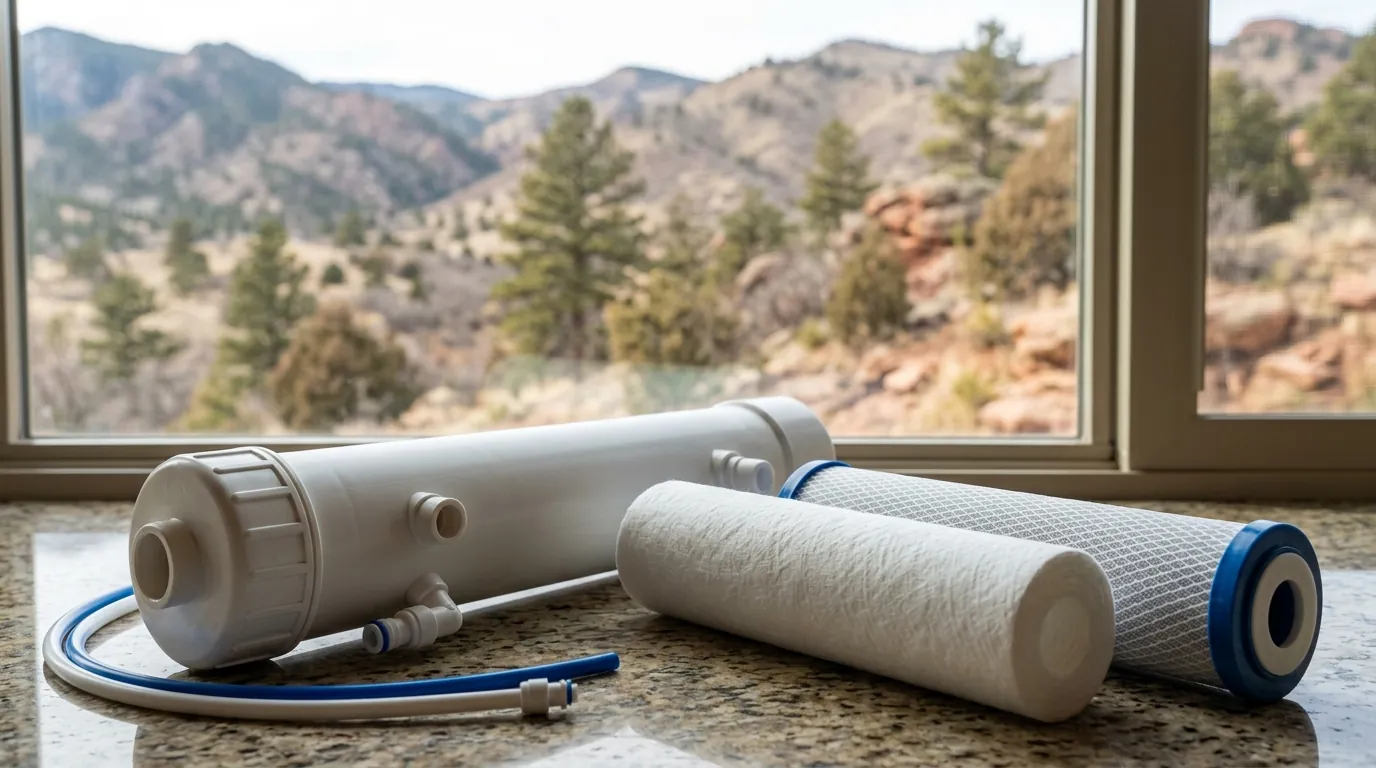
Signs it is due: the faucet trickles, the tank never seems full, taste creeps back, or the drain runs constantly because the automatic shutoff valve or check valve has failed. Prefilters get changed on the maker's shorter interval, the membrane far less often. We sanitize the housings, change every stage at once, check tank air charge with the tank empty, and test the output with a TDS meter so you know the membrane is actually rejecting.
Local conditions
PFAS history south of Colorado Springs, and where it stands
PFCs turned up in Security and Widefield wells in 2016, once the EPA and CDPHE lowered the allowed limit that May, and Security Water District shut down its Widefield Aquifer wells that year. In 2021 the district opened an ion exchange resin plant built with the U.S. Air Force, and it reports PFOA and PFOS at non-detect levels since. Colorado Springs Utilities found no PFAS above reporting limits in late 2024 and early 2025 testing. Owners who still want a second barrier usually choose RO at the kitchen sink.
What is included
What a careful RO install includes
Details that separate a quiet, dry install from a callout six months later:
- Feed pressure checked first
- Dedicated cold-water shutoff
- Drain saddle above the P-trap
- Air-gap faucet where required
- Tank air charge set before filling
- Tubing clipped clear of the disposal
- First tank flushed to drain
- Filter change dates labeled
Do it yourself?
RO maintenance: your part and ours
A few RO jobs are fine for an owner. Leaks and slow output usually are not.
| Task | Homeowner | Plumber |
|---|---|---|
| Prefilter change | Swap cartridges if the housings unthread by hand | Sanitize housings and change all stages |
| Slow faucet | Confirm the tank valve is open | Test tank air charge and membrane output |
| Constant drain noise | Note when it happens | Replace the shutoff or check valve |
| Leak under the sink | Close the feed valve and dry the cabinet | Reseat or replace fittings and tubing |
How the job runs
An RO install, from cabinet to first glass
Check pressure and space
Feed pressure read; cabinet measured for the unit and tank.
Tee the cold supply
A dedicated shutoff for the RO feed.
Set faucet and drain
Faucet hole drilled or reused; saddle above the trap.
Mount and connect
Manifold, tank and tubing secured clear of the disposal.
Flush and check
First tank sent to drain as the maker directs, every fitting checked dry.
Brands we service
We install and service Watts and A. O. Smith RO systems, and mount dedicated drinking-water faucets from Moen, Delta and Kohler when you want the finish to match.
- Rheem
- A. O. Smith
- Bradford White
- Navien
- Rinnai
- Noritz
- Moen
- Delta
- Kohler
- American Standard
- InSinkErator
- Uponor
- Watts
- Zurn
FAQ
Reverse osmosis questions we get
More than people expect. Every unit sends some water to drain to carry rejected solids away, and the ratio worsens on low feed pressure. A permeate pump or a newer high-efficiency membrane cuts the waste noticeably.
Yes, RO membranes reduce fluoride along with most other dissolved minerals. If you want minerals back for taste, a remineralization stage adds a small amount after the membrane.
Usually low tank air charge, clogged prefilters or a worn membrane. Check that the tank valve is open first; after that, a pressure gauge on the empty tank and a TDS reading tell us which part is at fault.
Yes, with the right stages ahead of it. Sediment and hardness both shorten membrane life, so on a hard or sandy well we put RO after the softener and sediment filter.
Yes, through a tee on the output. Long runs or a weak tank can starve the ice maker, which is where a booster or permeate pump earns its place.
Related services

