Tank or tankless: picking a water heater for a Colorado Springs house
By Ulysses Elkins, Plumbing Guides EditorUpdated October 2026
Need a plumber, not a guide?
We answer 24/7 across Colorado Springs and the Pikes Peak region.
Quick answer
For most Colorado Springs homes a tank costs less up front, and a tankless heater earns its higher price only with heavy, steady hot water use: ConsumerAffairs lists local tank installs at $1,400 to $3,000 and tankless at $3,000 to $6,500. Both need burner setup for the city's 6,035 foot elevation.
The up-front price gap, by the published numbers
ConsumerAffairs, in its 2026 Colorado Springs plumber guide, lists tank water heater installation at $1,400 to $3,000 and tankless installation at $3,000 to $6,500. National guides show the same pattern. HomeGuide gives $600 to $3,100 for standard tanks and $1,400 to $5,600 for tankless, and HomeAdvisor's normal range for a tankless install is $1,406 to $3,902. None of these is our price; they show the size of the gap.
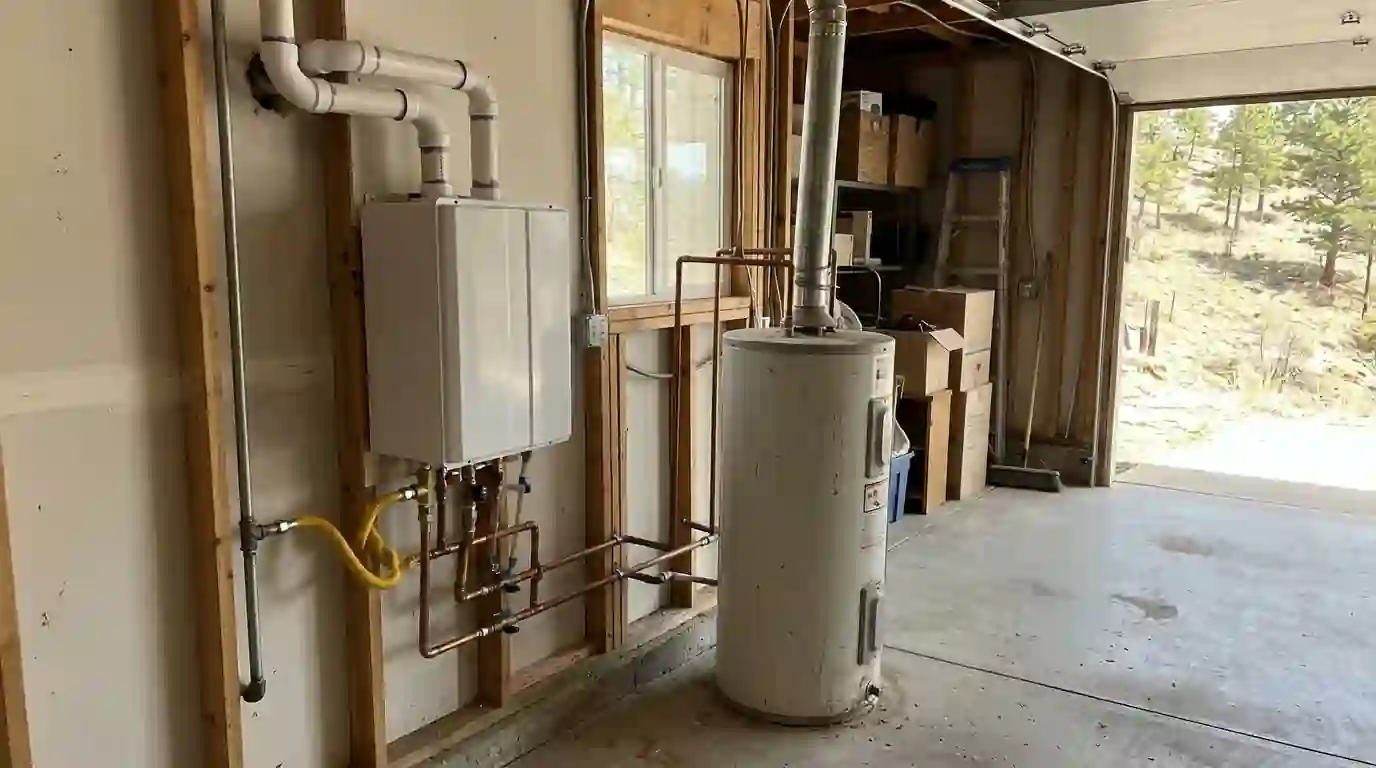
The gap is mostly not the heater. A like-for-like tank swap reuses the existing gas line, vent and water connections. A first-time tankless conversion usually needs a larger gas line, a new vent through the wall or roof, a condensate drain on condensing models, and new water and isolation valves. The more of that the house already has, the closer the two prices get.
How each type makes hot water, and where each runs short
A tank stores 40 or 50 gallons at temperature and reheats as you use it. Its limit is the first-hour rating: run three long showers and a dishwasher back to back and the last shower runs cool while the burner catches up. A tankless unit heats water only as it flows. It never runs out, but it has a flow limit in gallons per minute, and that limit falls as the incoming water gets colder.
That second point matters here. Water arriving from the street in January is far colder than in August, so the same unit delivers fewer gallons per minute in winter. A tankless heater sized on a summer number can fall short with two showers and a washer running on a cold morning. Sizing should use the winter inlet temperature and the household's real peak, not the brochure maximum.
Gas line and venting: the hidden half of a tankless conversion
A typical gas tank burner is modest. A whole-house tankless unit can draw several times that input at full fire, and the existing half-inch branch that fed the old tank usually cannot carry it, especially when the furnace and range run at the same time. The fix is a properly sized line from the meter or a large trunk, which is real gas line installation work, not a fitting swap.
Venting changes too. Most tankless units use sealed, direct venting in PVC, CPVC or polypropylene, with strict limits on length and elbows and clearances from windows and doors. Condensing models also need a condensate drain, often with a neutralizer. A careful tankless water heater installation plans all of that before the old tank comes out.

Rather have a plumber look at it?
Call any hour. A person answers.
Altitude derating applies to both
Colorado Springs sits at 6,035 feet. A water heater technical service bulletin calls for reducing a tank's main burner orifice by four percent for every 1,000 feet, starting from about 2,000 feet, which works out to roughly 24 percent here. Tankless units handle altitude through a setting made during installation, and their published output drops accordingly. Either way, the heater you compare should be the derated heater. Our guide on how altitude changes water heater setup explains what goes wrong when that step is skipped.
Scale and upkeep: soft city water, harder water nearby
Utility data puts Colorado Springs tap water at 2.1 grains per gallon, which is classed as soft. That favors tankless units, whose narrow heat exchanger passages are what scale clogs first. County estimates put Fountain and Monument at 8.2 grains per gallon and Pueblo at 8.1, and a tankless heater on that harder water needs descaling more often, or a softener ahead of it.
Angi lists flushing and descaling a tankless heater at $150 to $250, and HomeGuide gives $75 to $300. A tank needs a sediment flush and an anode rod check instead; Angi puts tank flushing at $110 to $200. Either can be part of yearly water heater maintenance, and when a tankless unit starts throwing scale or flow errors, tankless repair and descaling usually clears it.
Which household fits which heater
These are the patterns we see when people weigh the two. They are tendencies, not rules, and the house usually decides as much as the family does.
- Tank: tight budget, existing gas and vent in good shape, short-term ownership
- Tank: many simultaneous draws at once, such as several showers plus laundry
- Tankless: long back-to-back showers, a large soaking tub, or teenagers
- Tankless: no room for a tank, or a wish to free up closet space
- Tankless: willing to keep up yearly descaling on harder water
- Either: a plan to stay long enough for running costs to matter
Small differences people notice after the switch
Tankless owners sometimes report a brief burst of cold water when a tap is turned off and on again quickly, the so-called cold water sandwich, as the unit relights. Low flows, such as a single bathroom faucet barely open, may not trigger the burner at all. Neither is a defect. A small buffer tank or a recirculation setup can reduce both, and our guide to water heater replacement costs covers how those extras change an estimate. Tanks, for their part, take floor space and lose a little heat standing still, but they deliver water at any flow the moment a tap opens.
FAQ
Questions readers ask
It can, but slowly, and it depends on how much hot water the house uses. A tankless unit stops the standby loss of keeping a tank hot all day. With ConsumerAffairs showing local tankless installs well above tank installs, a small household may never close that gap. Heavy users close it faster.
Yes, if it is sized for the winter inlet temperature and the household's peak demand after altitude derating. The common mistake is sizing on a warm-weather number. A large household may need a higher-output unit or two units piped together.
Less often, but still yes. At 2.1 grains per gallon scale builds slowly, so many units on city water go longer between descaling than units on harder water. Follow the manufacturer's interval, and watch for flow or temperature errors as the signal to do it sooner.
No. Gas tankless units need electricity for the controls, fan and ignition. Many standing-pilot gas tanks will keep heating without power. If outages are a concern, that is a point in favor of a tank or a battery backup for the tankless unit.
Usually, and it frees floor space, but the location still needs a vent route within the unit's length limits, a gas line that can carry its input, a drain for condensate and service clearance. The old tank's spot is a starting point, not automatically the right one.
It is a third option worth considering for an electric home with space around the unit. HomeGuide lists heat pump water heaters at $2,000 to $4,600 installed. They need room for air movement and a condensate drain, and they cool the space they sit in.
Related