Trenchless sewer line work in Colorado Springs, without the long trench
Trenchless work replaces or rebuilds a sewer line through small access pits or an existing cleanout. It saves the driveway and the trees, but only when the old pipe can still guide a burst head or hold a liner.
- Pipe bursting and CIPP
- Jetted and filmed first
- Phones answered 24/7
Updated October 2026Phones answered 24/7
Want a price on this job?
Call and describe the job. We answer 24/7 and set a visit.
Quick answer
Trenchless sewer replacement in Colorado Springs runs $60 to $250 per foot on HomeAdvisor's figures, often more per foot than a trench but with far less to rebuild on top. The method needs a pipe that can still be followed end to end. A collapsed section, a deep belly or a sharp bend can rule it out, and the camera tells us which.
Two small pits instead of a trench
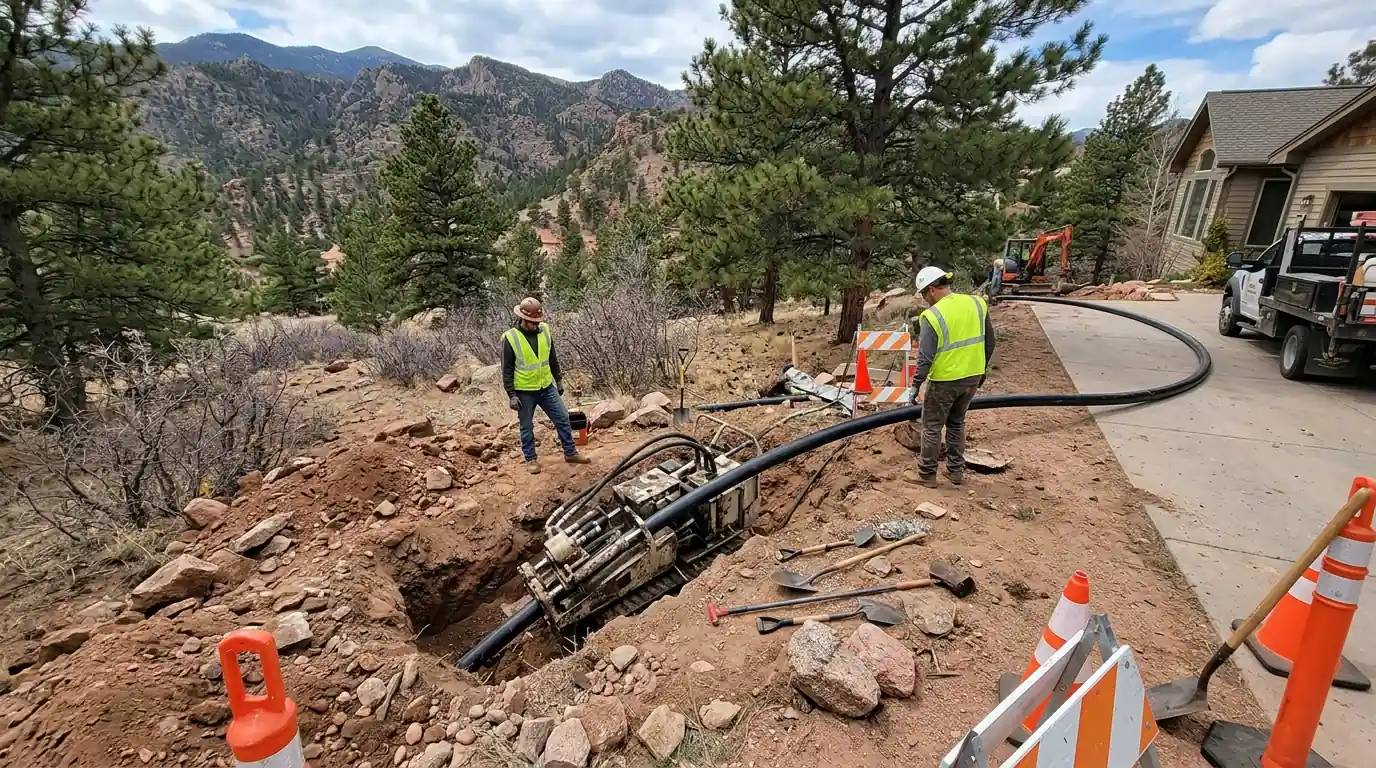
There are two trenchless methods and they solve different problems. Bursting pulls a cone-shaped head through the old line, cracking it outward while new HDPE follows behind in the same path. Lining leaves the old pipe in place and cures a resin-soaked felt tube inside it, a pipe within a pipe. Both start with jetting the line clean so the head or the liner meets bare pipe, and both end with a camera run.
Trenchless is not automatically cheaper. On a short, shallow lateral under open lawn, digging and replacing can cost less and lets us fix a belly that neither method corrects. Under a driveway, patio, mature tree or finished basement, the concrete, landscaping and flooring you do not have to rebuild is usually where trenchless pays for itself.
Cost
Trenchless pricing per foot
Trenchless work is usually quoted per foot plus the access pits. These published figures are for orientation only; we price your line after it has been jetted and filmed.
What moves the price
- Length of the run
- Bursting or lining
- Branch connections to reopen
- Depth and size of the access pits
- Cleaning needed before lining
- Tie-in at the main
Ranges are published market figures for planning, not a quote. We price your job after we see it.
Your options
Pipe bursting vs CIPP lining
Both avoid a trench. They differ in what the old pipe must be and what you end up with.
| Pipe bursting | CIPP lining | |
|---|---|---|
| Old pipe | Broken out into the soil | Stays as the host |
| Condition needed | Continuous path, can be badly cracked | Must still hold its shape |
| Diameter after | Same or upsized | Slightly smaller |
| Access | Pit at each end | Cleanout or one pit |
| Bellies and offsets | Not corrected | Not corrected |
Pipe bursting with new HDPE
Bursting suits clay, cast iron and Orangeburg that is cracked, root-filled or out of round but still continuous. We dig a launch pit near the house and a receiving pit at the far end, fuse HDPE lengths into one continuous pipe on the surface, then winch the bursting head through. The old pipe fractures into the surrounding soil. The new pipe has no joints along the run, so roots have nothing to enter. Bursting will not straighten a sag: the new pipe follows the old path, belly included.
HomeAdvisor lists pipe bursting at $60 to $200 per foot.
Cured-in-place pipe lining
Lining works when the host pipe is cracked or root-invaded at its joints but still holds its shape. After jetting and cutting roots, we pull or invert an epoxy-saturated felt liner into the line, inflate it against the old wall and let it cure. The result is smooth, jointless and slightly smaller than the original. Branch connections, such as a second bathroom tying in, are reopened from inside with a robotic cutter. Missing pipe, heavy offsets or a severe belly make lining a poor fit.
HomeAdvisor puts CIPP lining at $90 to $250 per foot.
Spot liners for one bad section
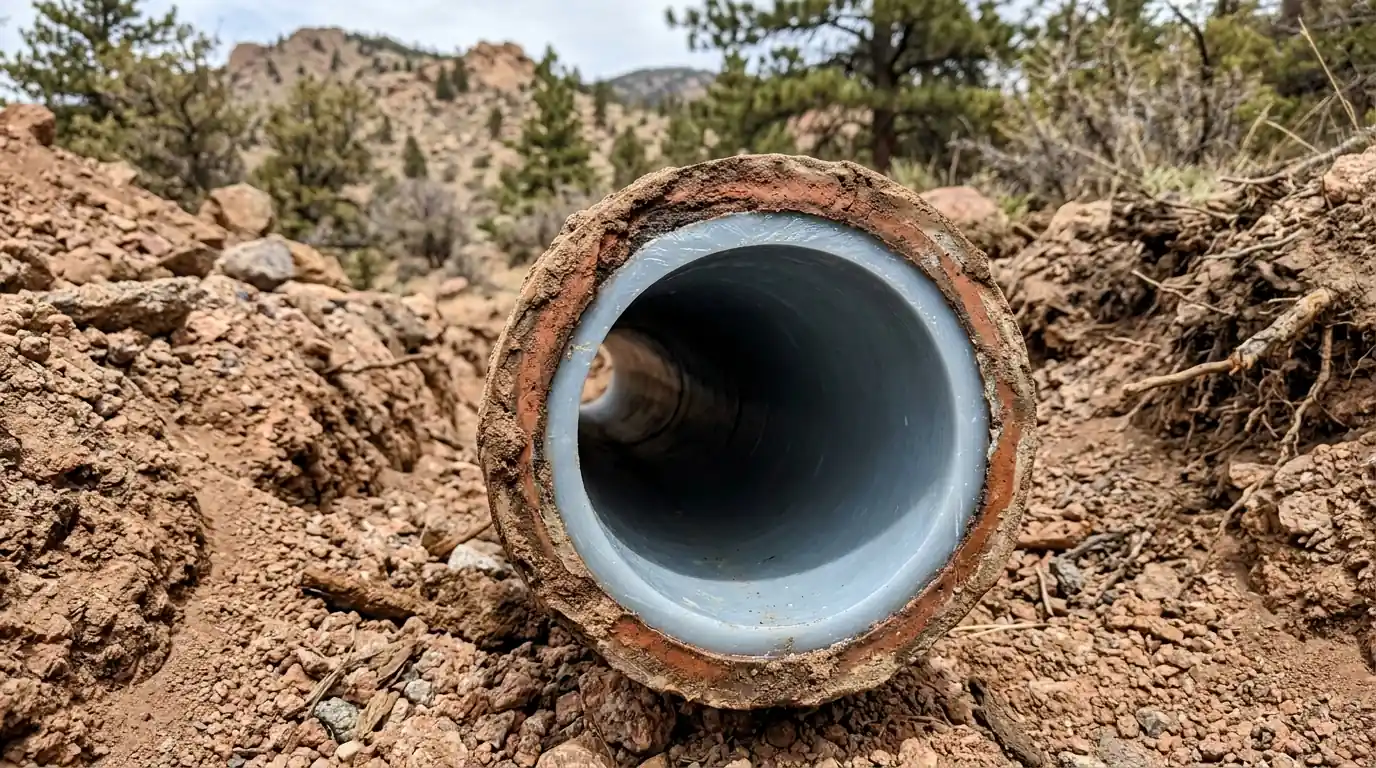
A spot liner, also called a sectional point repair, is a sleeve a few feet long set at one cracked joint or root entry. We locate the defect on camera, jet that section, then a packer carries the resin-soaked sleeve to the spot and inflates it until it cures. It suits a single defect in otherwise sound pipe, especially under a slab or driveway where a pit would be costly. If defects are scattered along the run, several spot liners can approach the price of lining the whole line.
Local conditions
Swelling clay and a buried line's alignment
The Colorado Geological Survey says bentonite and montmorillonite clays underlie many populated parts of Colorado and can swell up to 20% by volume when wet, pushing with 20,000 pounds per square foot or more, and it names sewer lines among the damage. It has mapped heave susceptibility across Colorado Springs. That movement matters for trenchless choices. A line shoved out of alignment or into a belly may not take a liner well, while burst HDPE goes in as one flexible piece with no joints for the ground to pull apart.
Timing
How long trenchless work keeps the drains off
A bursting job on a typical lateral usually fits in one to two days including the pits, with drains out from the moment the old pipe is opened until the HDPE is connected at both ends. Lining is often a single day once the line is clean, but the resin needs time to cure before water runs, several hours at ground temperature or less with hot water or steam. We give you the window before we start.
How the job runs
How a trenchless job runs on your lot
Jet and film
We clean the line to bare pipe and record it end to end, marking anything that rules a method out.
Pick the method
Bursting, full lining or a spot liner, chosen by pipe condition, grade and what sits above it.
Open access points
Small pits at each end, or the cleanout alone on many lining jobs.
Install and reconnect
Pull the HDPE behind the burst head or cure the liner, then reopen branches and tie both ends in.
Final camera
We film the finished line and walk you through the recording.
FAQ
Questions about pipe bursting and lining
A little. The liner's wall sits inside the old pipe, so a 4 inch line loses a small amount of diameter. Because the inside is smooth and jointless, it usually drains as well as the original.
No. Bursting follows the old path and lining copies the old shape, sag included. A belly deep enough to hold water and solids usually has to be dug up and regraded, sometimes combined with trenchless on the rest of the run.
Usually two small pits for bursting. Lining can sometimes go in through an existing cleanout with no pit, but a pit at the house is common when no usable cleanout exists.
Roots inside the old pipe are cut out first. Afterward the lined or burst pipe has no joints to enter. Roots outside the pipe stay where they are, so the tree keeps growing as it was.
No. It wins when the line runs under something expensive to dig up. Under open lawn, a trench is often cheaper and lets us correct the grade. Our repair or replace guide lays out the trade.
Related services

