Dripping and leaking faucet repair in Colorado Springs
Most dripping faucets need one worn part, not a new faucet. We identify the cartridge or seat, replace it, and say so plainly when the faucet body itself is done.
- Phones answered 24/7
- Kitchen, bath and tub faucets
- Repair before replace
Updated October 2026Phones answered 24/7
Want a price on this job?
Call and describe the job. We answer 24/7 and set a visit.
Quick answer
Faucet repair in Colorado Springs usually means replacing one part: a cartridge, a pair of seats and springs, or an O-ring matched to the brand and model. Identifying that part is the hard step, since one brand may use a dozen cartridges. When the body is cracked or parts are discontinued, a new faucet is cheaper in the end.
Where the drip starts and why
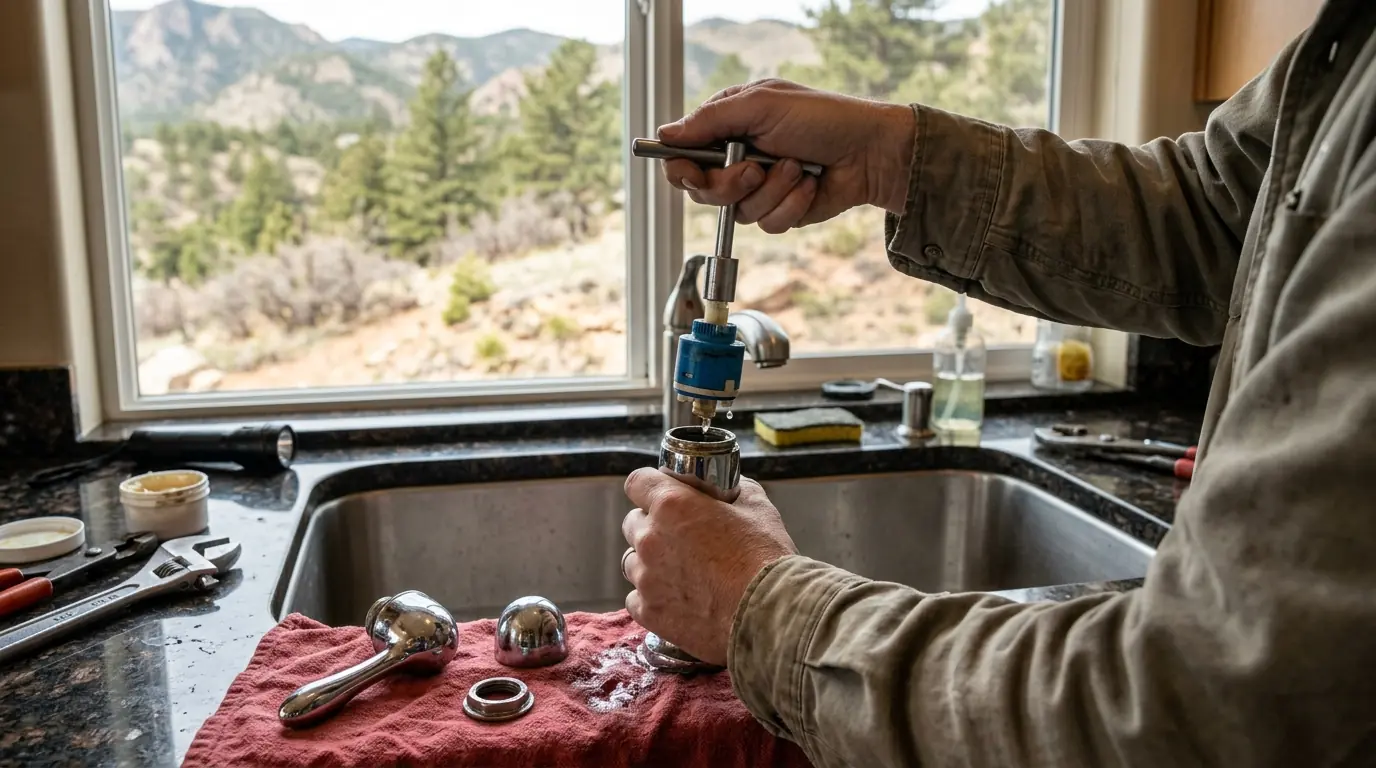
Every faucet stops water with something that wears. Compression faucets press a rubber washer onto a brass seat. Ball faucets use rubber seats and springs. Most modern faucets use a ceramic disc cartridge, two polished plates sliding across each other. A drip from the spout means the shutoff part is worn. Water at the base or under the handle means an O-ring or spout seal has failed instead.
A seized brass cartridge can crack an old housing if it is forced, so we pull it with a proper puller. If the faucet is worth saving, we fix it. If it is corroded through or discontinued, we say so and can install a new faucet when you have one picked out. A drip under the sink that is not the faucet is usually a supply line or trap, which falls under leak repair.
Cost
What a faucet repair costs next to a new faucet
Published figures for a leaky faucet repair are modest, and the part is often a small share. The bigger cost driver is time spent freeing a seized cartridge or tracking down a part for an unusual model.
What moves the price
- Cartridge type and brand
- Seized parts that must be extracted
- Seat work on compression faucets
- Pull-down hose replacement
- Angle stops that will not close
- Whether the faucet is worth repairing at all
Ranges are published market figures for planning, not a quote. We price your job after we see it.
Your options
Repair the faucet or replace it?
Both are legitimate answers. These are the points we weigh with you.
| Repair | Replace | |
|---|---|---|
| Best when | Body sound, parts available | Body corroded or cracked |
| Typical parts | Cartridge, seats, O-rings | New faucet and supply lines |
| Look | Stays the same | Your choice of new style |
| Next failure | Other worn parts may follow | Starts fresh |
Dripping cartridges and seats
A steady drip from the spout, or a handle you crank tighter each month, means the seal inside has worn. On a ceramic cartridge, grit scores the discs and a new cartridge is the fix, matched by part number rather than by eye. On two-handle compression faucets we replace the washers and, when the brass seat is pitted, dress or replace the seat so the new washer closes against something smooth. Ball faucets get a seat and spring kit. Skipping the seat is why some repairs drip again within weeks.
Low flow from scaled aerators
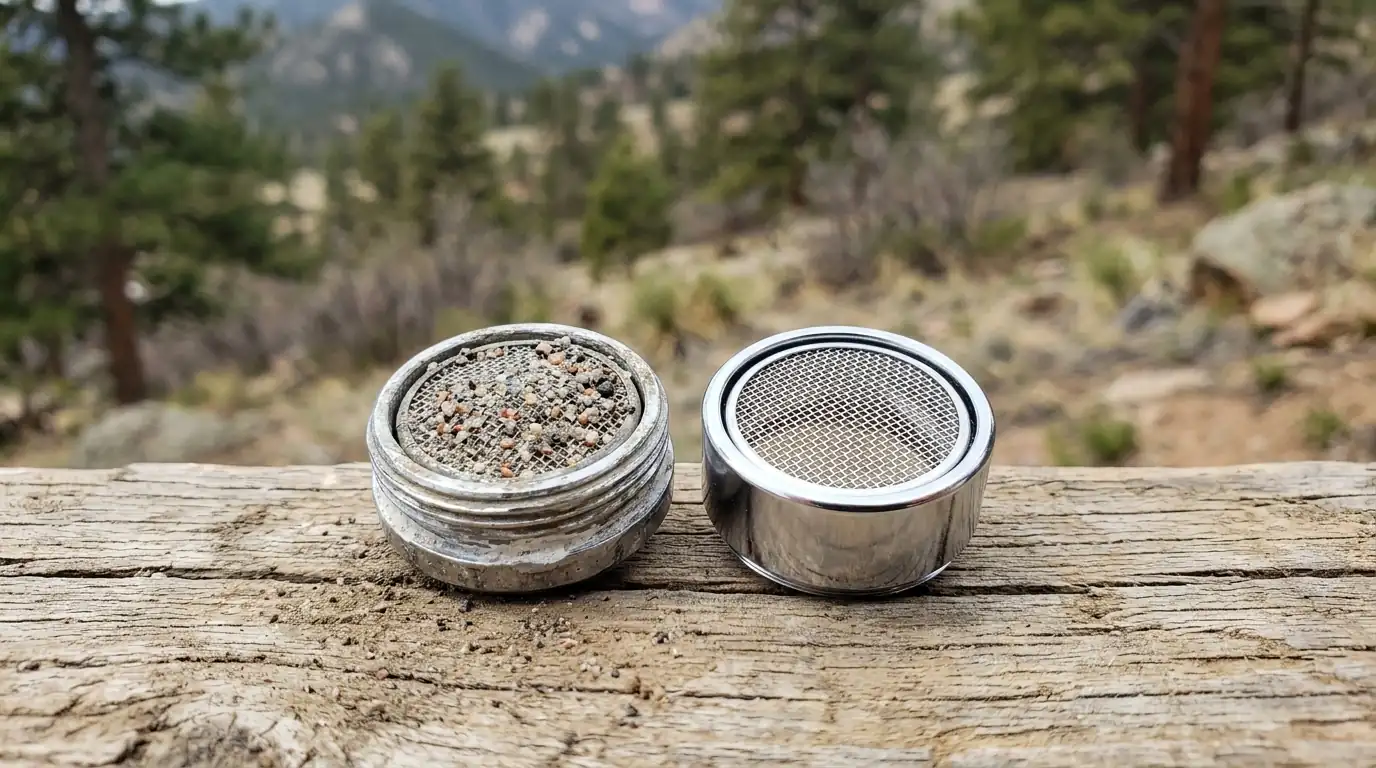
If one faucet slows while the others run fine, check the aerator first. Unscrew the tip and you often find grit, flakes of pipe scale or white bits of a broken-down water heater dip tube on the screen. Debris shows up after water main work or a heater replacement, when fresh flow stirs things loose. A clean or new aerator usually brings the flow back. If not, the restriction is upstream: a clogged cartridge screen, a kinked supply line or a half-closed stop. When every faucet is weak, it is house pressure, and we check the pressure reducing valve.
Leaks at the base of the spout
Water pooling around the base of a kitchen faucet, especially one with a swivel spout, comes from worn O-rings on the spout body. On pull-down faucets it is often the hose connection or a hose splitting inside the cabinet, so we look underneath before taking the top apart. On bath faucets, a base leak may be the cartridge nut or the deck gasket. Left alone, base leaks wick under the countertop and rot the cabinet floor, so they are worth fixing sooner than a drip that falls into the drain.
Local conditions
Soft water and what it means for your faucets
Utility-reported data puts Colorado Springs tap water at 35.8 mg/L hardness, or 2.1 grains per gallon, which is classed as soft. That changes what we find inside faucets here. Heavy white scale is less common than in hard water towns, so when a Colorado Springs faucet slows down we look for grit and debris before blaming minerals. Cartridges still wear and O-rings still dry out with age, but a slow stream usually traces to something caught on a screen.
Warning signs
Faucet trouble you can see from the sink
Drip from the spout
Water keeps coming after the handle is fully closed.
Handle needs extra force
You push or crank harder to stop the flow.
Puddle at the base
Water collects around the spout or under the handle.
Weak stream at one tap
Others run fine, pointing at the aerator or cartridge.
Temperature hard to set
Hot and cold jump instead of blending smoothly.
Wet cabinet floor
Swollen or stained base under a pull-down faucet.
How the job runs
How we fix a dripping faucet
Close the stops
We check they actually hold before opening anything.
Identify the faucet
Brand, model and cartridge style from markings, handle design or the cartridge itself.
Pull the worn part
With a cartridge puller when needed, so the body is not cracked.
Inspect seats and O-rings
Pitted seats are dressed or replaced and O-rings get silicone grease.
Reassemble and test
Hot and cold run full, then closed, while we watch the spout and base.
Clean the aerator
Last, since debris freed during the repair collects on the screen.
Brands we service
We repair Moen, Delta, Kohler and American Standard faucets and match cartridges by part number, not by look.
- Rheem
- A. O. Smith
- Bradford White
- Navien
- Rinnai
- Noritz
- Moen
- Delta
- Kohler
- American Standard
- InSinkErator
- Uponor
- Watts
- Zurn
FAQ
Questions about dripping and leaking faucets
Yes. The drip wastes water around the clock, and a worn cartridge often gets worse fast once grit starts scoring the discs. A drip on the hot side also means you are paying to heat water that goes straight down the drain.
Usually the cartridge was the wrong match, the seat under it was worn, or it was not seated fully and the clip or nut is loose. On compression faucets, a pitted seat chews through a new washer quickly.
Debris from the water heater, sediment or a crumbling dip tube, travels the hot line and catches on cartridge screens and aerators. If several hot taps are weak, the heater may need flushing or a dip tube check.
Old multi-turn stops often seize or drip once turned. We shut water at the main, replace the stops with quarter-turn valves and then repair the faucet, which makes the next repair much easier.
Look for a logo on the handle, spout base or escutcheon. If there is none, the handle shape and the cartridge itself usually tell us. Telling us what you see when you call helps us bring the likely part.
Related services

