Water and sewer line ownership in Colorado Springs, explained
By Ulysses Elkins, Plumbing Guides EditorUpdated October 2026
Need a plumber, not a guide?
We answer 24/7 across Colorado Springs and the Pikes Peak region.
Quick answer
In Colorado Springs, city code 12.4.409 makes the property owner solely responsible for the water service line from the right-of-way or easement line to the building, while the utility handles the part in the public right-of-way. For sewer, Colorado Springs Utilities says the whole wastewater line from the home to its main is the customer's.
The water service line splits at the right-of-way
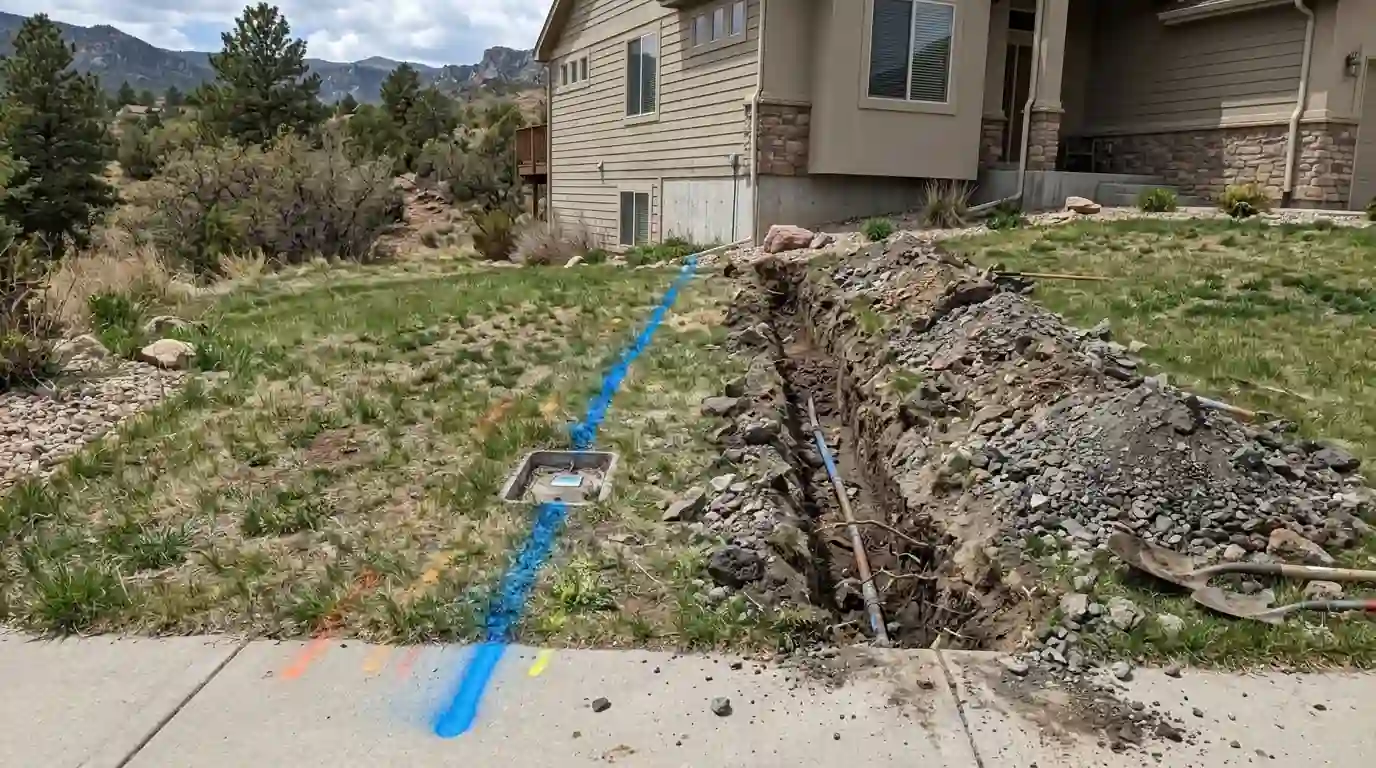
Under Colorado Springs city code 12.4.409, the utility handles the water service line in the public right-of-way, and the property owner is solely responsible for maintenance, repair and replacement from the right-of-way or easement line to the building. On most lots that means the pipe under your front yard, from roughly where the public strip ends up to the wall where the line enters the basement or crawlspace, is yours.
The line does not announce where that boundary is. Your plat or survey shows the right-of-way, and the meter pit or curb stop is usually close to it. If you are not sure which side a leak is on, the safest first step is to ask the utility to look at its side while a plumber checks yours, rather than assuming either way.
The curb stop: shared, but not yours to turn
The code makes curb stops jointly owned, but only the utility may operate or repair them. That small detail matters in an emergency. If a pipe bursts inside the house, you do not shut the curb stop yourself. You close the main shut-off valve inside the house, which is entirely yours.
That inside valve is often the weak link. Old gate valves seize half open or snap at the stem, and packing nuts drip once they are finally turned. If yours will not close fully, replacing it with a quarter-turn ball valve is a small job that pays off the first time something leaks. Our main shut-off valve replacement page covers the options.
The 24 hour reporting rule and repair deadlines
The same code requires owners to report a service line leak within 24 hours of discovery. Leaks on lines larger than 1 inch must be repaired within 72 hours, and leaks on lines 1 inch or smaller within 45 days, or water service can be suspended. If your line is the smaller size, that leaves time to compare estimates, but the reporting clock starts the day you find the leak, not the day you get around to it.
Finding it is the first job. A wet strip in the lawn in dry weather, a soft spot or small sinkhole above the line, or a meter that turns with every fixture closed all point to the yard line. Leak detection narrows it down before anyone digs, and main water line repair can often fix a single leak with one short excavation.

Rather have a plumber look at it?
Call any hour. A person answers.
Lead service lines are not allowed to stay connected
Colorado Springs code does not permit lead service lines to be connected to the water system. When the utility finds lead in a service line, it notifies the owner and records that notice annually with the El Paso County Recorder until the whole lead line is replaced. In other words, a lead line becomes part of the property record and follows the house at sale.
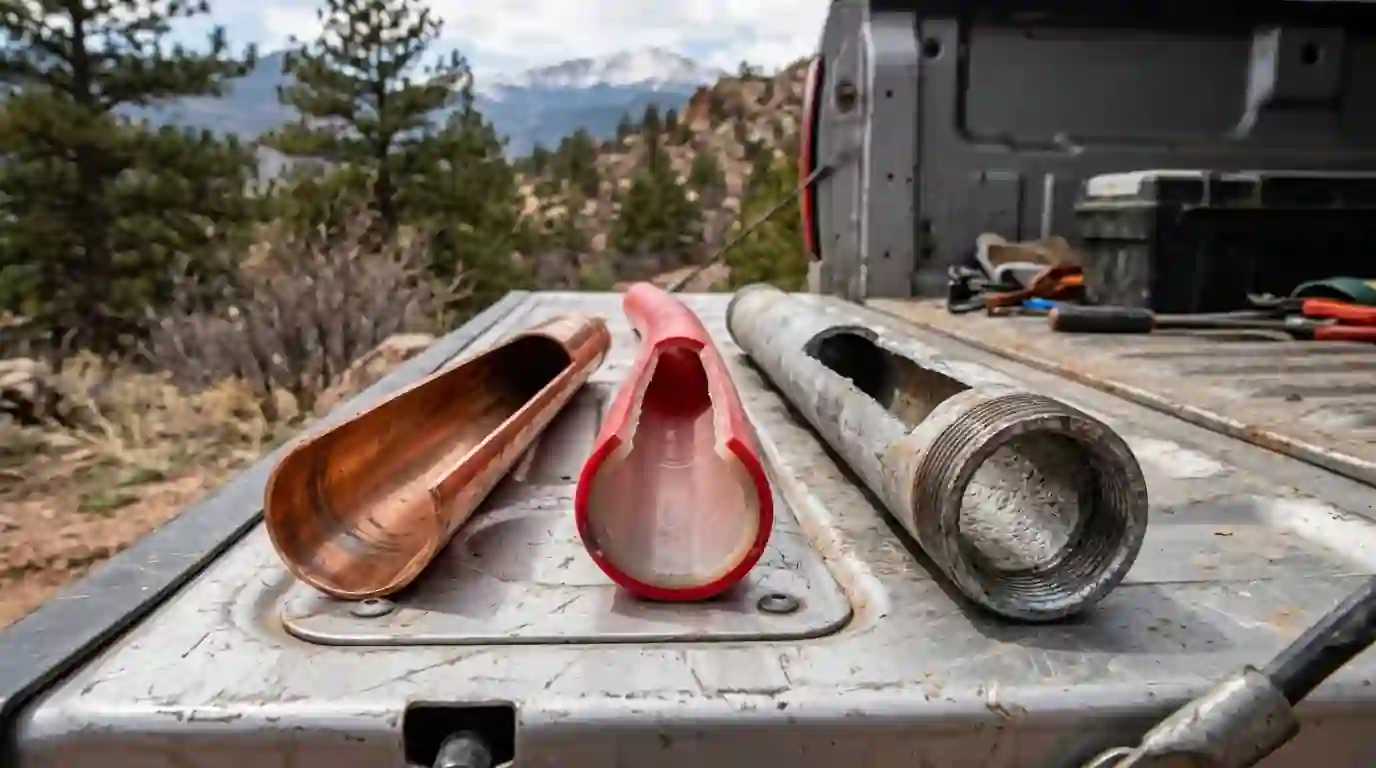
If you are unsure what your line is made of, look where it enters the house before the meter or main valve. Lead is dull gray, soft enough to scratch easily with a key, and does not attract a magnet. Galvanized steel also looks gray but a magnet sticks to it. Copper scratches to a penny color. When the line needs to go, water line replacement takes it out from the right-of-way to the house.
The sewer lateral is yours from house to main
The sewer side is simpler and larger. Colorado Springs Utilities states that maintaining the wastewater service line, which runs from the home to the utility's main, is the customer's responsibility, and damage caused by service line blockages is the customer's responsibility too. It recommends using a business that specializes in sewer line cleaning. That covers the whole run, including the section under the street that you never see.
Roots at joints, grease, sagging sections and broken clay or cast iron are the usual causes of backups. Main sewer line cleaning clears the blockage, and a camera afterward shows whether the line is sound or needs repair. If you are buying, our guide to scoping the sewer before you buy explains why that camera run belongs in the inspection.
What these lines cost when they fail
HomeAdvisor lists main water line replacement in a normal range of $647 to $2,834, and separately at $50 to $150 per linear foot, which is the more useful number for a long front yard. For the sewer, HomeAdvisor gives a normal range of $1,388 to $5,323 for line replacement. Depth, length, what sits on top of the line (a driveway, a mature tree, a retaining wall) and whether the work reaches into the street all move the price within those ranges.
Clues that the problem is on your side
These signs point to the private part of the line. Any one of them is worth a look before it gets worse.
- Water meter dial moves with every fixture off
- Green, soggy strip in the lawn along the line route in dry weather
- Low pressure throughout the house that started suddenly
- Gurgling floor drains or toilets when the washer drains
- Sewage odor or backup at the lowest drain in the house
- Sinkhole or settling over the sewer path between house and street
FAQ
Questions readers ask
Yes. City code requires a service line leak to be reported within 24 hours of discovery, regardless of size. The repair deadline then depends on the line size: 72 hours above 1 inch, 45 days at 1 inch or smaller. Missing either can lead to water service being suspended.
It depends on which side of the meter connection the leak is on and where the right-of-way line falls. The utility handles its part in the public right-of-way. Call the utility first to look at the meter, and have a plumber check the private side so nobody waits on the other.
No. The code allows only the utility to operate or repair a curb stop, even though it is jointly owned. Use the main shut-off inside the house instead. If that valve is seized or missing, it is worth replacing before you need it in an emergency.
That depends entirely on the policy and any service line endorsement you carry. What is fixed is responsibility: Colorado Springs Utilities places the line from home to main, and damage from blockages in it, on the customer. Read your policy or ask your agent before you need it.
Shared laterals exist in some older neighborhoods, where two houses tie in before reaching the main. The utility's rule is that the service line is the customer's, so a shared section is usually a matter between the two owners. A camera run will show where the lines join.
Look where the line enters the house, before the main valve. Scratch it gently: lead is soft and dull gray and a magnet will not stick, galvanized is gray and magnetic, copper shows a penny color. If the utility has identified lead, it notifies the owner directly.
Related