Repair or replace a sewer line? How the call gets made
By Ulysses Elkins, Plumbing Guides EditorUpdated October 2026
Need a plumber, not a guide?
We answer 24/7 across Colorado Springs and the Pikes Peak region.
Quick answer
A plumber repairs a sewer line when the camera shows one or two bad spots in otherwise sound pipe, and replaces it when defects repeat along the run or the pipe material itself is failing. HomeGuide lists repairs at $150 to $3,800 depending on method, while HomeAdvisor's normal range for full replacement is $1,388 to $5,323.
The decision starts with a camera, not a shovel
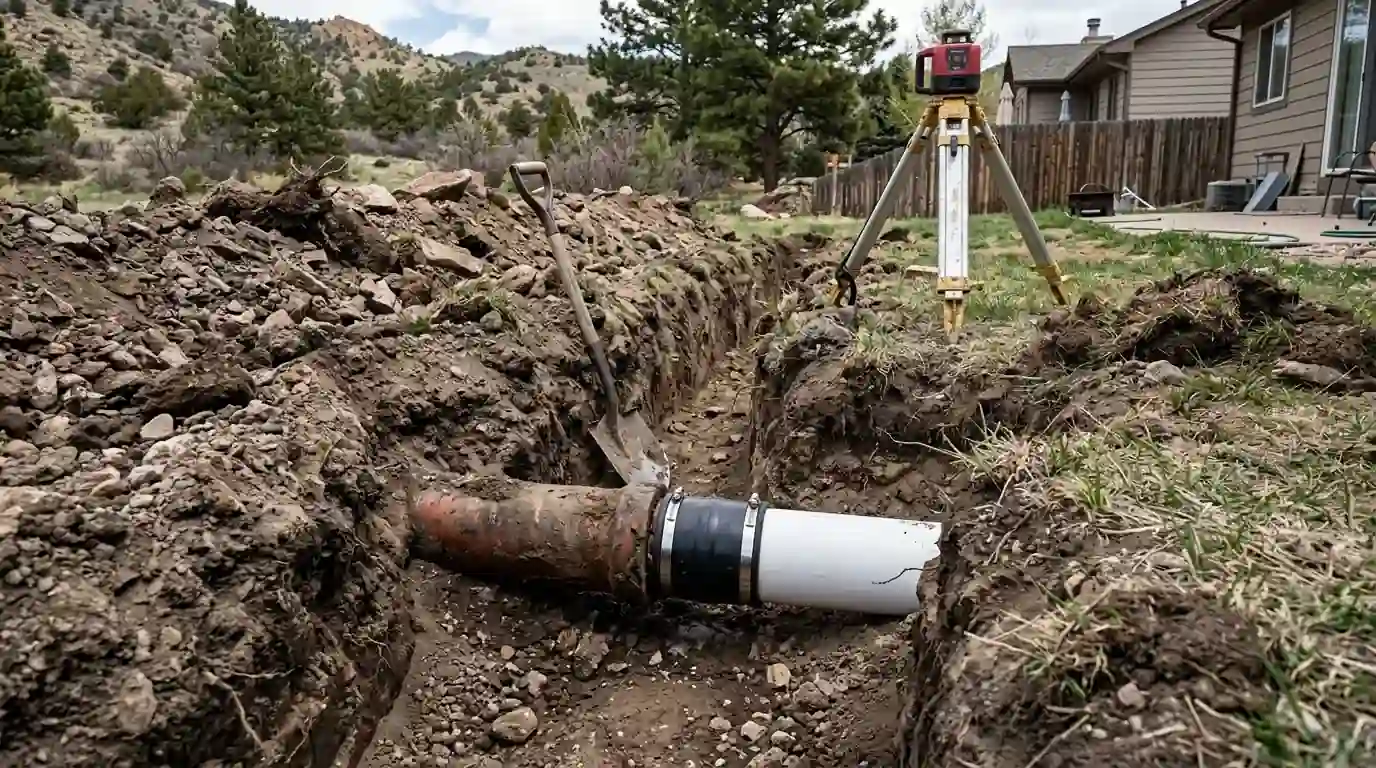
Nobody can make this call honestly from a backup alone. A blockage tells you something is wrong; it does not tell you whether the cause is one root-filled joint or a line that is failing end to end. The first step is to clear the line enough to run a camera, then record the whole length from the cleanout to the city main, with footage marked and defects located from the surface.
If the line is packed with roots or grease, a main line cleaning comes first so the camera can see the pipe wall. Then a sewer camera inspection gives you the video and the footage of every defect. With that in hand you can get comparable estimates, and you can see for yourself what the plumber is describing.
Defects a spot repair can fix
When the rest of the line is round, clean and joined tightly, a single problem can be repaired where it sits. That is usually the cheaper and faster path, and it leaves good pipe in place.
- One joint with root intrusion in otherwise sound pipe
- A single offset or separated joint
- One cracked or broken section of a few feet
- A damaged connection at the house cleanout or foundation wall
- A short belly where the line is shallow and easy to reach
Defects that point to replacing the line
Replacement wins when defects repeat, or when the material is failing everywhere at once. Orangeburg, a tar-impregnated fiber pipe, deforms and blisters with age, and once it starts going oval there is no section worth saving. Clay tile with roots at joint after joint will keep growing roots back no matter how often it is cabled. Old cast iron can scale, crack along its length and wear a channel through the bottom where it carries water.
Bellies are their own case. A low spot that holds water collects solids and causes repeat clogs, and lining cannot fix it, because a liner follows the shape of the host pipe, sag and all. Multiple bellies usually mean the bedding under the line has moved. Here that movement has a known cause: the Colorado Geological Survey says bentonite and montmorillonite clays underlie many populated parts of Colorado, can expand up to 20% by volume when wet, and lists disruption of sewer lines among the losses.

Rather have a plumber look at it?
Call any hour. A person answers.
Dig, burst or line: matching the method to the pipe
Once replacement is the answer, the method comes next. Open trench excavation replaces the pipe with new PVC and can correct grade, which is the only real fix for bellies. HomeAdvisor lists traditional replacement at $50 to $250 per linear foot. Pipe bursting pulls a new HDPE pipe through the old one while a bursting head breaks the old pipe outward; HomeAdvisor puts it at $60 to $200 per foot. Cured-in-place lining forms a new pipe inside the old one, at $90 to $250 per foot by HomeAdvisor's figures, and works best on a line that still holds its shape and grade.
Trenchless methods save lawns, driveways and mature trees, and usually need only an access pit at each end. They are a poor fit for a collapsed line, a severe belly or a run with many direction changes. Our trenchless sewer replacement page compares bursting and lining in detail, and full sewer line replacement covers the open-trench route.
Questions that change the answer on your property
Two houses with the same camera footage can still get different recommendations. These are the details that tip it one way or the other:
- How long is the line, and how deep is it at the problem spot?
- What sits on top: a driveway, a mature tree, a patio or a retaining wall?
- Is the defect near the house, mid-yard or close to the main?
- Is the pipe material the same along the whole run?
- How many times has the line been cleaned in the last few years?
- How long do you plan to stay in the house?
Why older neighborhoods lean toward replacement
The median home in Colorado Springs was built in 1990, so half the city's houses are older than that, and the original laterals in older homes are often clay or cast iron. In the Old North End Historic District, homes reflect styles from 1885 to 1965, and lines that old under mature street trees tend to show defects along their length rather than at one joint. Ownership matters here too: Colorado Springs Utilities makes the customer responsible for the wastewater line from the home to the main, as our guide to who owns the water and sewer lines explains.
Putting the costs side by side
HomeAdvisor puts a typical sewer line repair at $600 to $1,050, and HomeGuide gives a wider $150 to $3,800 depending on the method. For a full replacement, HomeAdvisor's normal range is $1,388 to $5,323, and HomeGuide cites $2,000 to $10,000 for a 40 foot run. ConsumerAffairs, in its Colorado Springs guide, lists sewer line repair or replacement at $3,500 to $18,000, a single range that spans everything from a modest repair to a long, deep replacement. A sewer line repair that buys a few years on a failing clay line is not cheaper if it is followed by a replacement anyway, so compare the cost per year of service, not only the first invoice.
FAQ
Questions readers ask
Yes, as maintenance. Cabling or jetting removes roots, but they return through the same joints, often within a year or two. If roots come from one joint, a spot repair stops them. If they enter at many joints, regular cleaning only manages the problem and replacement or lining ends it.
Not necessarily. A single shallow belly that holds a little water may cause no trouble and can be monitored. One that collects solids and causes repeat clogs can often be dug out and regraded in that spot. Many bellies along the run point to replacement.
Usually not. Orangeburg deforms as it ages, and a liner needs a host pipe that still holds its shape. Once Orangeburg is oval or blistered, bursting or excavation is the realistic option. The camera footage shows how far the deformation has gone.
They may be reading the same footage with different methods in mind, or one may not have seen the full line. Ask each for the video, the footage of every defect and the method behind the price. Comparing like for like usually resolves most of the difference.
A properly made repair with new pipe and approved couplings is not the weak point. The rest of the old line is. That is why a spot repair makes sense only when the camera shows the remaining pipe in good condition.
Ask for a camera run after the work, recorded with footage marks, showing the new section or liner and the joints at each end. A clean, round pipe with no standing water at the repair is the result you are paying for.
Related