Should you scope the sewer line before buying in Colorado Springs?
By Ulysses Elkins, Plumbing Guides EditorUpdated October 2026
Need a plumber, not a guide?
We answer 24/7 across Colorado Springs and the Pikes Peak region.
Quick answer
Yes, scope the sewer before you close on a Colorado Springs home, because Colorado Springs Utilities makes the owner responsible for the wastewater line from the house to its main. HomeGuide puts a sewer camera inspection at $125 to $500 on average, a small cost next to digging up a cracked or sagging line after you move in.
At closing, the line to the main becomes yours
Colorado Springs Utilities states that maintaining the wastewater service line, which runs from the home to the utility's main, is the customer's responsibility, and that damage caused by a blockage in that line is the customer's responsibility as well. In plain terms, every foot of pipe from the cleanout to the main in the street, including the part under your yard and often under the sidewalk, becomes your problem the day the deed records.
A standard home inspection does not look inside that pipe. Inspectors run water and flush toilets, which tells you the drains move today. It does not show a root mass half blocking a joint, a sag that holds water, or a clay section that has cracked. A sewer scope is the only way to see those before you have agreed to the price.
What a camera inspection actually sees
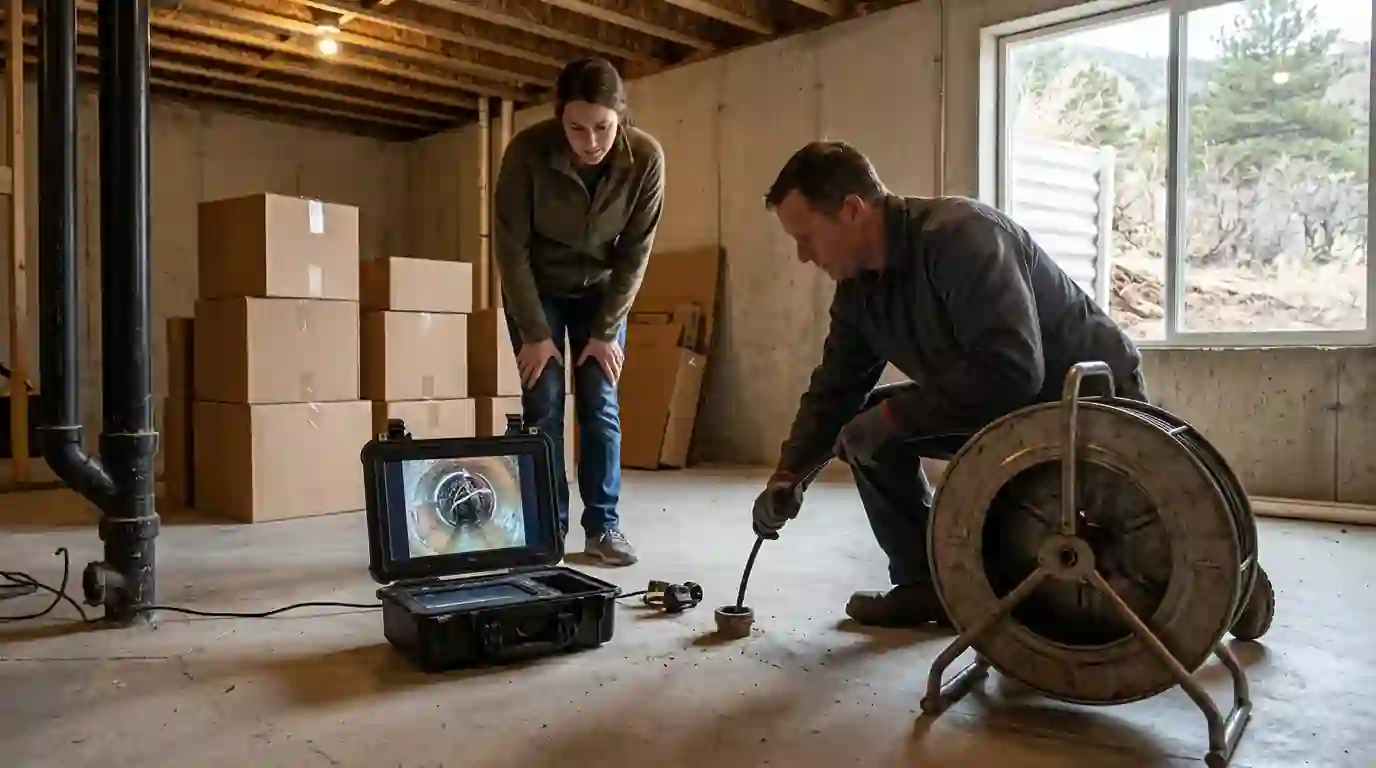
The plumber feeds a waterproof camera on a push cable through a cleanout, or through a toilet flange or roof vent when no cleanout exists, and records the run to the main. A counter on the screen shows footage, and a transmitter in the camera head lets the plumber locate the camera from above and mark the depth and position of any defect on the ground. That marking is what turns a video into something a contractor can price.
- Roots entering at joints, from fine hairs to full blockages
- Bellies, low spots that hold standing water
- Offset or separated joints where pipe sections have shifted
- Cracks, broken sections and collapsed pipe
- Pipe material changes: cast iron, clay tile, Orangeburg, ABS or PVC
- Scale, grease and debris that point to a cleaning need
Which Colorado Springs homes deserve a closer look
Every purchase deserves a scope, but some deserve a slow one. The median Colorado Springs home was built in 1990, so half the housing stock is older than that, and the older the house, the more likely the original lateral is cast iron or clay. In the Old North End Historic District, homes reflect styles from 1885 to 1965, and original clay tile or cast iron laterals under mature trees are exactly where roots and cracked joints show up.
Soil matters too. The Colorado Geological Survey says bentonite and montmorillonite clays underlie many populated parts of Colorado, can expand up to 20% by volume when wet, and lists disruption of pipelines and sewer lines among the resulting losses. It has published a heave-susceptibility map for the City of Colorado Springs. Swelling clay is one reason a younger plastic line can still show an offset joint or a belly.

Rather have a plumber look at it?
Call any hour. A person answers.
Fitting the scope into a tight inspection window
Many buyers here are on a clock. HUD reports that about 70% of the nearly 66,000 military personnel tied to Fort Carson, Peterson, Schriever and the Air Force Academy live off base, and plenty of them buy on short relocation timelines. A sewer camera inspection fits inside a normal inspection period if you arrange it early, ideally the same week as the whole-home plumbing inspection.
- Ask the listing agent where the cleanout is and whether it is accessible
- Ask whether the line was cleaned or jetted recently; fresh cleaning can hide roots
- Request the full video file, not only a written summary
- Make sure defects are located and marked by footage and depth
- Run water through the house during the scope to show any bellies
Reading the report: minor, negotiable or deal-changing
Light roots or grease at one joint is usually a maintenance item: a cable or jet cleaning now, and a check again in a year or two. A single offset joint or one cracked section is a negotiable repair, often a spot excavation or a spot liner. Repeated bellies, Orangeburg pipe that is deforming, or clay tile with roots at joint after joint usually point toward replacing the sewer line, either by digging or by trenchless methods such as pipe bursting.
Our guide on deciding between sewer repair and replacement goes further into which defects can be fixed in place and which cannot.
Putting numbers on what the camera found
Published ranges help you frame a request to the seller. HomeAdvisor lists a typical sewer line repair at $600 to $1,050, and HomeGuide gives $150 to $3,800 for repairs depending on the method. For a full replacement, HomeGuide cites $50 to $250 per linear foot, or $2,000 to $10,000 for a 40 foot run. Ask for a written estimate tied to the marked footage, then decide with your agent whether to ask for a repair before closing, a price reduction or a credit. A line that is fixed before closing with no follow-up scope is worth less than one you can verify yourself.
FAQ
Questions readers ask
Some home inspection companies offer scoping as an add-on, and that is a reasonable choice for spotting problems. A plumber who scopes adds the next step: locating defects from the surface and telling you what the repair method would be. Either way, get the video and the footage marks.
Usually yes, if a little less urgent. Newer PVC lines can still have construction debris, a joint that was never fully seated, or a belly where the trench settled. Expansive clay soil, which the Colorado Geological Survey maps across parts of Colorado Springs, can shift even a young line.
Ask for the video, not just the report, and check the date and the footage. If the line was cleaned right before that scope, roots may have regrown since. A fresh scope during your own inspection window is cheap insurance against a stale result.
Often yes, by pulling a toilet and going through the closet flange, or through a roof vent on some houses. Both take more time. A missing cleanout is itself worth noting, since adding one makes every future cleaning and inspection easier.
The camera footage will show where the lateral meets the main. The utility handles its own main, but Colorado Springs Utilities places the service line from the home to the main on the customer. Defects at the tap connection should be discussed with the utility using the video as evidence.
Not a city-style scope, but the line from the house to the tank still deserves a camera, and the septic system needs its own inspection by a septic contractor. El Paso County Public Health estimates about 30,000 septic systems operate in the county, so it is common outside city sewer.
Related