How to winterize hose bibs and sprinkler lines in Colorado Springs
By Ulysses Elkins, Plumbing Guides EditorUpdated October 2026
Need a plumber, not a guide?
We answer 24/7 across Colorado Springs and the Pikes Peak region.
Quick answer
Winterize hose bibs and sprinkler lines in Colorado Springs before October 2, the mean first fall freeze NWS Pueblo lists for the city, and sooner if an early cold front is forecast. Irrigation customers must also have the backflow assembly tested before winterizing, so the order is test first, then shut down, drain and blow out.
Timing: the freeze dates that set the calendar
NWS Pueblo lists October 2 as the mean date of the first fall freeze in Colorado Springs, with the earliest on record on September 1, 1911 and the latest on October 31, 1963. Pueblo's mean first freeze comes a little later, on October 8. An average date means plenty of years freeze before it, so a plan built around mid-October is a plan to get lucky.
Spring matters just as much. The mean last spring freeze in Colorado Springs is May 8, and the latest on record was June 18, 1912. Recharging a sprinkler system in a warm week of April and leaving it full invites a split lateral or a cracked backflow assembly from one late cold night. Watch the forecast and be ready to drain again if it turns.
Hose bibs: disconnect, drain and check the valve
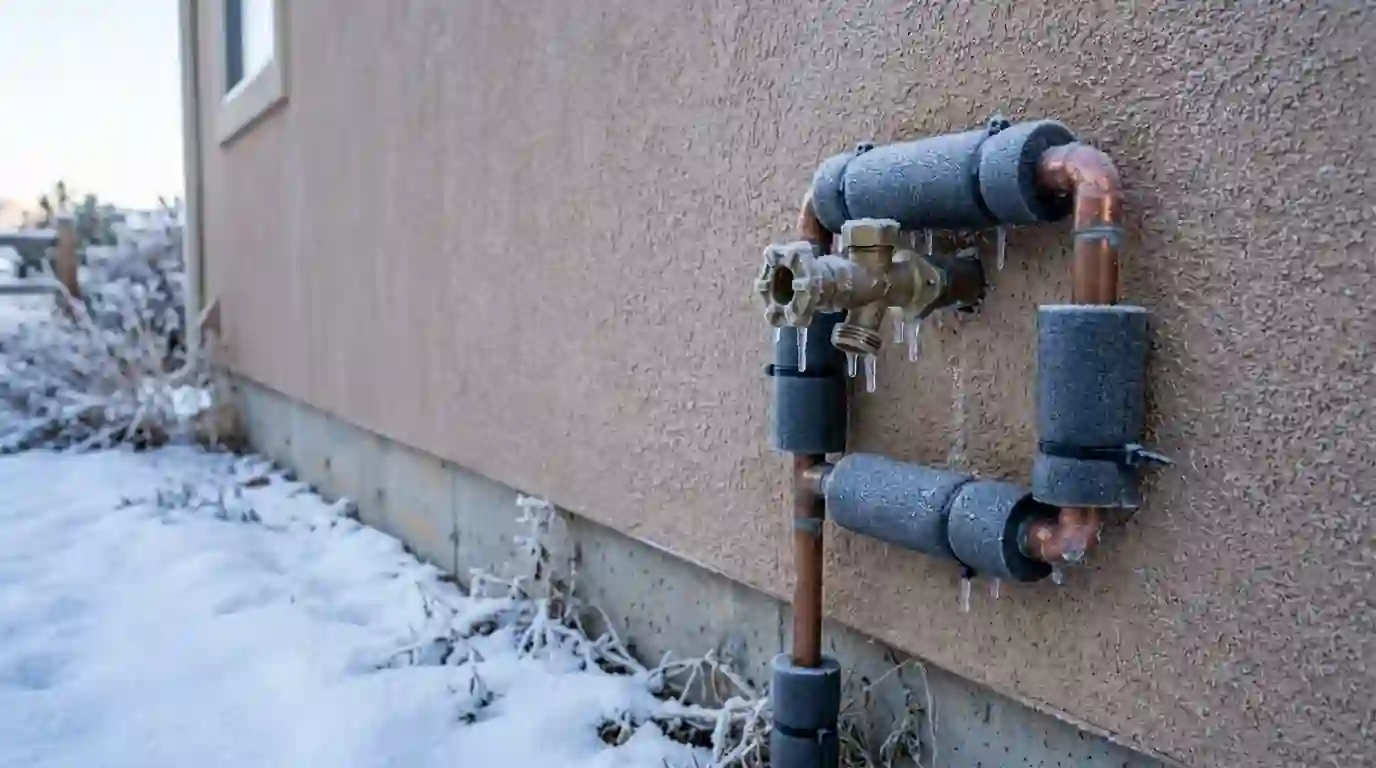
Most newer houses have frost-free sillcocks. The handle is outside, but the actual valve seat sits several inches inside the heated wall, and the pipe between them is pitched to drain when the handle is closed. That only works if the water can get out. A hose left attached holds water in the barrel, the ice splits it inside the wall, and nobody knows until the faucet is opened in spring and water runs into the basement ceiling.
Older homes may still have standard compression hose bibs, which sit entirely outside and freeze easily. Those need an interior shut-off, closed in fall, with the outside handle left open so the short section drains. If yours has no inside valve, or the frost-free valve drips with the handle closed, a hose bib repair or replacement fixes it. HomeAdvisor lists hose bib replacement in a normal range of $200 to $600.
- Disconnect every hose, splitter and timer
- Open each outside faucet to let it drain, then close it
- Close interior shut-offs for standard hose bibs and leave the outside handle open
- Check the vacuum breaker on each spigot for cracks or drips
- Fit insulated faucet covers as an extra layer, not a substitute
Sprinkler systems: test, shut down, drain, blow out
Colorado Springs irrigation customers must have backflow prevention tested every year before the system is winterized, and the test has to be done while the system is still pressurized. In 2019, records were due October 1 and violation notices followed from October 4. That makes the sequence fixed: backflow testing first, then shutdown. Our guide to backflow testing in Colorado Springs covers the program rules.
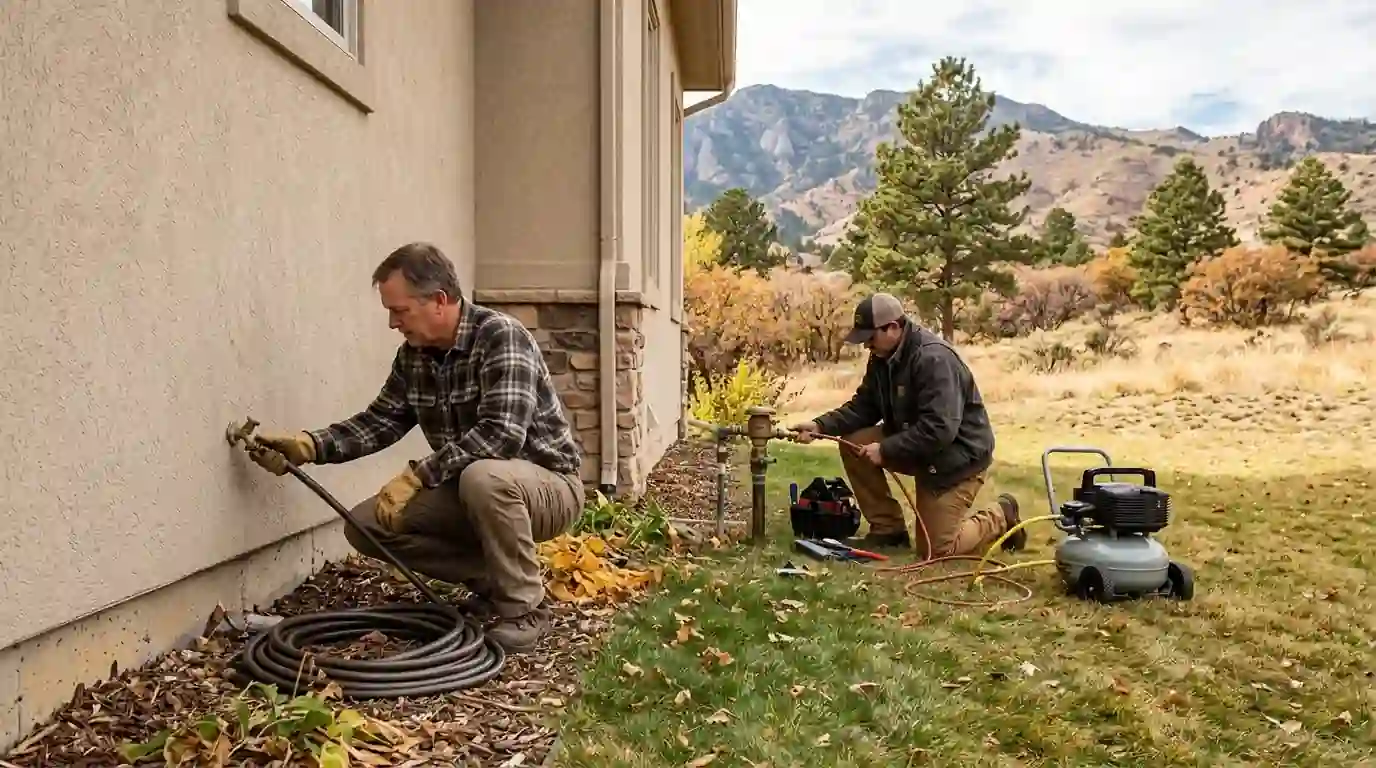
Once the test is filed, the shutdown runs in a set order. Blowing out with compressed air should use moderate pressure and short bursts per zone; too much pressure can damage heads and fittings, and running air through a dry line overheats plastic parts.
- Close the irrigation shut-off inside the house
- Open the drain on the supply side of the system
- Blow out each zone with compressed air until only mist comes out
- Open the backflow test cocks and leave the valves at half turn
- Turn the controller to off or rain mode

Rather have a plumber look at it?
Call any hour. A person answers.
Why the lines you cannot see need air, not just a closed valve
El Paso County's frost line is 30 inches below grade, the depth a local contractor guide attributes to the Pikes Peak Regional Building Department as the minimum for footings, posts and foundations. Sprinkler laterals and drip lines run much shallower than that, so any water left in them is in the frozen zone all winter. A closed valve stops new water from entering, but it does nothing about the water already sitting in the pipe.
Manual drain valves at low points help on some systems, but they rarely empty every head and fitting. Compressed air is what clears the last of it. The backflow assembly itself sits above ground and freezes first, which is why a pressure vacuum breaker left full often comes out of winter with a cracked bonnet or body that needs backflow preventer repair or replacement before the spring test.
Indoor pipes that act like outdoor pipes in winter
The lines feeding the outside faucets are not the only ones at risk. Colorado Springs has recorded lows of -27 F and averages 5.2 nights a year below 0 F. On those nights, a supply line in a garage wall, a crawlspace with gaps in the skirting or a kitchen sink against an outside wall behaves like outdoor plumbing.
Insulating exposed runs, sealing gaps where cold air reaches them, adding heat cable to a line that cannot be moved and rerouting supply pipes out of garage walls are all part of pipe insulation and freeze protection. Angi puts pipe insulation or heat tape work at $360 to $850, which is a fraction of what a burst line inside a finished wall costs to repair. If a pipe does freeze, our guide on what to do first with frozen pipes covers the safe order.
A fall checklist before the first hard freeze
Work through this in September, and do it again in a hurry if an early front shows up in the forecast.
- Book the backflow test and confirm the report is filed
- Shut down, drain and blow out the sprinkler system
- Disconnect hoses and drain every outdoor faucet
- Close interior shut-offs for any standard hose bibs
- Check insulation on pipes in the garage, crawlspace and outside walls
- Find the main shut-off and make sure it turns
FAQ
Questions readers ask
No. A frost-free sillcock only protects itself if the water inside can drain out when the handle is closed. An attached hose traps that water, and the valve can split inside the wall. Disconnect the hose every fall, even on a mild forecast.
A small compressor often cannot move enough air to clear a zone properly, and it may leave water in the low spots. Too much pressure can damage heads and fittings. If you do it yourself, use short bursts, moderate pressure and never let air run through a dry line for long.
Contact the backflow program and your tester right away. The rule is testing before winterizing, but a cracked assembly helps nobody. Some testers will move the appointment up; at minimum, protect the assembly with an insulated cover until the test and blowout can happen.
Not on the first warm week. The mean last spring freeze in Colorado Springs is May 8, and it has come as late as June 18. Many owners wait until mid-May, then open the main slowly, close the test cocks and check every zone for leaks.
Yes. A drip means the valve washer or seat is not sealing, so water keeps reaching the part of the faucet exposed to cold. It can freeze and split the valve. Replace the washer or the sillcock before the first freeze.
Yes. Drip lines are shallow and full of small fittings that crack easily. Open the end caps, blow out the line with low pressure, and remove any filter or pressure regulator bowl to store indoors for the winter.
Related